The Brief: Tariff Refunds, Amazon Price-Fixing, Consumer Spending, and Walmart's Fulfillment Test
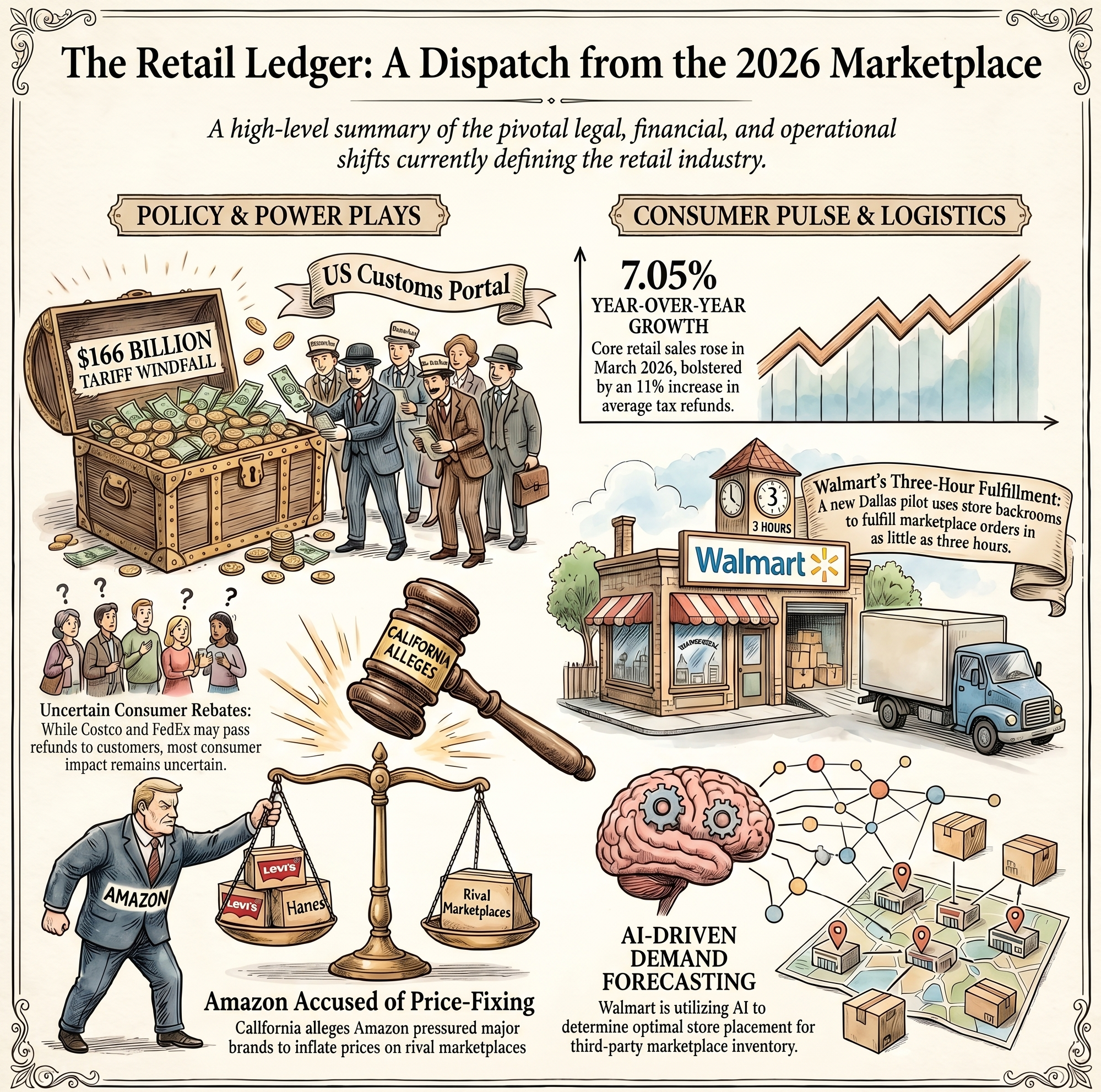
Welcome to The Azimuth Brief for April 22, 2026. Here are the top retail and ecommerce stories that caught my attention.
Today's stories:
US government launches $166B tariff refund portal
California alleges Amazon coordinated price-fixing with major retailers
March retail sales show resilience amid inflation and gas price spikes
Walmart pilots store-based fulfillment for marketplace sellers
1. US Government Launches Tariff Refund Portal for $166 Billion in Illegal Duties
US Customs and Border Protection launched the CAPE portal (Consolidated Administration and Processing of Entries), allowing businesses to begin requesting refunds for tariffs struck down by the Supreme Court. The government could owe businesses up to $166 billion after the Supreme Court ruled in February that President Trump had illegally issued tariffs under the International Emergency Economic Powers Act.
The system limits refund applications to unliquidated tariffs plus tariffs finalized by CBP within the past 80 days. As of April 9, more than 56,000 US importers had registered to receive refunds. Up to 82% of IEEPA duty payments, amounting to $127 billion, are eligible for refunds in CAPE's initial deployment.
Refund checks are not expected until this summer. The government estimates the claims review process could take 45 days, with checks processed 60 to 90 days after approval. Refunds will only go to the importer of record or the licensed customs broker who originally paid the duties, leaving uncertainty around whether consumers will see any of that money. Some companies, like FedEx and Costco, have said they plan to pass refunds to customers.
2. California Alleges Amazon Coordinated Price-Fixing with Major Retailers
California Attorney General Rob Bonta released newly unsealed documents showing how Amazon allegedly pressured major brands like Levi Strauss and Hanes to inflate prices on rival online marketplaces as part of a wide-ranging price-fixing scheme. The documents are part of a 2022 antitrust lawsuit alleging Amazon stifled competition and increased consumer prices across the internet.
The documents include communications between Amazon and Hanes, where Amazon sent the vendor links to listings on Target and Walmart showing lower prices than on Amazon. Hanes confirmed it reached out to Target and Walmart to have the prices increased. In another case, Amazon alerted Allergan that it temporarily suppressed listings for its eye drops once it found they were being sold for less elsewhere. Allergan replied, saying Walmart raised its price back to $16.99.
Amazon also allegedly pressed Levi's to ask Walmart to hike the price of its khaki pants. Walmart raised its prices, the filing states. Bonta's office has asked a San Francisco Superior Court judge to prevent Amazon from engaging in the alleged price-fixing practices while the lawsuit proceeds.
3. March Retail Sales Show Resilience Amid Inflation and Gas Price Spikes
US retail sales rose for the sixth consecutive month in March 2026, as higher-than-average tax refunds helped offset increased gasoline prices linked to the conflict in the Middle East, according to the CNBC/NRF Retail Monitor released by the National Retail Federation.
Core retail sales (excluding restaurants, auto dealers, and gas stations) were up 0.41% month over month in March and up 7.05% year over year. That compares with increases of 0.27% month over month and 5.87% year over year in February. Total retail sales rose 0.4% month over month and 6.59% year over year in March.
The results came as the IRS said 2026 tax refunds averaged $3,521 as of late March, up 11.1% from 2025 following changes in tax law passed last year. Almost all retail sectors recorded year-on-year increases, with clothing stores, sporting goods stores, and health and personal care stores seeing the highest growth. NRF president and CEO Matthew Shay noted that despite record-low consumer sentiment and the highest inflation rate in two years, consumers continued to spend on household priorities.
4. Walmart Pilots Store-Based Fulfillment for Marketplace Sellers in Dallas
Walmart is testing the use of backroom storage space in its stores as fulfillment centers for third-party marketplace sellers, according to multiple outlets. The pilot program is currently being tested in several Dallas-area locations and aims to facilitate same-day delivery for select products from the company's online marketplace. By storing inventory from marketplace sellers alongside its own products in store back rooms, Walmart can reportedly reduce delivery times from one to two days down to as little as three hours.
The initiative leverages Walmart's network of more than 4,700 US stores to compete directly with Amazon's fulfillment capabilities. Walmart's marketplace currently lists approximately 500 million items and has been growing rapidly, with marketplace sales up approximately 20% in recent quarters. The retailer has been using AI to help determine which stores marketplace items should be shipped to based on local demand forecasting.
Walmart's store-fulfilled delivery has been one of its fastest-growing channels, with expedited deliveries under three hours representing approximately 35% of store-fulfilled orders.
That's it for today.