First-Time Coaching Flag Football: How It’s Going & What I’ve Learned
Well, I’ve taken my inaugural turn at coaching 5th/6th-grade flag football. Though I’ve never coached flag football, I watched my older son play a few seasons and got a sense of what I thought was important to succeed at the sport and things I thought were always game killers.
So, when the opportunity arose, I figured it was time to put my money where my mouth is.
If you are a first-time coach looking for some pointers, you can see what I’ve done, improve upon it, and adapt it for your own situation. Let’s run through a quick breakdown of the team, the league, my philosophy, and the fun stuff: the plays.
Team and league background
The team
Our team this season is a random collection of friends. While this makes it fun for the kids, it also presents challenges I needed to plan around (more on this below). After all, there is no random superstar athlete assigned to my team.
League format
This league is different in that it is either 6v6 or 5v5, based on roster size and available subs. This season, the league has decided we will play 5v5. This format fits my overall philosophy well, but also challenges me on defense.
Unique rules
Only one run (screen pass counts as a run) per drive on each side of the field. No runs inside the 10 or within 5 yards of the first down.
No rushing the passer unless there is a play behind the line of scrimmage (run, fake handoff, screen pass).
Must have at least one offensive player on each side of the center (can’t overload one side).
My flag football philosophy
After watching a couple of seasons with my other son, I believe youth flag football is won with speed, space, and purpose. If you give players space, they can use their speed to their advantage, regardless of how fast they are. And, of course, everything we do needs to be done with purpose. We run routes, throw, pull flags, and attack the ball carrier with purpose.
Let’s spend a second talking about game-killers. I’ve seen it in just about every game: consistent deep throws lose more games than they win. It may be fun for players to throw and catch deep, but they get picked and returned for TDs way too often.
Finally, it is youth sports, and sportsmanship matters. We conduct ourselves like we should. When we pull flags, we don’t drop them or spike them. We hand them back to the player. We celebrate wins and each other, pick each other up when things are tough, acknowledge mistakes will happen, and learn from them without hanging our heads. We shake hands, congratulate the other team when they make a good play, and show respect.
So, here’s how it all looks.
Team challenges and limitations
No true QB
Our two QBs are reluctant QBs and prefer other positions. Neither is a natural thrower. Neither wanted (or wants) to play QB, but they are our best option. We try to rotate them so they get turns playing other positions, but they are our two best at the position (I think they are beginning to enjoy it though). While this can be good for limiting deep passes, the ones we scheme open need to be done almost to perfection. I also recognize I need to make it easy for them to snap, read, and throw comfortably.
Lack of experience
Just about every player has zero experience playing organized flag football. Teaching both sides of the ball gets complicated because of this.
No superstar athletes
Most players are good athletes, but they’re not the fastest or most natural football players. This isn’t to say we don’t have quick players or players who can catch, but we don’t have elite speed or a superstar who can carry the team. I’d say half of our team is of average speed. We need to be a collective.
Players are independent
Coaches are not allowed on the field during play, meaning players need to call their own plays. It’s critical they know what they're doing and take ownership of the play-by-play. While this can make it fun for the players, when things don’t go as planned, it can go sideways real quick.
My plan and playbook
Create plays that match my philosophy and enable players to maximize their skills.
Make plays “simple” with terminology the players can understand.
Build upon concepts as the season progresses.
Understand that our best defense will be a good offense.
Flag football playbook for 5th and 6th-graders
For games 1 and 2, we installed four plays. We initially called the “Triple-stack” formation for 6v6, but since we are now 5v5, it is simply STACK (if you want to see 6v6 formation, just contact me). It should be obvious why it is called “stack,” but this is easy for the kids to remember. Let’s walk through them.
Note: For us, the X WR is a less important designation due to the roster makeup. It serves more of an identifier when teaching the plays than assigning a player as a typical X.
Here is Stack LEFT (we “stack” players, routes go left: easy for kids to understand). The play design provides the QB two short throws where, if we move with quickness, the WRs should be open. The streak route gives us a look deep if we want/have a mismatch, knowing the safety will cheat to the Y WR at 10 yards. I included the gray ovals to show that the goal here is to create space for WRs to catch and run.
Our next play, Stack “LEFT RIGHT” takes this same concept, but the Z receiver jukes left and cuts right. This player is open 95% of the time, and, because defenders are all drawn to the opposite side of the field, it’s often a huge chunk play. The kids LOVE this play!
Our final two plays, Stack “MOTION” and Stack “BREAK,” incorporate motion, one being a run and the other a pass. Why “Break?” It’s like a jail break: we run as fast as possible. The route for the motion play is the same as “Left.”
The cadence is for the Z to move on the first “hut.” The only nuance to MOTION is that the player in motion has the option to run a wheel route to the sideline or cut inside the X receiver, based on either what he sees or if he gets a late start to his motion. Most times, it’s a wide-open wheel route, but it does require an accurate throw.
One formation, easy routes, obvious terminology.
We focused on these concepts exclusively for the first two games. This helped them settle into calling plays in the huddle without a delay of game, run the right routes (mostly), and go through the motions of play.
Game results:
Game 1: Tie, 44-44 (had a two TD lead late, giving way to a pick-six, punt, and quick drive). Not bad considering we haven’t really talked about defense yet.
Game 2: Win, 44-24
Adding in new plays
Our next evolution was to incorporate a different formation called FLAT. This should be obvious, but it lines players up “flat” along the line of scrimmage, although this time we make the left side our strong side. These plays have the WRs run different routes to keep the defense honest and, hopefully, confused.
Note: after some in-game trial and error, we wound up scaling back new plays. We kept three: Flat BREAK, Flat MOTION, and Flat MOTION 2.
MOTION and BREAK are identical and mimic the operation from the stack. However, for MOTION, we introduce a subtle crossing concept over center. MOTION 2 sends the Y instead of the Z in motion and opens us up for deep routes (when we need) while giving the QB an outlet to the center or Y player — all with space. The kids love MOTION 2 the most of the three.
For MOTION 2, the center is often the most dangerous WR option, although we’ve successfully hit on a few deep passes to the X lately. The trick with the deep pass is to see the mismatch quickly and throw it in a roughly 1.5-count. This keeps the safety far enough away and the CB from making up ground on a floating ball.
Because we had to cut some plays from our Flat package, we added a screen pass to our Stack concept, simply called “Stack SCREEN.” Remember, screen passes count as a run play. Here’s how it looks.
Adding the new plays and formation, our next three games went as such:
Game 3: Win, 58-12
Game 4: Win, 44-32
Game 5: 52-40
These concepts and plays have done exactly what I hoped they would. Our slowest player has multiple TDs, a ton of receptions, and can use space to his advantage. Every player touches the ball multiple times each game. Every player has scored a TD.
What we need to work on
Players, especially young ones, tend to become lax when things go well. The attention to detail dropped. It’s not the way we are going to finish the season like we want.
Route running:
Last week, we spent the first half of practice talking about route running. During the previous game, the team was not consistently moving with purpose. They rounded their breaks, ran the wrong routes far too often, and drifted backward when they were inevitably covered. There were times when four receivers were deep. (and yes, we threw INTs because of it). This is not a good recipe, especially without having a pinpoint QB.
We rehearsed jukes, crisp cuts, and staying at the proper depth. Five yards does not mean 10. We talked about being covered and how to react (work back to where you came from, or, if deeper, run toward the QB). Because of our situation, it is critically important that the QB knows where he will throw the ball, how to recognize whether someone is open, and release it within the allotted time (a 4-one-thousand count).
We combined this with rehearsing our core plays with a mix of walk-throughs and then at full speed. We demonstrated how easy it was to cover someone when they round routes and drift backward. We ran routes until everyone nailed it. The extra step you take and the extra space it creates make all the difference.
And boy, did it pay dividends during our game. The first play the kids chose was Stack LEFT RIGHT. They ran crisp routes. The Z (“right-cutting”) WR juked and ran the route like he was supposed to. Defenders were pulled away, the juke created extra space, and the WR was wide open, quickly turning it up the field for a TD.
That’s how you execute with speed, space, and purpose!
Defense:
Knowing we don’t have the most athletic, fastest, and tallest players, I knew our defense would suffer. However, we’ve been making defensive coaching a focus of each practice and in-game learning, hoping to improve a little with each snap. We play man-to-man with a free safety monitoring the field, helping cheat to height and speed mismatches. This is important because teams like to throw deep (not always a bad option when their WR is a foot taller).
But hey, I’ll invite deep passes because we’ll get our picks 🙂
The safety is really the glue that holds it together. They need to alert the team to runs, help in pass defense, and attack flags when shorter passes are completed. For someone who hasn’t played organized football before, the improvement in recognizing where the QB is looking and sacrificing possible plays to one side in favor of helping out the mismatch has been remarkable. My tip: find a strong safety!
Individually, at this age, footwork and smooth movement with purpose are key to defensive proficiency. We struggle with CBs waiting for WRs to get to them before they react, and they get burned, putting the safety in a tough position. We work on backpeddling, how to turn to follow WRs, and how to position themselves to allow a catch but immediately pull flags. This keeps plays small, limits TDs, and forces the opposing offense to continue executing.
We’ve reinforced to keep the WR in front of them and not go for the interception unless it’s an easy one. Knock it down if you are in front of the WR, otherwise, allow the catch and immediately pull their flags. Giving up a positive play is part of the game, but by immediately tackling them, we remove their speed and space, and force them to continue executing. This has been challenging, but we are making small improvements each week.
Our biggest challenge is chasing down defenders after a play is made or a flag pull is missed. It’s common for players to feel they are too far away to make a difference, but in flag football, you’re never out of a play. Players tend to turn backward or sideways to avoid pulls, giving defenders time to make up their lost ground. Moving with purpose until the whistle takes effort and we’re improving.
Finishing the season strong
I’ve really enjoyed my time so far, and it’s been rewarding watching the kids improve each week. Is there anything better than watching a group of young kids with no experience walk into a huddle and call out, “Stack Left Right … Stack Left Right?” The parents consistently tell me how much fun they’re having (winning helps, I’m sure), and that’s great to hear. Sports should be fun.
I’m looking forward to seeing how the players commit to improving during the rest of the season. I hope I have provided enough tools and coaching to put them in a position to earn their league title. As the other teams improve each week, it’ll be tough, but I’ll take my group of kids any day.
Stack LEFT RIGHT. Now let’s finish this thing!
[UPDATE] How The Season Ended
Heading into the final week of the regular season undefeated, the team’s confidence was sky high. In fact, too high. Practice was a mess. The kids were mostly uninterested in review and skill development. They were focused on touchdown celebrations.
We took the opening drive for a TD, but something wasn’t right. Half of the team ran the wrong route. Then, our defense quickly gave up a tying score. Speed, space, purpose? More like, half-speed and little purpose.
Our offense routinely lined up in incorrect formations on almost every play. We had players on the wrong side of the field, receivers bunched close to the center (bye bye space), and the wrong routes being run … all. Game. Long.
We scored a TD late, but it was mostly garbage time. We lost our first game 36-32. I was kind of glad we did. The kids were not. This was an opportunity to reinforce that we needed to pay attention to details. We needed to practice like we play (with purpose). The QB needed to take ownership of calling plays and lining up people correctly.
Championship Game
We headed into the championship game feeling good. Our practice was solid! The kids were dialed in. They hated losing, and it became all too real that they may not win. They knew they were, in fact, not unstoppable.
We won the toss and took the ball. We always take the ball because we want to exert pressure. Two quick plays, with routes run perfectly, creating space, and we were up 6-0. Our defense went lights out, batting passes and pulling flags as I’ve never seen them do. They played with purpose!
We got a stop, took the ball, and, wouldn’t you know it, ran routes so clean it opened up some deeper sideline throws. It was quickly 13-0. We kept our foot on the gas. 13-6, then 20-6, 26-6, and 32-6. On the final play before half, the opposing team had the ball at the 2-yard line. One play to cut into the lead. An unsung hero, who played lights out defensively, recovered and broke up a pass. Halftime.
We started the second half on defense, and the team, while still playing well, began to feel it a little too much. They started moving a bit slower (or, as I say, not with purpose). 32-12. But we responded on a sustained drive, pushing our lead to 38-12.
We then got lax, and they took advantage. 38-18, then 38-25. The kids got it, felt a little pressure, and they continued to do what they did all season: dialed in.
FLAT-MOTION … TD! 44-25. Game, set, match.
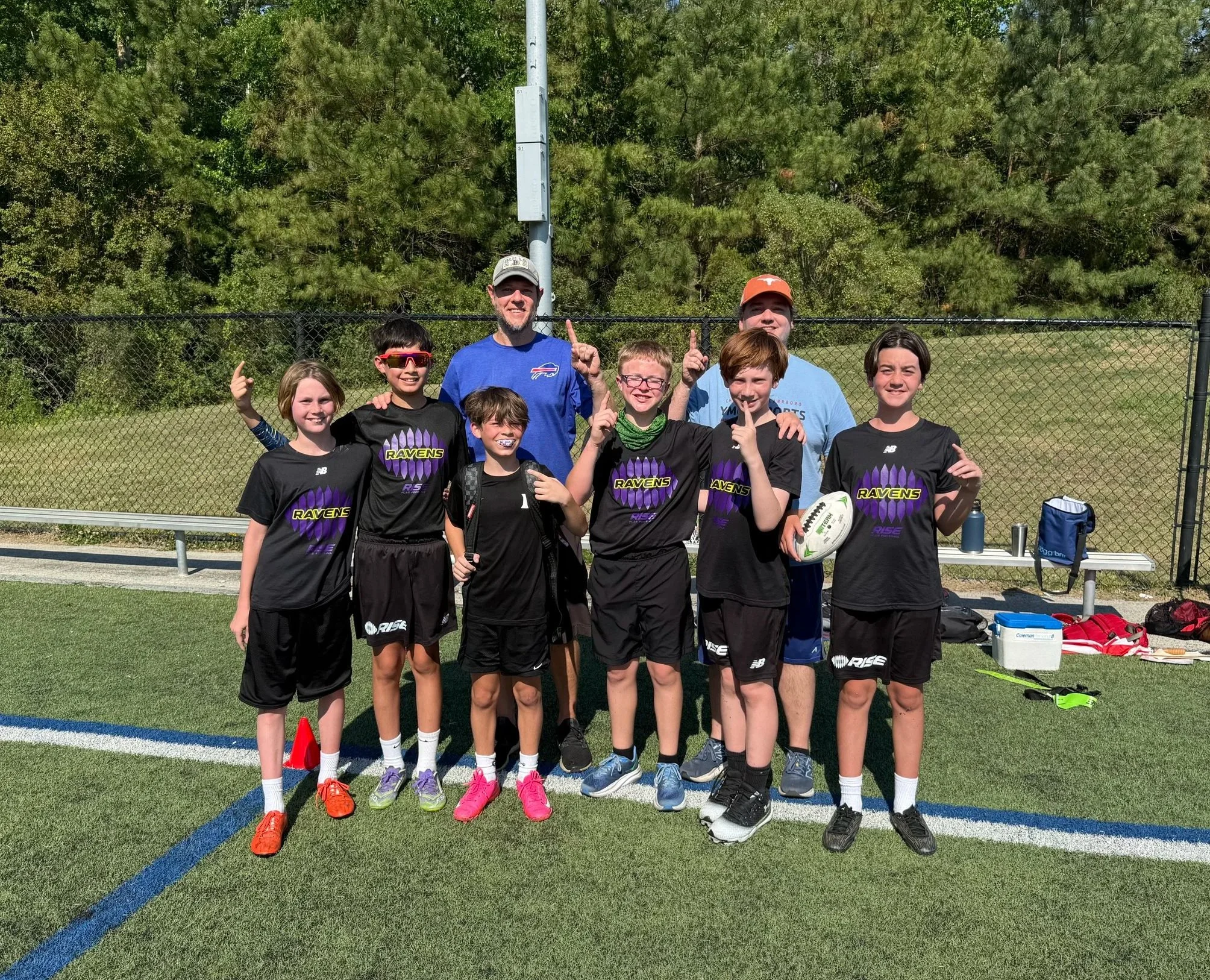
I am incredibly proud of how the kids learned the purpose of running routes: how each one is important to the success of the play. For how they commanded the field on their own. How they didn’t run from adversity or sulk when they made a mistake. They were coached up, nodded, focused on the next play, and got better with each snap. How they took one of their greatest weaknesses, flag pulling, and were so good at it in the final game that it took the opponent’s best plays and shut them down.
Until next season, T-BONE LEFT.