Featured Post: My Reading & Podcast List
Here are recent books I’ve read and podcasts I enjoy. If you’re looking for something interesting to listen to or read, these are a few that have stood out to me. Let me know if you have a recommendations.
Post-Purchase Email Marketing and Subject Line Examples
When it comes to post-purchase email marketing, it may just be the most underutilized yet powerful email marketing tactic there is. A strategic, well-thought-out series can help increase customer retention and help build brand loyalty and advocacy. The best part of all is that these messages are automated, generating revenue while you sleep.
Creating a series of messages designed to enhance the purchase experience is something every retailer should implement.
Post-purchase email marketing may be the most underutilized yet powerful email marketing tactic. A strategic, well-thought-out series can help increase customer retention and help build brand loyalty and advocacy. The best part of all is that these messages are automated, generating revenue while you sleep.
Creating a series of messages designed to enhance the purchase experience is something every retailer should implement. With each message and series sent, taking into consideration the individual's purchase history is important. After all, a loyal customer may not need the same nurturing or messaging as a first-time purchaser.
Post-Purchase Email Metrics
Order follow-up (2026)
Open rate: 47.63%
Click-to-sent: 4.01%
Conversion rate: 0.84%
Click-to-conversion: 20.87%
AOV: $129
Revenue per send: $1.08
Cross-sell (2026)
Open rate: 42.09%
Click-to-sent: 2.93%
Conversion rate: 0.75%
Click-to-conversion: 25.50%
AOV: $106
Revenue per send: $0.79
Feedback request/product review (2026)
Open rate: 50.70%
Click-to-sent: 3.66%
Conversion rate: 1.07%
Click-to-conversion: 29.16%
AOV: $131
Revenue per send: $1.40
For context, the average scheduled campaign email generates just $0.18 per send. Even the most modest post-purchase automation, cross-sell at $0.79, delivers more than 4 times that value. Order follow-up and feedback request emails both clear $1.00 per send, making them highly effective automated messages.
Types of Post-Purchase Email Messages
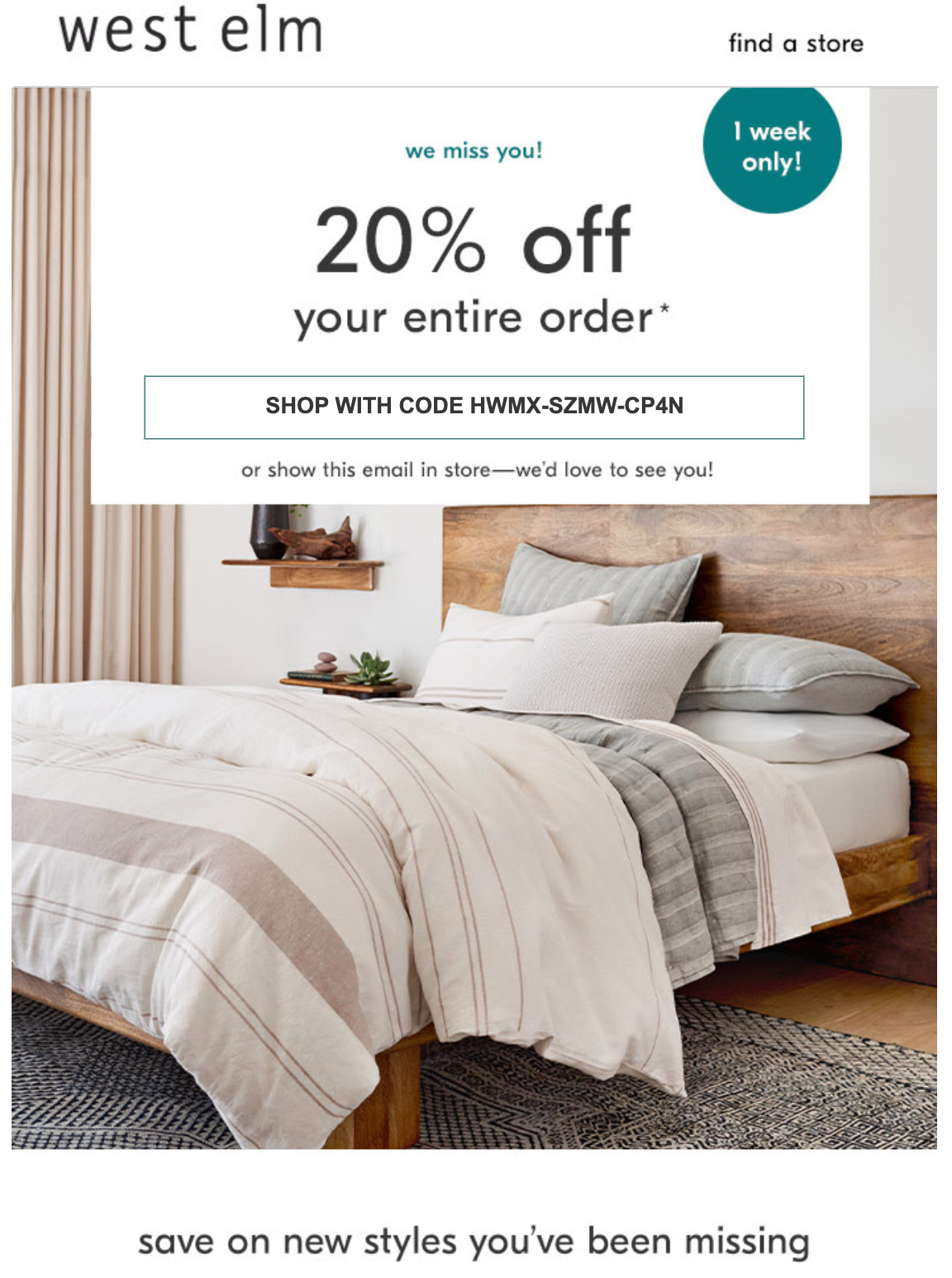
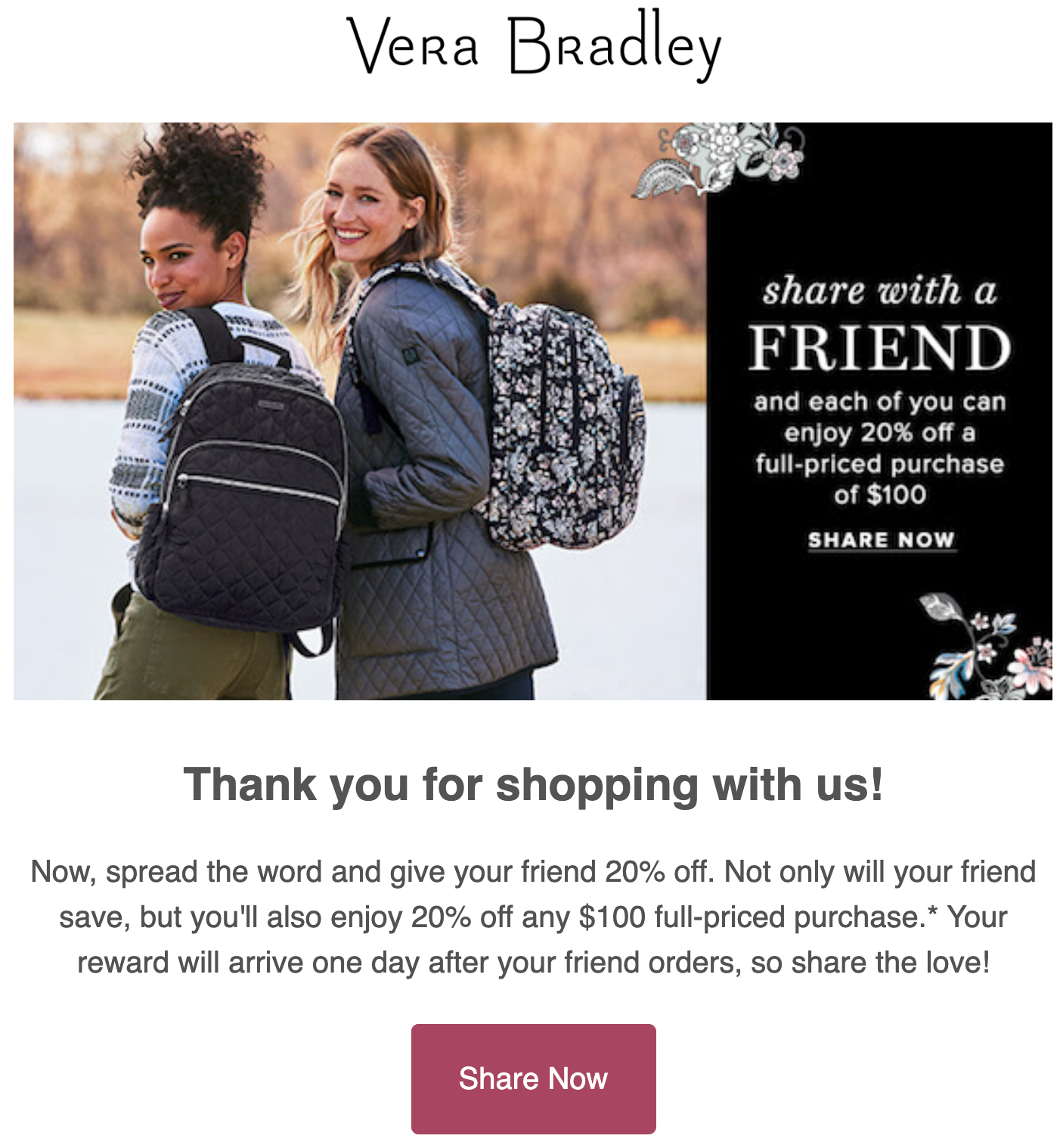
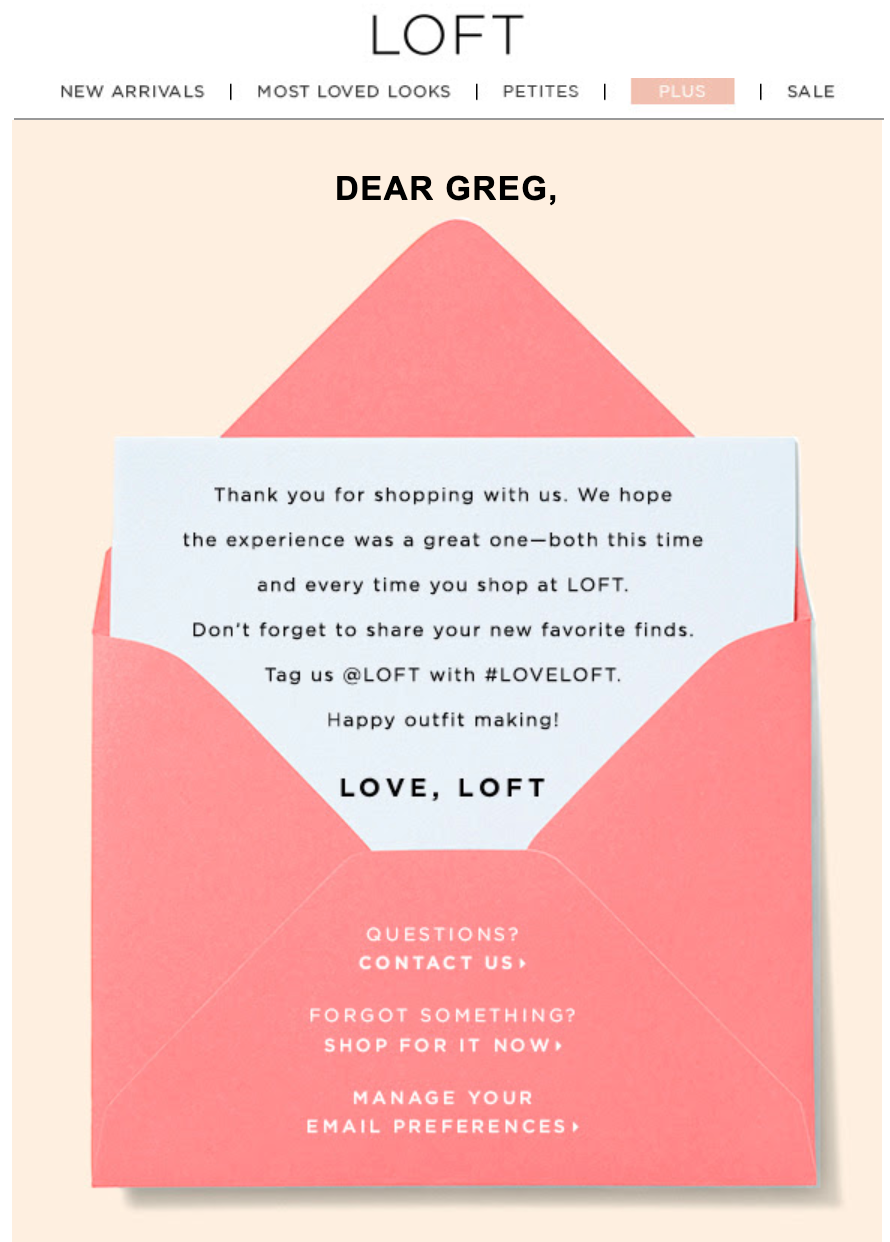
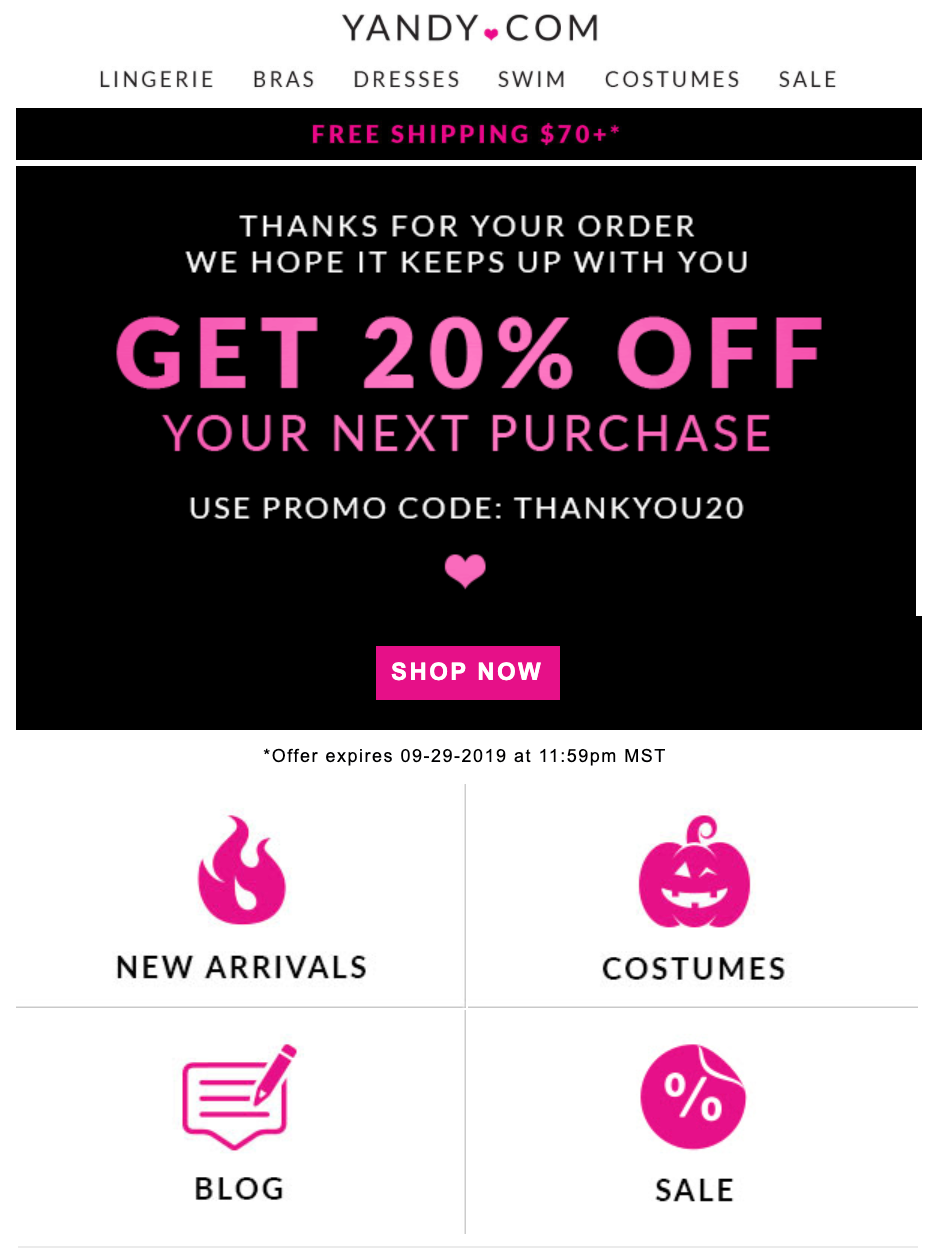
As you can see, post-purchase messages well outperform regular email campaigns, and there are no limits to the types of messages you could send in a post-purchase series, including:
“Thank you” message (w/ or w/o an incentive).
Product care/tips and tricks.
How-to resources.
Customer service info/guarantees.
Product recommendations or cross-selling opportunities.
Social invites or crowdsourcing (Share a photo with us!).
Manage preference request.
Product reviews.
Reorder reminders.
Gift-giving or date reminder requests.
Refer-a-friend invitations.
When building your automated post-purchase marketing program, have fun, be creative, and, most importantly, make your customers’ purchase experience better.
Post-Purchase Email Marketing Examples:




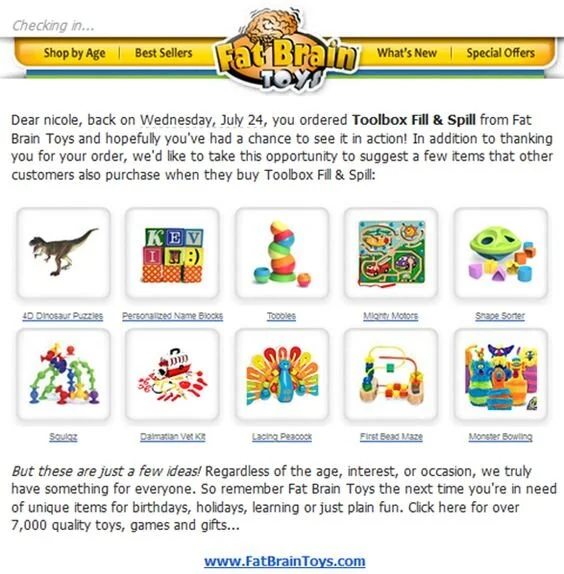


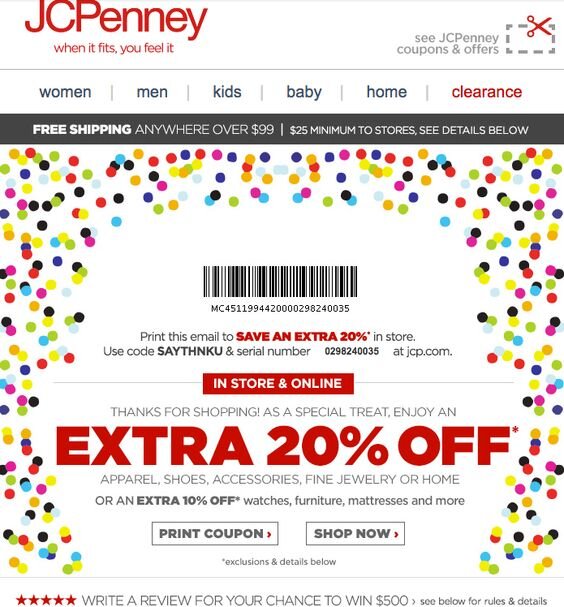






Post-Purchase email subject lines
Wow, thank you again! 💋
Seafood Grilling Tips That Set You Up for Succulent Success
Thanks For Your Order. Enjoy This Gift For You
Tips to make the most of your Bosch appliance
It’s happening – Your custom orthotics are on their way!
This is so exciting! Your impression kit is here.
Your personal exercise plan, Greg!
Thanks for your purchase – here’s a BONUS coupon to use the next time you shop!
Greg, read this before you set up your new TV.
Stick Up Cam 101: Tips and Tricks
How to Clean and Care for Your ______
Our Best Recipe(s) Ever!
Thank You!
Meet Your Perfect Pair 😍💕
Thank you for your recent purchase!
Thank you for shopping at _____!
[Video] Your Recent Coelho Purchase
Has anyone ever told you that you're incredible!
20% OFF | Our Thank You Gift To You 💕
Thanks again for your order
Thank you for making a LEGO® purchase. (message 1 of 4)
We hope yer hooked… (message 2 of 4)
Captain Brickbeard is ready for ya… (message 3 of 4)
1 month 'til you find the treasure... (message 4 of 4)
Other post-purchase articles:
Creating a Post-Purchase Email Strategy with Simple, Smart Segmentation
3 Ways to Cultivate Post-Holiday Customer Loyalty
Why Post-Purchase Marketing Is So Important
How to Create Post-Purchase Emails that Renew the Customer Journey
»» Have any questions about post-purchase email marketing? Let me know.
Examples of Back in Stock Email Marketing, Complete with Subject Lines
Back-in-stock notifications may be the highest-performing automated emails a brand sends. In this post, you’ll find top-tier example subject lines, performance stats (60% open, 19% click, 5.8% conversion), and five immediate tactics you can apply to your e-commerce email flows.
How Effective are back-in-stock messages?
In 2024, Back-in-stock messages had a 59.2% open rate, 19.5% click rate, and a 5.3% conversion rate. This was the highest conversion rate of ANY automated message, by far. Consider these must-have automated email messages for brands — both automated and scheduled campaigns.
Here are a few tips for ecommerce brands looking to use back-in-stock messages to increase sales.
Provide early access with back-in-stock automation
Use a sense of urgency and fear of loss in your messaging
Don’t feel the need to discount
Tailor messages to specific products when necessary
Include product recommendations
Back-in-Stock Email Marketing Examples








What’s the best back-in-stock subject line to use?
The best back-in-stock subject line uses a sense of urgency and combines it with the term “back.” This combines the urgency with social proof (they sold out once, they will again). A good example is “Back in Stock, But Not For Long.”
Examples of The Perfect Back-in-stock email subject line
Here are some back-in-stock email message subject lines used by real brands:
Top Sellers Back in Stock😍
🐍Back in ssssssssstock
Restocked! Ribbed Cotton Range Is BACK
Back in Stock: Lafeber Products
BACK IN STOCK: The Henley
THEY’RE BACK ⚡
URGENT: It’s Back In Stock!
Back in Stock 🌿 CBD Truffles
Back In Stock? Enough Said.
The wait is over: ramen is back!
Greg, SILK BEDDING BACK IN STOCK
Your fave Birkenstock style is BACK!
Back In Stock...
Back & Selling Fast!
Your fave camera bag is back in new colors!
LOOK WHO'S BACK 👀
Your favorite is back!
Favorites Back in Stock!
Everyone's adorable bestie is back 🎀
Your Favorite Lingerie is Back! (But not for long 👀)
Missed me? Back in stock
Back in Stock: A Knit to Know
WOW! Back In Stock: But Not For Long
Love Everybody 🖤 Back In Stock
MUST-HAVE BACK IN STOCK
Back in stock and going fast 💨
BACK IN STOCK You Have Been Waiting
Our holiday gift to you: back-in-stock best sellers
Have any questions about back-in-stock email marketing? Let me know.
2019 Holiday Season Takeaways and Ecommerce Marketing Action Items
The 2019 holiday season has concluded, and once again ecommerce experienced record-breaking sales. But what made the 2019 holiday season so successful, and which trends have become the new normal? Analyzing the results does no good unless you implement the lessons learned to further your marketing program.
The 2019 holiday season has concluded, and once again ecommerce experienced record-breaking sales. This online holiday season registered just above $142 billion in online sales, a 13% increase from last year, according to Adobe Analytics.
But what made the 2019 holiday season so successful, and which trends have become the new normal? Let’s explore.
The Subtle Nuances of November
In sports, subtle moves with a major impact are called the “game within the game,” which succinctly describes the continuing evolution of Gray November’s monthlong series of discounts.
We started seeing pre-Black Friday deals and other heavy discounts start in late October. But once we entered November, we started seeing this “game within the game” begin to play out.
Black Friday is Now a Week-long Event
The concept of Black Friday week started in 2018 and became an official thing this year. Many retailers started their sales on the previous Sunday, and many others jumped in on Monday.
Beginning that day, more than a quarter of subject lines in my personal retailer tracking inbox had the term “Black Friday.” It’s possible that Black Friday week was a result of the day falling later in the year, but it continues the trend of a growing sales event. Expect this to be the new norm.
The Cyber Five Expands to the Cyber Ten
The Cyber Five (Thanksgiving through Cyber Monday) now accounts for 20% of the holiday season’s ecommerce revenue. But this period has morphed into the Cyber Ten, thanks in part to Black Friday week.
The ten days from the Sunday before Thanksgiving to Cyber Monday accounted for seven of the top online sales days of the entire season, with six of them hitting $3 billion+ in ecommerce sales and accounting for 27% of the total holiday revenue.
Black Friday, Cyber Monday Remain Tentpoles
Black Friday recorded $7.4 billion in ecommerce sales, falling just short of Cyber Monday 2018’s record-setting $7.9 billion day.
But this year, shoppers propelled Cyber Monday to $9.4 billion in ecommerce sales, meaning both days grew nearly 20% year-over-year. While consumers show a willingness to shop early, they’re also willing to shop often, especially on these tentpole days.
The New Daily Online Sales Benchmark is $2B
Only a couple of years ago, $1 billion in one-day ecommerce sales was the benchmark to hit during the holidays. In 2018, only the period of Dec. 22-25 failed to reach that mark.
But in 2019, only Christmas Eve missed it, with $850 million in ecommerce sales. Two billion dollars is now the new online sales benchmark, with 29 days reaching it, including each day during the Cyber Ten.
Mobile Revenue Grows, Smartphones Gain Share
Mobile continued its march toward the dominant shopping method in the 2019 holiday season. However, tablet’s share of mobile was replaced by smartphones.
In 2019, purchases on smartphones accounted for nearly 35% of revenue, according to Adobe, while tablets accounted for 5%
In 2018 season, smartphones made up 31% of revenue, and tablets 9%
We saw this same shifting pattern for mobile devices in web traffic:
In 2019, smartphones accounted for 58% of retail web traffic, while tablets hit 5%
This was up from 51% in 2018, when tablets made up 8% of the traffic
I have repeatedly said if you’re not mobile optimized, you’re not optimized – and we’re clearly at the point now where smartphone optimization is table stakes.
Consumers Continue to Value Email
Email marketing continued to drive ecommerce sales, accounting for 17% of online revenue this year, nearly half of which (49%) came from smartphones. To put this in context, social media drove less than 2% of sales. You can see why email marketing is a powerful promotional tactic.
Email volume continues to increase year over year, confirming that Gray November is alive and well. This season, average daily sends began to increase the last week of October and continued through November. Overall, there were 10% more emails sent in November than in October.
Emails sent from the Bronto Marketing Platform supports the notion that Black Friday week is a promotional event. In November, there were 54% more emails sent during Black Friday week than in the previous weeks. This represents a significant increase in sends during the week of Black Friday compared to previous years.
Of course, discounting in email remained the top tactic. Eighty-four percent of consumers said they’re more likely to open emails with discounts, and 58% felt that relevant email offers had a higher likelihood of purchasing.
2019 Holiday Season Takeaways and How to Use Them
Analyzing the 2019 holiday season does no good unless you implement the lessons learned to further your marketing program. From the takeaways above, here are opportunities for some marketing reflection and optimization throughout 2020:
$2B is the New Daily Ecommerce Sales Benchmark
Question: How do you plan to attract new customers and increase AOV to take advantage of this increase in consumer spending?
Email Marketing Needs to be a Major Program Component
Question: What specifically can you do to improve your email program throughout the year?
The Cyber Ten replaced the Cyber Five
Question: Do you have enough value-adds and promotional strategies to take full advantage of this extended sales period?
Smartphones Took Over Web Traffic, Getting There for Online Sales
Question: Are your website, emails, popup forms and paid search strategies optimized for mobile users?
Now is the time to dive deep into the types of offers customers responded to, the types and timing of automated email messages (i.e., abandoned cart, post-purchase, etc.), subject line tactics, paid search strategies, and the traffic sources and devices.
These tactics will allow you to test hypotheses and roadmap improvements to your overall marketing programs, giving you an early start on next year’s planning while driving increased sales year-round.
Top Marketing Podcasts of 2019
As host of the Commerce Marketer Podcast, I conduct a lot of interviews. But choosing my favorite episodes is like choosing a favorite child (if my kids are reading this, I love you both the same). However, I forced myself to choose some of the episodes that really resonated with me for one reason or another.
Here are some of my favorite marketing conversations from 2019, in order of episode number. I hope you enjoy.
As host of the Commerce Marketer Podcast, I conduct a lot of interviews. But choosing my favorite episodes is like choosing a favorite child (if my kids are reading this, I love you both the same). However, I forced myself to choose some of the episodes that really resonated with me for one reason or another.
Here are some of my favorite marketing conversations from 2019, in order of episode number. I hope you enjoy.
Episode 043: Super Bowl Commercial Recap Roundtable
More than 100 million people watch the Super Bowl each year, but the commercials have become the must-see event within the event. This episode discusses the Super Bowl from a marketing and entertainment perspective. We’ll revisit the commercials, halftime show, and even how we interacted with our mobile devices during the big game - after all, what good is a $5 million commercial if everyone is checking their Instagram feed?
Why I chose this episode: This episode was a three-person roundtable. The guests were fun, brought great perspective, and episodes like this are just fun to do because no one takes themselves too seriously.
Episode 046: Email Deliverability: Everything You Need to Know
Did you know that having good email deliverability does not mean your emails reach the inbox? Understanding email deliverability is crucial, yet many marketers do not fully understand what goes into it.
Why I chose this episode: My guest, deliverability expert Chris Kolbenschlag, tackles myths, best practices, things marketers shouldn’t do and other elements around email deliverability in an easy-to-understand manner — which is what I love about this episode.
Ep. 050: How Lifecycle Email Marketing Is Like a Fine Wine
This episode discuss how one compani built their email program from the ground up using lifecycle email marketing to drive nearly half of their 2018 email revenue. We cover the strategies behind triggered campaigns, how to avoid the pitfalls of email fatigue with segmentation, mistakes made with their lifecycle campaigns, and lessons learned.
Why I chose this episode: My guest was Ben Argov, president of International Wine Accessories (IWA). Ben and I met several years back and he is one of the nicest people I know. Ben is honest about what works, what doesn’t, and what needs to be improved in his email program. What made this one special was that he sent me a spreadsheet of his email metrics to help guide the conversation. If you’re into email marketing, this episode is a must-listen!
Ep. 054: How Ikonick Uses Modern-Day Marketing to Drive Success
I’m joined by Mark Brazil, co-founder of the canvas art company Ikonick, to discuss how he created a multimillion-dollar business in less than two years by combining email, video, social, and influencer marketing. Mark covers everything from social media, email marketing, content marketing, storytelling strategies, and how they measure success.
Why I chose this episode: I met Mark while speaking at a conference in Quebec City in early 2019. After our initial conversation I knew I had to have him on the show. Mark is brutally honest, in a Gary V type of way (after listening you’ll know why), and shares some amazingly useful insights. This episode is great for entrepreneurs, and email and social media marketers alike. I forgot to mention, this dude is funny as heck!
Ep. 059: How Vera Bradley Designs a Modern-Day Retail Experience
I’m joined by Harry Cunningham, vice president of retail brand experience at Vera Bradley, to discuss what goes into designing modern-day brick-and-mortar stores that appeal to consumers. Harry explains some of the driving forces behind Vera Bradley’s redesign of their storefronts, explains how the store design revolves around solving shopper challenges, and shares everything you can think of when it comes to the in-store experience.
Why I chose this episode: It’s such a cool topic — and one I find fascinating. Harry is an engaging speaker and really brings you into his world of how he approaches store design concepts through stories that demonstrate the how and why he makes the decisions he does.
Ep. 60: The Behavioral Science of Marketing
Nancy Harhut is a behavioral science marketer and chief creative officer at HBT Marketing, discusses how marketers can use behavioral science — like “eye magnet” words, the Von Restorff Effect, proper use of charts and images, tactile experiences, and landing page techniques — to nudge their customers and encourage purchase decisions.
Why I chose this episode: Again, this topic is fascinating! This was a topic I had been wanting to cover for some time, and was fortunate enough to mention it to another guest of mine who coincidentally knew someone. That someone was Nancy. And boy, did she deliver! Nancy discussed so many tactics in an easy-to-understand manner, while providing specific use-cases for each. This episode has so many practical takeaways for marketers.
Find out more about The Commerce Marketer Podcast
Back to blog home
Email Expectations vs. Reality: Are You Letting Your Customers Down?
Consumer expectations versus reality. It is a complex topic for all retailers, but especially for those who sell online. Look at how Amazon has raised the bar on consumer expectations, such as with fast and free shipping. Consider how accessible mobile phones are, allowing consumers to find any product they are searching for, regardless of where they or the product is located. Social media, and its integration into the shopping experience, is providing a direct connection between brand and consumer.
Consumer expectations versus reality. It is a complex topic for all retailers, but especially for those who sell online. Look at how Amazon has raised the bar on consumer expectations, such as with fast and free shipping. Consider how accessible mobile phones are, allowing consumers to find any product they are searching for, regardless of where they or the product is located. Social media, and its integration into the shopping experience, is providing a direct connection between brand and consumer.
The best way to meet consumer expectations is to develop a more robust personalization program, especially when it comes to email marketing. According to a 2016 Flagship Research survey, nearly 60% of consumers expect gender to be used to make email messages more relevant. More than 60% of consumers expect emails to be personalized based on interests they gave in their profile, their birthday, purchases they made online, and what they looked at on their website. While these figures are telling, what is even more daunting for retailers is that 40% of consumers expect offline purchases to be used to make email marketing more relevant. I repeat, offline purchases!
The good news is that many of the necessary data points are already being collected by retailers. When it comes to email marketing, retailers often ask for this data at signup or inside of messaging itself. Consumers who provide this information do so willingly, but expect something in return: relevance.
Perception is Reality
Retailers aren’t meeting that expectation. Instead, consumers find marketing emails consistently useful only 15% of the time, and at the same time, consistently find emails not useful nearly 60% of the time. This is a drastic difference between expectations and reality.
The primary reason for this gap is the prevalence of batch-and-blast messaging. Too often, retailers have limited internal resources that prevent them from sending deeply segmented emails to their subscribers. The result is generic messaging aimed at the masses rather than the individual. Whether a subscriber purchased yesterday, last month, or never, they get the same message.
Retailers can upend that habit by honing in on those data points that can make their email marketing more relevant. For instance, retailers can look at the source of the email subscriber. The person signing up from the maternity section of the website is likely much different than the one signing up from the men’s clothing section. The same holds true for those clicking inside emails. The person clicking on maternity links in a message should receive different messaging than the men looking at button-down shirts. After all, they have different needs from your store.
Sixty-two percent of consumers expect their website browsing data to be used to personalize the emails they receive. Give them what they expect by implementing a browse recovery strategy. These messages can be a significant revenue driver for any email program. While these messages are generally clothed as promotional messages (pun intended), they are immediately relevant to the recent online window shopper.
What’s It All Worth?
At the end of the day, does this all really matter? The answer is yes! One retailer did just this and implemented a unique second welcome series message based only on a specific link click in the first message. This targeted message was sent to just 3% of the new subscribers, but generated a 140% lift in total message revenue, compared to the generic second welcome series message. This is the power of relevance!
Only 15% of consumers say that marketing emails are consistently relevant. Your competitors likely know this. Take the initiative to meet consumer expectations before they do.