Featured Post: My Reading & Podcast List
Here are recent books I’ve read and podcasts I enjoy. If you’re looking for something interesting to listen to or read, these are a few that have stood out to me. Let me know if you have a recommendations.
Mobile: It's Not Just for Millennials Anymore
Smartphones are everywhere, and people are becoming increasingly reliant upon them to accomplish everyday tasks: setting their wake-up alarm, listening to the radio, and, of course, shopping. Because of this consumer reliance on these devices, a mobile-first approach is essential for retailers today, from responsive design for emails to mobile-friendly websites (including the checkout process).
However, even with this increase in smartphone usage …
Smartphones are everywhere, and people are becoming increasingly reliant upon them to accomplish everyday tasks: setting their wake-up alarm, listening to the radio, and, of course, shopping. Because of this consumer reliance on these devices, a mobile-first approach is essential for retailers today, from responsive design for emails to mobile-friendly websites (including the checkout process).
However, even with this increase in smartphone usage, the majority of purchases are still happening on other devices. But why? Is it because technology has not yet caught up with consumer expectations for a purchase experience? Does age still dictate who uses smartphones for purchases? Or is it a combination of these, and then some?
Optimization Obstacle
Data from our recent survey, "How Consumers Across the Globe Use Multiple Devices to Shop and Buy," indicates that even in today’s mobile-first world, there are still inherent obstacles to making a purchase via a smartphone. Let’s think about why this might be the case.
Envision a scenario that challenges virtually every retailer today. You’re commuting on a train. You browse a website on your phone, find a product, cart the item and start to make a purchase, but the checkout process is not fully optimized for your smartphone. So you abandon the cart and finish your order via a friendlier device, such as a laptop. In this scenario, the mobile device was essential, but thanks to the obstacles of the brand’s mobile checkout, the conversion was dependent on another device. This gives would-be purchasers the opportunity to shop elsewhere.
This is exactly why retailers are focusing so heavily on prioritizing the mobile experience. They understand that allowing potential customers to leave their site without making a purchase not only gives them the opportunity to shop elsewhere but also establishes in the consumer’s mind that the brand is not customer-centric.
It's Not Just for Millennials
As you would expect, our research shows that age appears to influence the level of comfort with making purchases on smartphones. Millennials are more likely to view mobile purchasing as the norm, but the behavior isn’t limited to younger generations. The older age groups are also comfortable making mobile purchases via the smartphone, which underlines the necessity to focus on providing a smooth mobile experience.
It’s expected that, over time, mobile purchasing across almost all age groups will increase, and it will likely be a result of two things. First, as smartphone payment technology advances and retailers streamline their purchase process, smartphone conversions will become as easy and as natural as walking into a store and paying for an item.
And as technology further cements itself into every aspect of everyday life, consumers, even in the older age groups, will be less reliant on desktops and laptops to make a purchase.
Until complete adoption, though, here are three ways you can help streamline the mobile purchase process:
Add a message to your welcome series inviting new subscribers to create an online account. This can help make entering payment and shipping information easier during the checkout process, as entering this information on smaller devices is often a major obstacle during a mobile purchase.
Ensure your emails are responsive and your message is clear. Don’t use too much text in your emails. Not only can it be hard to read on mobile phones, but attention spans are short. If you can’t convey your messaging in a matter of seconds (think three or fewer), your contact will likely swipe away from your email.
Focus on the mobile site experience, including the checkout process. Can people easily navigate the site, save items and check out? Look for areas of high friction and improve them.
At the end of the day, the mobile experience matters. Whether mobile is used to start the purchase process or complete one from start to finish, a mobile-first approach is paramount in providing consumers the shopping experience they expect.
Handbook to the Holidays: Helping holiday shoppers indulge
Consumers are not only starting their holiday shopping earlier, they are treating themselves to gifts when shopping for family and friends. During the 2015 holiday season, 50% of shoppers bought something for themselves when shopping for others, a seven percentage point increase from 2014, according to Deloitte.
Consumers’ willingness to stuff their own stockings during the holidays means retailers need to be thinking about ways to entice consumers to splurge on them- selves, in addition to developing promotions that appeal to early-bird holiday shoppers.
Consumers are not only starting their holiday shopping earlier, they are treating themselves to gifts when shopping for family and friends. During the 2015 holiday season, 50% of shoppers bought something for themselves when shopping for others, a seven percentage point increase from 2014, according to Deloitte.
Consumers’ willingness to stuff their own stockings during the holidays means retailers need to be thinking about ways to entice consumers to splurge on them- selves, in addition to developing promotions that appeal to early-bird holiday shoppers.
“The trend of consumers buying for themselves during the holidays has been picking up steam the past several years,” says Greg Zakowicz, marketing automation provider Bronto Software LLC’s senior commerce marketing analyst. “Offering consumers bigger savings on purchases is a great way to encourage them to buy for themselves too.”
Pitching a promotional code for hitting a spending threshold with a single purchase or over several purchases during the holiday season is one way to encourage shoppers to spend on themselves since many consumers will use the code to purchase an item on their wish list.
“Setting a spending bar to earn a coupon not only helps increase average order size, but can keep shoppers coming back during the holidays to earn the incentive,” says Stephanie Hileman, e-commerce digital marketing specialist for athletic apparel and shoe manufacturer Brooks Sports Inc., a Bronto client. “We see throughout the year that customers often struggle with the fear of missing out when it comes to deals so we try to leverage this during the holidays.”
Emailing consumers daily deals is another way to entice holiday shoppers to indulge. To make a daily deal appealing, Hileman recommends segmenting offers among email recipients so that shoppers receive offers tied to their specific interests. “Our loyal customers, for example, are notified about deals and discounts first,” Hileman says. “Consumers like to be treated special and VIP treatment helps us stand out in a crowded marketplace.
Alternatively, promotions can be built around product categories or brands the customer favors.
“A lot of our customers like to shop by outfit, so we might offer a deal that rewards them with a free accessory when they buy an outfit or a discount on pants when they purchase a matching top,” she says.
Offering gift card buyers a second gift card of lesser value for meeting a spending threshold, such as a bonus $50 gift card when purchasing a card of $100 can coax shoppers interested in buying for themselves to convert. In many cases, a shopper will keep the free gift card—and then spend more than the value on it when redeeming it later for herself, Hileman says.
“By adjusting the redemption date on the free gift card to post-holiday, retailers can maintain momentum after the holidays,” she says. “This works well in our industry especially since several people begin to tackle their New Year’s fitness goals in Q1.”
With some consumers starting their holiday shopping weeks in advance of Black Friday, retailers can’t afford to wait until Thanksgiving to start offering holiday deals, Zakowicz says. But retailers must be careful, lest they sacrifice sales they’d otherwise get later in the season by offering their best deals early.
Zakowicz recommends gradually increasing discounts and other incentives as the holiday shopping season progresses to keep shoppers interested.
“Retailers can still offer good value in their early promotions, but the goal is to steadily increase the value offered so their marketing strategy doesn’t peak too soon,” Zakowicz says.
E-retailers should also lay the groundwork to nurture future sales from customers gained during the holidays. Thanking a customer via email for her business and including a coupon for a future purchase, or sending loyal customers sneak previews of future sales can keep shoppers coming back once the holidays are over.
“Retailers that recognize consumers buy for them- selves during the holidays and that holiday shoppers are starting earlier will be more successful in their holiday marketing efforts,” Zakowicz says.
This was originally published on Internet retailer.
Why Post-Purchase Email Marketing Is So Important
Imagine walking into a car dealership. You browse the cars on the lot, exchange info with the salesperson and then leave without buying. You then drive down the road to another dealership and repeat the process, but this time, you actually purchase the car on the spot. The next morning you wake up to two emails in your inbox, one from each salesperson. How would you feel if the messages were identical? Would you feel truly valued as a customer? Wouldn’t you prefer to receive something a bit more personalized?
Imagine walking into a car dealership. You browse the cars on the lot, exchange info with the salesperson and then leave without buying. You then drive down the road to another dealership and repeat the process, but this time, you actually purchase the car on the spot. The next morning you wake up to two emails in your inbox, one from each salesperson. How would you feel if the messages were identical? Would you feel truly valued as a customer? Wouldn’t you prefer to receive something a bit more personalized?
Customers face this scenario on a daily basis. Many retailers don’t craft specific messages specifically for recent purchasers, or they fail to suppress them from receiving promotional messages after a purchase. But this post-purchase period is a time when consumers are likely to be most receptive to your messaging. So why waste this opportunity by sending the same standard messages? Instead, take the time to consider what the customer might want or need after the purchase and craft your messages accordingly.
When commerce marketers hear post-purchase, they immediately think of order and shipping confirmations, and product review messages. While these messages are OK, and in some cases necessary, I am talking about a different way to engage a customer – providing value, offering help, introducing resources, or asking to continue the conversation.
Getting Started
A post-purchase message sent 3-5 days after purchase, simply thanking the customer, is a great way to start. I’ve found these to be some of the best-performing messages from a revenue standpoint. The beauty of the message is its simplicity. It thanks the customer for the recent order and either incentivizes them to make another purchase or provides a customer service-oriented call to action (CTA), such as linking to your customer service portal or a resource center.
If the message is incentivized, you can always create a second, non-incentivized version that sends if the contact makes another purchase over the next set number of days. Using this approach keeps the customer from expecting an incentive every time, although some retailers are fine with this approach as long as it drives revenue.
Creating a Series
Subsequent messages can have a variety of themes, but each one should be used to convey some sort of value proposition, such as:
Product care/tips and tricks.
How-to resources.
Customer service info/guarantees.
Product recommendations or cross-selling opportunities.
Social invites or crowdsourcing (Share a photo with us!).
Manage preference request.
Product reviews.
Reorder reminders.
Gift-giving or date reminder requests.
Refer-a-friend invitations.
Social Engagement
While we talk about retailers enhancing the customer experience, it can be difficult to implement in an online world. However, social media is the great equalizer in that respect. It allows retailers to humanize their brands and actually create a dialogue with purchasers. Consider implementing socially-themed messages into your post-purchase messaging, such as:
Crowdsourcing/Share with us (e.g., Selfie submissions).
Social site introduction.
Facebook review requests.
User-generated content (UGC) contests based on products purchased (e.g., Post a photo wearing your new socks with our hashtag for a chance to win!).
Loyalty Programs
If you have a loyalty program, talk about it. Include loyalty points in each of your emails, or use specific messaging to ask people to sign up for the program. If your program is spend-based, consider messaging that introduces these tiers and triggers messages when contacts are close to reaching the next level. You can even include specific product recommendations to encourage the next purchase.
Balance Your Messages
When constructing your post-purchase messaging, be sure to balance promotional content that encourages another purchase with other useful content that offers value to the customer. For instance, product care tips and additional resources benefit the customer, whereas cross-sell and reorder reminder messages benefit you. Remember: If all of your messages ask customers to purchase from you, you’re not really providing that value to the subscriber. But if every message only benefits the consumer, you’re likely leaving money on the table. Aim for a 50/50 or 60/40 consumer-to-company ratio, so you both have something to gain in the process.
Complete the Experience
As mentioned earlier, while a customer is receiving this series of messages, it’s best to suppress them from your standard promotional messages. This way, you can control the purchase experience for the customer and ensure they receive messages relevant to them at that time. Since some of your post-purchase messaging will be promotional, you’ll still have opportunities to increase sales. Just keep in mind that if you’ve scheduled a product review message to send 45 days after a purchase, and your post-purchase series ends after 10 days, you don’t necessarily have to prevent the customer from receiving promotional messages after the 10-day mark. Just don’t overwhelm your subscribers. Use your best judgment.
Customer loyalty is no longer assumed; it must be earned. Consumers now view their interaction with a brand as part of an overall experience and expect relevant communications, which is why targeted post-purchase messaging is not only successful in driving revenue but is an essential component in creating customer loyalty.
A Guide to Choosing the Best Template for Your Holiday Emails
How do you showcase your best offers? More than any other time of the year, the holiday season involves lots of special offers, discounts, new products, and even new categories. Combine this with increased sending cadence and reduced subscriber attention spans, and you’ve got a prescription for poor-performing emails.
But there is an answer.
How do you showcase your best offers? More than any other time of the year, the holiday season involves lots of special offers, discounts, new products, and even new categories. Combine this with increased sending cadence and reduced subscriber attention spans, and you’ve got a prescription for poor-performing emails.
But there is an answer. Spend the time now thinking about how your messaging aligns with the layout of your email, and consider which type of layout works best with the message you want to convey. Here are five email layouts and the types of messages that tend to work best with them.
1. Single Hero Image
Probably the most common layout used today is a single-image email focusing on one clear call to action (CTA). This layout is designed to allow a subscriber to digest the message and decide on an action in 3 seconds or less. It may be most effective for:
Black Friday and Cyber Monday – generic email linking to deals on the homepage.
Flash sales – straightforward sale with a limited duration.
Sale expiration – last chance reminder.
Web-based gift guides – introducing gift guides that can be viewed online.

2. Product Boxes as a Secondary CTA
This email, a popular style for Q4, commonly has a hero image followed by product (or category) boxes below the primary content. You can manually create these specific recommendations or generate them using a recommendation engine. The layout allows the reader to not only browse for those people on their gift list but also identify products of interest to themselves. This layout is most commonly used for:
Highlighting gifts under a certain dollar value.
Advertising a stocking stuffer section.
Offering subscriber recommendations.

3. Extended Content Sections
Similar to using product boxes as secondary CTAs, this design allows you to feature image-based secondary and tertiary content in addition to your primary promotion. With these larger sections, you have more space to promote larger areas of themed content (e.g. gift guides, value props), and you can use more visual creativity to grab a subscriber’s attention.
This layout is also more effective on mobile devices, as the sections remain a user-friendly size when scaling. This layout could be used in any capacity where you have more generic secondary content to promote, such as:
Gift guides.
Gift cards.
Extended return policy notices.
Shipping deadline estimates.

4. Product Only
Commonly sent throughout the year as a recommendation or new item email, this style is slowly gaining traction as a go-to during the holiday season. This message is often very basic graphically, with the focus solely on promoting specific products or categories, sometimes even with personal recommendations in the recovery section of the email.
While there may not be a lot of glitz and glamour around this style, it can be quite effective for driving sales, as it allows subscribers to find a specific product they’re looking for. It is used for:
Promoting top gifts for the season.
Offering gifts under a certain amount.
Personalized recommendations.
Top Black Friday/Cyber Monday deals.

5. Extended Scroll
These messages are designed around engaging the subscriber in an extended scroll down the email. Emails like this work well on mobile phones because of a person’s natural tendency to thumb scroll. This layout can be most effective when walking people through something step by step, such as building the perfect holiday outfit, or by creating some sort of email game, such as a “See what’s under the Christmas tree” game. The extended scroll works well for:
Specific product style guides.
Top gifts.
Step-by-step or numerical order guides/recommendations.
Contest/gamification.
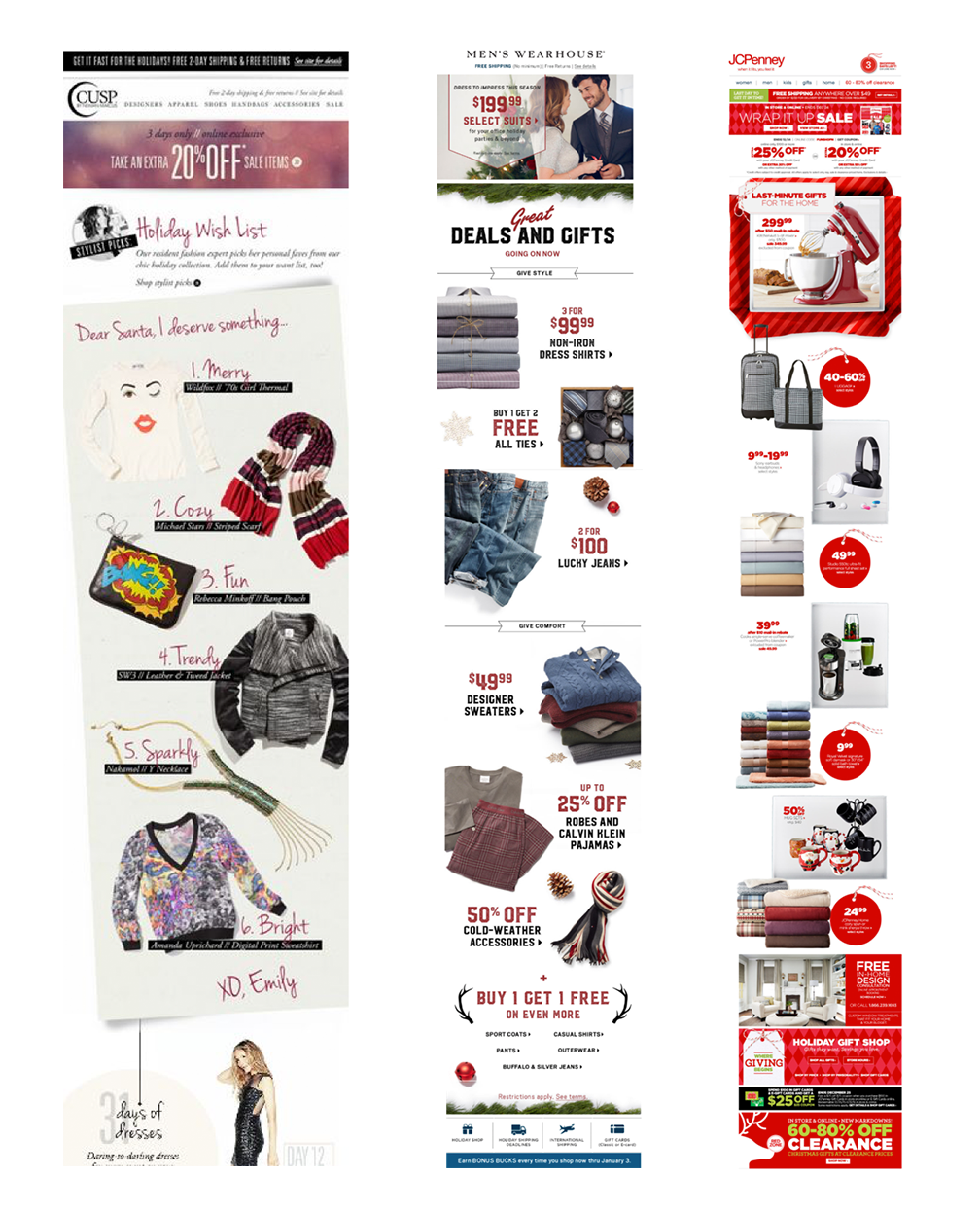
So there you have it – five email layouts that can be tuned to add some spice to your email program during the holiday season. When trying to determine which style may be best for you, think through the ultimate goal of the email and ask yourself, “Does the layout accomplish this goal?”
How Consumers Across the Globe Shop and Buy Online
Consumer technology is constantly evolving, reshaping the way retailers and consumers interact on a daily basis. These changes force retailers to provide functionality that allows consumers to easily make purchases on their device, or devices, of choice. It’s become critical to understand how devices are used in different ways from one region to another.
Consumer technology is constantly evolving, reshaping the way retailers and consumers interact on a daily basis. These changes force retailers to provide functionality that allows consumers to easily make purchases on their device, or devices, of choice. It’s become critical to understand how devices are used in different ways from one region to another.
Looking at results from a recent Bronto-commissioned survey of adult populations in the UK, US and Australia with access to a laptop, desktop, tablet, smartphone or wearable, the device of choice and shopping patterns change, not surprisingly, based on demographics and locale. So what does this tell us about how retailers need to prepare for shifts in consumer purchasing behavior?
Location, Location, Location
Smartphone adoption, to no one’s surprise, is at 75% or greater in the United States, Australia, and the United Kingdom, with Australia leading the way at 88% adoption. However, the UK appears to be leading the way in terms of ditching their reliance on desktops and laptops in favor of mobile devices. Desktop ownership is significantly lower than both the US and Australia, and the country has the highest tablet ownership of the three.
Does Buying Behavior Match?
In the US and the UK, 60% of respondents have used multiple devices to complete a purchase, while only 35% of Australians have done so. While this may signify a smoother purchase process regardless of device in Australia, we see a lower overall adoption of purchasing via mobile device in Australia. This leads me to believe that consumers are less comfortable making mobile purchases in AU, while UK and US consumers are still struggling to find a seamless, one-device experience. In those regions, it may be that the purchase process on mobile devices is still not fluid enough for consumers to complete the purchase on their device, causing them to abandon and later complete the purchase on a second device, likely a laptop or desktop.
In the US and AU, desktops and laptops remain the most common devices for purchasing, while in the UK, laptops and smartphones are the most common methods. When looking specifically at mobile devices, smartphone purchasing is fairly even between the US and UK, but tablet purchasing is significantly higher in the UK than in the US or AU.
What’s the DNA of Who’s Buying?
It is not surprising that the younger the demographic, the more comfortable they are shopping via smartphones. Younger consumers in the US appear to be most comfortable making purchases via smartphone, with the UK and AU following respectively. However, the US begins to see the noticeable drop with the 45-54 group (from 58% to 31%), while the AU and UK see the decline with those ages 35-44. While US consumers under the age of 54 are more comfortable using smartphones for purchases, they are still not ready to ditch the more traditional methods.
When it comes to gender differences, we see men owning slightly more devices than women in all three countries. However, when it comes to smartphone purchases, the AU and UK are dead even with 37% of men and women making purchases via smartphones. Surprisingly, we see a significant disparity in the US, with 43% of men making smartphone purchases versus only 35% of women.
Take Two Tablets and Call Me in the Morning
In the UK and AU, the 25-34 year-old demographic leads the way with regards to tablet purchases, while in the US, it’s those 35-44. Overall, this is not entirely a surprise, considering the low desktop ownership in the UK. But it may indicate that, in the UK, tablets have successfully replaced desktops in the home and thus generated a greater share of those purchases.
Final Thoughts
Purchasing with a mobile device is fast becoming the norm, and streamlining the online purchase process will be essential to provide your customers the experience they expect. Here are a few ways to ensure a smoother consumer experience:
Focus on mobile first. Mobile devices are constantly becoming more powerful and are fully embedded into everyday life. Assume this, or another mobile device, will be the primary form of engagement now and in the future. Be sure your emails are mobile-friendly and your website provides a great mobile experience.
Make it easy to purchase. Having a mobile-friendly site does not mean you have optimized your purchase process. You must streamline the checkout process and reduce obstacles to conversion. Consider promoting account creation in your email messaging when acquiring new email subscribers to support a smooth checkout process.
We know that consumers expect a consistent omnichannel experience, but delivering it in a manner your audience expects will be critical in order to maximize revenue and create long-lasting customer loyalty.
Anniversaries Aren’t Just for Couples: Build Lifetime Value with Automated Offers
Retailers are constantly looking for simple, automated lifecycle messages that not only contribute to their bottom line, but also re-engage subscribers. The usual suspects – birthday and re-engagement messages – are common.
The anniversary message, though, is often underused, especially since the kinds of anniversaries celebrated are as varied as the products and customers you have.
Here are three very simple date-based automated messages that can drive revenue and successfully re-engage your email subscribers.
Retailers are constantly looking for simple, automated lifecycle messages that not only contribute to their bottom line, but also re-engage subscribers. The usual suspects – birthday and re-engagement messages – are common.
The anniversary message, though, is often underused, especially since the kinds of anniversaries celebrated are as varied as the products and customers you have.
Here are three very simple date-based automated messages that can drive revenue and successfully re-engage your email subscribers.
Purchase Anniversary
Send a message one year from a customer’s first order date explaining the significance of the anniversary, thanking them, and inviting them to come back and shop (with or without an incentive). These customers remain active email subscribers, so this can also be a great opportunity to ask them to update their preferences with you. After all, a lot can change in one year.
To keep the goodwill going, consider sending this message in subsequent years with increasing benefits as a means of rewarding them for their subscription loyalty.
The email from men’s clothing provider Paul Fredrick specifically highlights the first year anniversary.

Wedding Anniversary
For a more traditional occasion, a wedding anniversary email is a great, yet seldom used, message for many retailers. If your company sells traditional anniversary gifts (e.g. leather, paper), or relationship-related gifts, such as lingerie, gift baskets, flowers or jewelry, you have a perfect opportunity to collect and use this data. If a customer does provide this information, they are showing you they trust your brand. Provide value to them in return.
Of course, don’t wait until the last minute as many of us do in real life. Be sure to send this message before the actual date, so the customer has time to shop, compare items and have the gift delivered. And be sure to tout your value-adds. Do you offer white glove service, gift wrapping or other valet-type upgrades? If so, advertise these as add-ons or include them as part of the incentive in the message.
But this message doesn’t have to be about driving conversions. Send a goodwill anniversary message on the actual day without a call to action to shop. Link directly to your site or to an unrelated social callout, or simply omit any call to action altogether. This day-of message should be about fostering a relationship between your brand and the subscriber.
Sign-Up Anniversary
While these first two are more personal in nature, you may not have the data available to execute them. Don’t worry. You can still send an anniversary message based on the date they joined your email program. Show them how much you appreciate that they are still subscribers.
If the subscriber has made a purchase in the past, take their purchase behavior into consideration when determining the incentive. Based on the number of purchases, lifetime spend or average order value (AOV), you can include an appropriate incentive to reward customer loyalty, attempt to increase their AOV by setting a minimum spend, or drive a first purchase by reinforcing your brand’s value.
One cautionary note: Default to the purchase anniversary message if the sign-up occurred near the purchase date. People are likely to remember their purchase rather than the date they signed up to receive your emails.
There you have it. Three incredibly simple automated messages that can help drive revenue and/or re-engage subscribers with your email program. Have fun, be creative and give your valued email subscribers a nice virtual hug.
The Adventures of a Choose-Your-Own Welcome Series
I remember as a child reading “Choose Your Own Adventure” books, where the story and ending ultimately depended on the choices I made throughout the story. Why not be adventurous and take this same approach with your welcome series? After all, a welcome series is designed to introduce, engage and build consumer confidence with your brand. What better way to do that than by delivering content based on the actions and preferences of your newly acquired customers?
I remember as a child reading “Choose Your Own Adventure” books, where the story and ending ultimately depended on the choices I made throughout the story. Why not be adventurous and take this same approach with your welcome series? After all, a welcome series is designed to introduce, engage and build consumer confidence with your brand. What better way to do that than by delivering content based on the actions and preferences of your newly acquired customers?
Consider the possibilities for a shoe retailer who could send welcome series messages with a loafer theme to contacts who showed an interest in loafers at a very early stage. Or a clothing company that can send maternity-specific messaging to those who click links for maternity products. The ability to make these messages as relevant as possible ultimately helps set your series up for even greater success.
To execute a “choose your own”-style welcome series, follow these four steps:
Step 1: Collect Subscriber Data
A successful welcome series requires reliable data. Think about how you can optimize your acquisition points to collect more relevant information. There are four primary places where you can collect new subscriber data:
Ask for it During Sign-up : Are you asking for preference data you can segment upon at sign-up? Your subscribers are more likely to provide you with information during those initial interactions when they are most engaged with your brand. If your sign-up process allows, you should attempt to collect gender, category of interest, or any other targeted information that pertains to your products.
Identify the Sign-up Location: Add a hidden field or list assignment based on the page the user is viewing when they choose to sign up. For example, if you’re a shoe retailer, your hidden field value could capture whether the contact used the form from the men’s page or the women’s page. You can take this a step further by having a more detailed field, such as men’s loafer, tennis shoes, etc. Read more on using this tactic here.
Capture Click Activity: The welcome message should be the most-read message in your email program. Use a contact’s click behavior within this message to determine which message they will receive next. Not only are they interested in your products (they just signed up), but their actions immediately tell you what they are focused on. The navigation bar makes the obvious choice here, as these are commonly your overarching links of importance.
Request Additional Preference Data via Dedicated Messaging: A manage preferences message is a common part of a welcome series. If you send it early in the series, you can use the data provided to dictate future messages.
Step 2: Create Your Segments
What information do you need in order to segment your list? Gender, product category, price point, something else, or all of the above? Your criteria for segmentation will be based on how you’ve been collecting your data up to this point, but that doesn’t mean you can’t update your plans and incorporate some of the strategies from step one going forward. For example, if you only collect email addresses at sign-up and have no other means of gathering info, identify contacts who clicked on particular links in the welcome message, and build new segments from there.
Note: Be mindful that a person may enter multiple segments, so creating a priority list will be important for you. For example, if someone clicks on both the women’s and maternity links in your welcome message, you need to determine which of these two segments takes precedence over the other. You may decide maternity has a more immediate need and send the maternity-focused series to this contact.
Step 3: Create a New Stream of Messages
Now that you know what specific audience you want to target, you can begin creating your new welcome series messages. You can customize the imagery, highlight specific value-adds, include secondary CTAs, and even feature specific product recommendations based on the segment. You may also have a better idea of crossover categories that would be most likely to convert. If you’re tight on resources, using product recommendations and related crossover categories within your existing emails may be easier to execute until new messages can be created.
Take this Everlast email, for example. I could easily use the three CTAs in the email to determine what the focus of the subsequent messages should be. I could even combine that with gender to really differentiate product types within the category.

Step 4: Analyze and Adapt
As with other automated messages, never set it and forget it. Be sure to analyze the performance of these messages to determine not only if they convert better in general, but also which segments and which messages in the series convert better. With this information, you can begin to apply a profitable segmentation strategy to your standard promotional messages as well. It could also be the first step in customizing a similar strategy for other series, such as those for post-purchase or lapsed purchase.
There you have it. Have fun experimenting with a more unique subscriber onboarding adventure, while really focusing on your overall segmentation strategy. So how will your story end? To try this strategy, return to Step 1. To try a more basic optimization strategy, click here. The choice is yours.


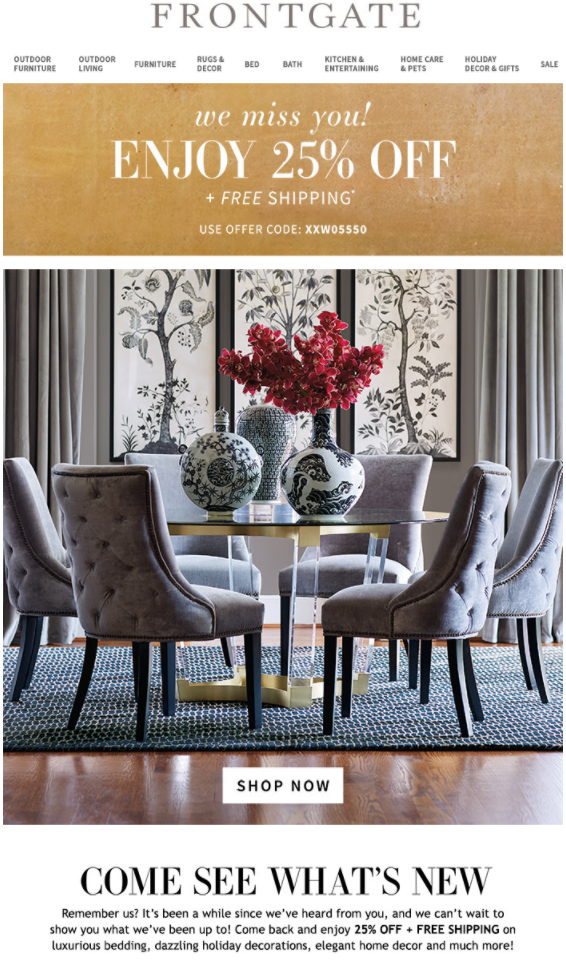


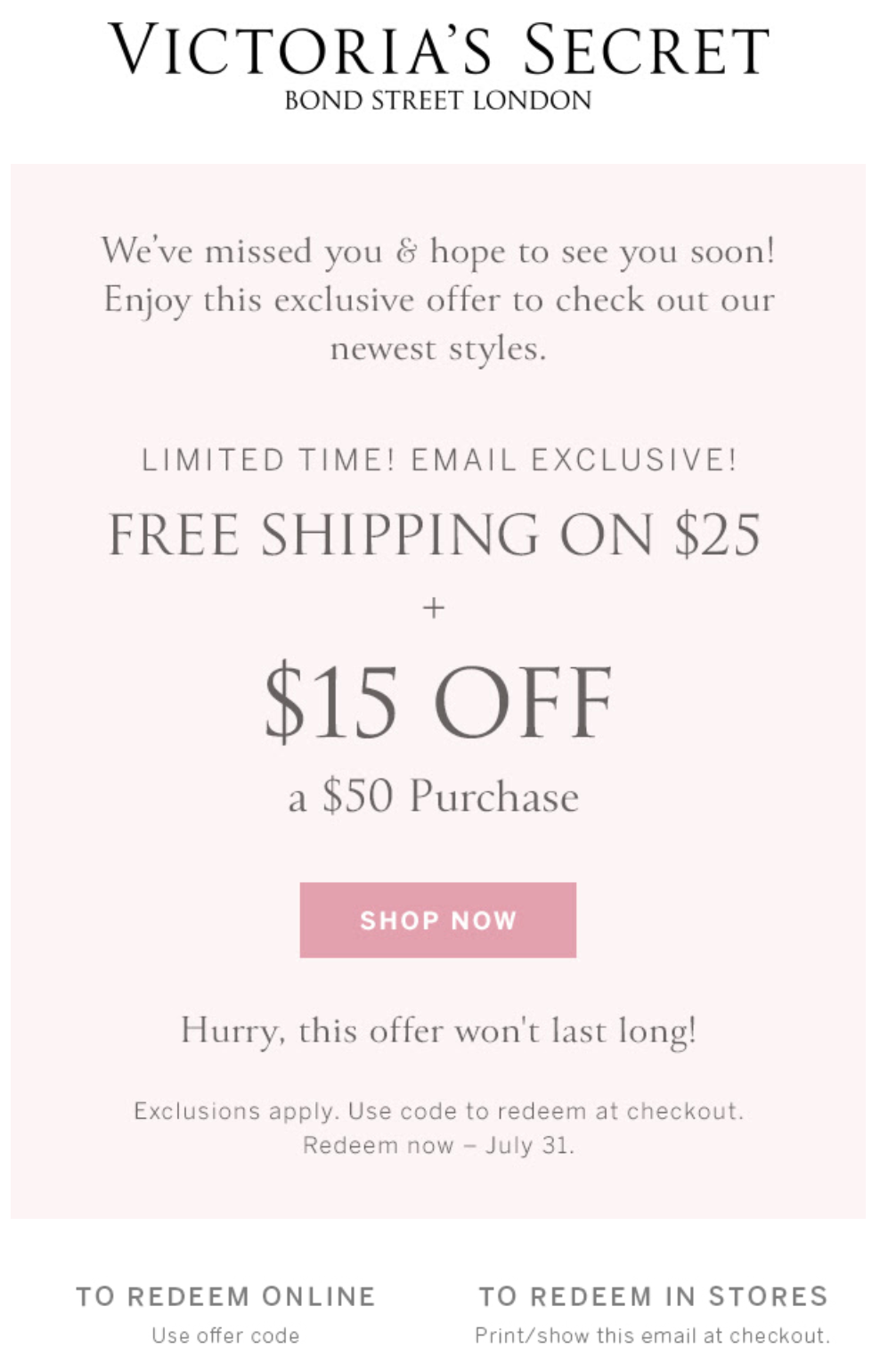


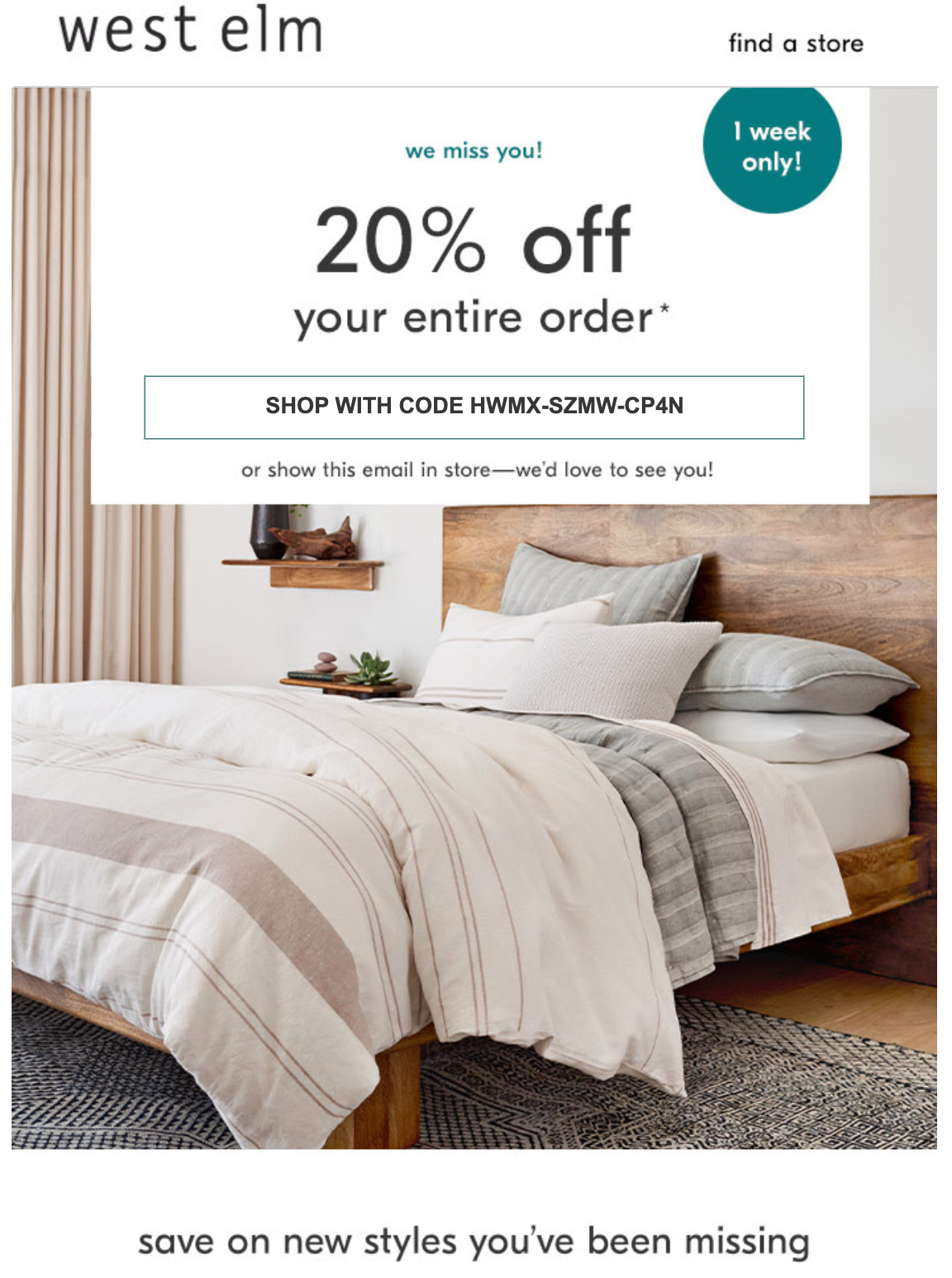


What Will They Buy Next? Using Product Recommendations in Email
Creating relevant emails is not a new concept, but due to resource limitations, it can often be difficult to execute. If you can’t be as targeted and relevant as you’d like at the individual email level, using product recommendations in your messages can fill the gap.
Creating relevant emails is not a new concept, but due to resource limitations, it can often be difficult to execute. If you can’t be as targeted and relevant as you’d like at the individual email level, using product recommendations in your messages can fill the gap.
For those who can create targeted promotional emails, product recommendations can help you take those messages to the next level. When using product recommendations, however, there are things to be mindful of, such as what your recommendations are based on. Is it purchase behavior, click behavior, website browse behavior, or a combination of these? It’s important to determine upfront so you can audit the results for accuracy and identify opportunities to potentially collect additional subscriber info. Doing so will help create more accurate recommendations.
Let’s look at some messages where recommendations would be most effective and some pitfalls to be wary of when doing so.
Lifecycle Messages
Inserting product recommendations in lifecycle messages, such as a post-purchase, anniversary, or birthday messages, is a natural fit. These messages are already relevant by nature, and including specific suggestions based on customer history can make them even more powerful. If you’re using a lifecycle message where you don’t have purchase info but may have click and preference details, such as a welcome series message, use whatever data you have to be as relevant as possible.
However, be careful not to refer to your recommendations as being “just for you.” Instead, consider using something more diplomatic, such as “items we think you may like” or “customer favorites.” You’re still learning what they may be interested in, so don’t make it sound as though you’re already certain of their preferences.. Doing so might give a negative impression.
Cart Abandonment Messages
As consumers get closer to making a purchase, recommendations may be the deciding factor in not only getting the contact to buy but also increase their cart total. Maybe the contact sees a dress in the recommendations that they missed while browsing your site. Or it could it be that pair of shoes that complement the outfit in the cart. Don’t underestimate the power of recommendations, even at a point so close to purchase.
The examples below show three slightly different approaches to recommending products. Pottery Barn Kids showed “also viewed” products, while NewEgg labeled their section “Trending Now.” Do I really believe that all four things trending on NewEgg are TV-related items? No, I don’t. And Adore Me may actually be showing their most popular sets, but they may not be as relevant to the shopper with this message because they tried to cross-sell their primary products rather than recommending products similar to the abandoned pajamas.

All three examples were well-constructed, but I would avoid using labels along the lines of “Products Recommended for You” in an abandoned cart message. The subscriber already identified specific items they’re interested in, so your goal should be to either complement the abandoned product or provide a similar solution to the problem the abandoned product solves.
Transactional Messages
Don’t forget about your transactional messages, such as order and shipping confirmations. These messages can be substantial revenue drivers, and considering recipients have just made a purchase, it might be the perfect opportunity to showcase some upsell or cross-sell items here. In this Williams-Sonoma example, the “also purchased” products are mostly relevant. Why wouldn’t I need a new spatula along with my new griddle? What I like about this is they are also relatively low-cost items, so making an impulse purchase decision is more likely.

If you can easily edit the message layout, I prefer to have this recommended content along the right rail as opposed to below the primary content. This allows you to keep your promotional content above the fold while remaining CAN-SPAM compliant.
Be Wary of Automated Promotional Messages
If you plan to send recurring recommendation emails to your audience, don’t automate the exact same message. Change the subject line from send to send. You could still automate your message, but be sure to keep your message fresh. All it takes is one not-so-relevant email before a contact decides to never open your messages again. Using the same subject line allows the subscriber to identify this message in the inbox before even opening it.
For instance, I once received an email from a company with the subject line “Gregory, Recommendations Just for You.” Upon opening, not a single product was indeed relevant to me. Now, every time this company sends me that message with the identical subject line, I immediately hit delete. Sending a message with an identical layout is fine. Just be sure to freshen the subject line with each repeated send to a contact.
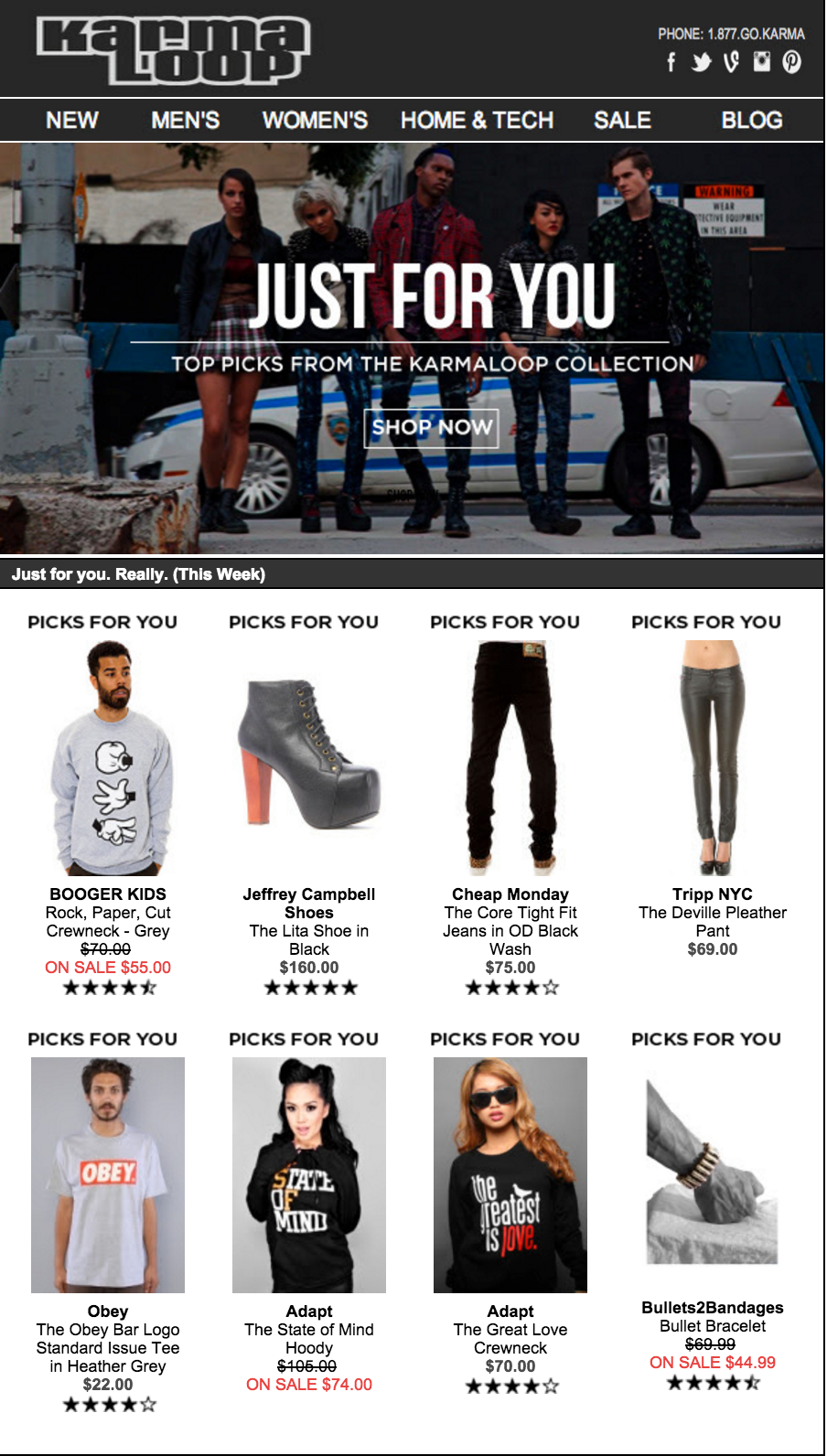
In this example from KarmaLoop, I am a non-purchaser. They continue to send me recommendation messages like this. As you can see, these products don’t have much in common, yet the creative says these are just for me! The products are for both genders and from a variety of price points. This may be an attempt to determine what I click on to further their segmentation, but they could do that with standard promotional messages. They could also collect gender at sign-up, and even with no other info, make these recommendations more relevant.
Subject Line: Just for you. Really. (this week)
With Overstock.com, I have purchased in the past. I once bought a couple of iPhone accessories for my wife. What I don’t necessarily like about this message is the primary recommendation for stylus pens with a sub-recommendation for an iPhone accessory. Based on my purchase history, the iPhone accessory is more targeted to my potential needs, and the other two jewelry recommendations miss the mark.
I have no issue with trying to determine whether I might be in the market for some jewelry, but two recommendations for jewelry seem like a stretch to me. Why not include one jewelry item and maybe one other female fashion accessory?
Subject Line: Gregory, recommendations Just for You…
I do like the price points of the suggestions. They are all in line with the price of the original items purchased, so they are not making drastic recommendations. But the subject line used for this message is identical to the one I mentioned from another retailer above, so I know this is an automated message. Again, if these recommendations completely missed the mark, I would be very hesitant to open in the future. In this case, it was relevant enough to open again.

Always check that your recommendations are indeed hitting the mark. Remember, results will vary based on what you segment on (browse, purchase or click behavior). However, if they don’t appear to be delivering the results you’d expect, edit your settings and keep tweaking until you get the best possible results.
Final Thoughts
People have different needs and shopping behaviors, so recommendations don’t always have to be exact. They should simply estimate what people may like. But with that being said, they should still be in the ballpark in order to engage the subscriber. Test and monitor the results of your recommendations for relevance and accuracy. And finally, don’t force these recommendations into all of your messages. Look for the opportunities where it makes sense to do so and gives you the greatest likelihood of success.
SMS Marketing: Keys to Success and Pitfalls to Avoid
Let's face it, nearly everyone texts. In fact, I bet your phone is within eyesight right now. Is it? Because so many of us keep our phones close by, the time between when text messages are received and read is probably seconds! This alone makes SMS marketing a potentially powerful tool. However, many companies are missing a huge opportunity with their SMS marketing programs.
Let's face it, nearly everyone texts. In fact, I bet your phone is within eyesight right now. Is it? Because so many of us keep our phones close by, the time between when text messages are received and read is probably seconds! This alone makes SMS marketing a potentially powerful tool. However, many companies are missing a huge opportunity with their SMS marketing programs.
The problem is that many marketers don’t think of SMS the same way they think of other promotional channels. That is to say, they assume batch and blast, unoriginal messages will convert subscribers. You wouldn’t send the same email to your subscribers every single week, would you? Yet this is exactly what many companies do when sending SMS messages. Today I am going to show you just a few a few examples of the SMS good, bad, and somewhere in between.
The Bad
This first set is from Macy’s.

Notice anything here? One of the problems with Macy’s program is the promotion is almost always identical. In almost every message I am offered 20% off my purchase. I know it is coming, so there is no reason for me to check the message. Where is the urgency to purchase? Why would I shop now when I can simply wait for the next one? Here is a prime example where I may see the text within seconds or minutes after receiving it, but the CTA is lacking.
Here is an opportunity to test different incentives to see if a discount threshold can be found, or simply to give the appearance that a specific discount is not standard.
The In-Between
Here is an example from buybuy Baby.
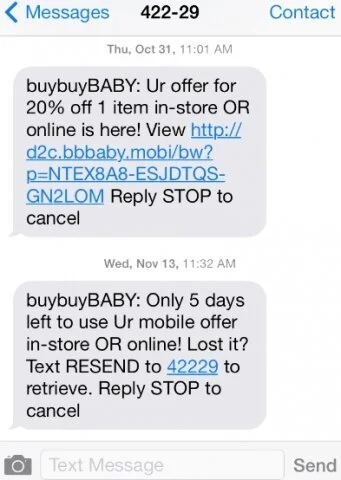
You can see this follows the same concept as Macy’s SMS. The incentive is for 20% off, which we all know is the standard coupon for Bed Bath & Beyond stores. I have stockpiles of BBB coupons. What sets this apart from that piece of direct mail I have? These two examples are the SMS version of batch and blast emails. Although I don’t see the value in these messages, I can give BBB a small pass, as I don’t think anyone buys from BBB without one of their 20% coupons. This just provides an on-the-go coupon for people.
Also, the use of the word "Ur" seems a bit loose to me. I don't see why they couldn't just write out "Your". I know it is "text speak" but it doesn't seem natural from this specific brand. If length was a problem, then they could have shortened the URL, similar to how Macy's shortens them in their example.
The Good
So how can SMS be used in a manner that sparks action? Here is an example.

OK, I have a confession. I drive an Altima (not that there’s anything wrong with that). Just like a re-order email or SMS message would function, this message reminds me when I am due for an oil change. What this message has that the previous two examples don’t is it provides value and has a clear CTA. While it is not a typical retailer, it does demand action from the subscriber. Typical retailers could learn from implementing these principles into their messages.
Using SMS for a product reorders can be very valuable. Making it possible for one-click reordering while on the go can also drive more conversions than a random batch and blast text message like the BuyBuyBaby or Macy’s messages.
One final example to look at is from Target.
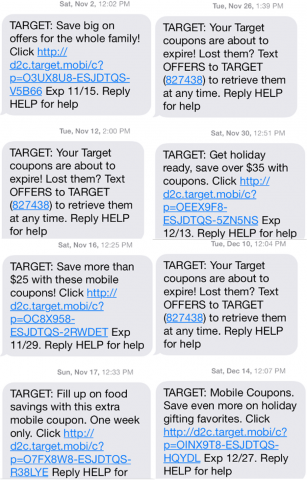
Target does exactly what Macy’s doesn’t, they change it up. The links in these messages drive me to a Target page that shows all of the different coupons they offer. The product coupons change from message to message so they force me to look at them when I receive the SMS. I don’t often make a trip to Target, but I have found two independent offers via these messages that drove me in-store to purchase. Success!
I would bet that if people were signed up for both the Target and Macy’s SMS programs they would be more engaged with the Target program.
Keys to Success & Pitfalls to Avoid
Types of campaigns where SMS can be effective:
Reorder reminders
Informational alerts, like flight delays or event reminders
Transactional messages, such as order confirmations or shipping confirmations
Special deals or campaigns, such as 12 days of deals for Christmas
SMS can also be a great way to grow your email subscriber list with text-to-sign-up
SMS Tips & Tricks:
Don’t send the same message time after time – (you wouldn’t do it with an email, why do it with SMS?)
Send messages that provide the subscriber with value
Have a clear CTA
Make the CTA easy to redeem
Make the offers unique – if I get the same offer via every channel, why should I subscribe?
Treat your SMS program like an independent marketing channel – after all, it is!
Test incentives and promos to determine what converts best
Whether you are thinking of, or currently are using, SMS as a marketing channel, be sure to think through your program and how it connects with your subscribers. Otherwise, it will be like getting texts from a stranger. Want proof? Give me your cell number and I’ll text you my weekly grocery list. Let me know how long it takes you to stop reading my texts, LOL.