Featured Post: My Reading & Podcast List
Here are recent books I’ve read and podcasts I enjoy. If you’re looking for something interesting to listen to or read, these are a few that have stood out to me. Let me know if you have a recommendations.
Post-Purchase Email Marketing and Subject Line Examples
When it comes to post-purchase email marketing, it may just be the most underutilized yet powerful email marketing tactic there is. A strategic, well-thought-out series can help increase customer retention and help build brand loyalty and advocacy. The best part of all is that these messages are automated, generating revenue while you sleep.
Creating a series of messages designed to enhance the purchase experience is something every retailer should implement.
Post-purchase email marketing may be the most underutilized yet powerful email marketing tactic. A strategic, well-thought-out series can help increase customer retention and help build brand loyalty and advocacy. The best part of all is that these messages are automated, generating revenue while you sleep.
Creating a series of messages designed to enhance the purchase experience is something every retailer should implement. With each message and series sent, taking into consideration the individual's purchase history is important. After all, a loyal customer may not need the same nurturing or messaging as a first-time purchaser.
Post-Purchase Email Metrics
Order follow-up (2026)
Open rate: 47.63%
Click-to-sent: 4.01%
Conversion rate: 0.84%
Click-to-conversion: 20.87%
AOV: $129
Revenue per send: $1.08
Cross-sell (2026)
Open rate: 42.09%
Click-to-sent: 2.93%
Conversion rate: 0.75%
Click-to-conversion: 25.50%
AOV: $106
Revenue per send: $0.79
Feedback request/product review (2026)
Open rate: 50.70%
Click-to-sent: 3.66%
Conversion rate: 1.07%
Click-to-conversion: 29.16%
AOV: $131
Revenue per send: $1.40
For context, the average scheduled campaign email generates just $0.18 per send. Even the most modest post-purchase automation, cross-sell at $0.79, delivers more than 4 times that value. Order follow-up and feedback request emails both clear $1.00 per send, making them highly effective automated messages.
Types of Post-Purchase Email Messages
As you can see, post-purchase messages well outperform regular email campaigns, and there are no limits to the types of messages you could send in a post-purchase series, including:
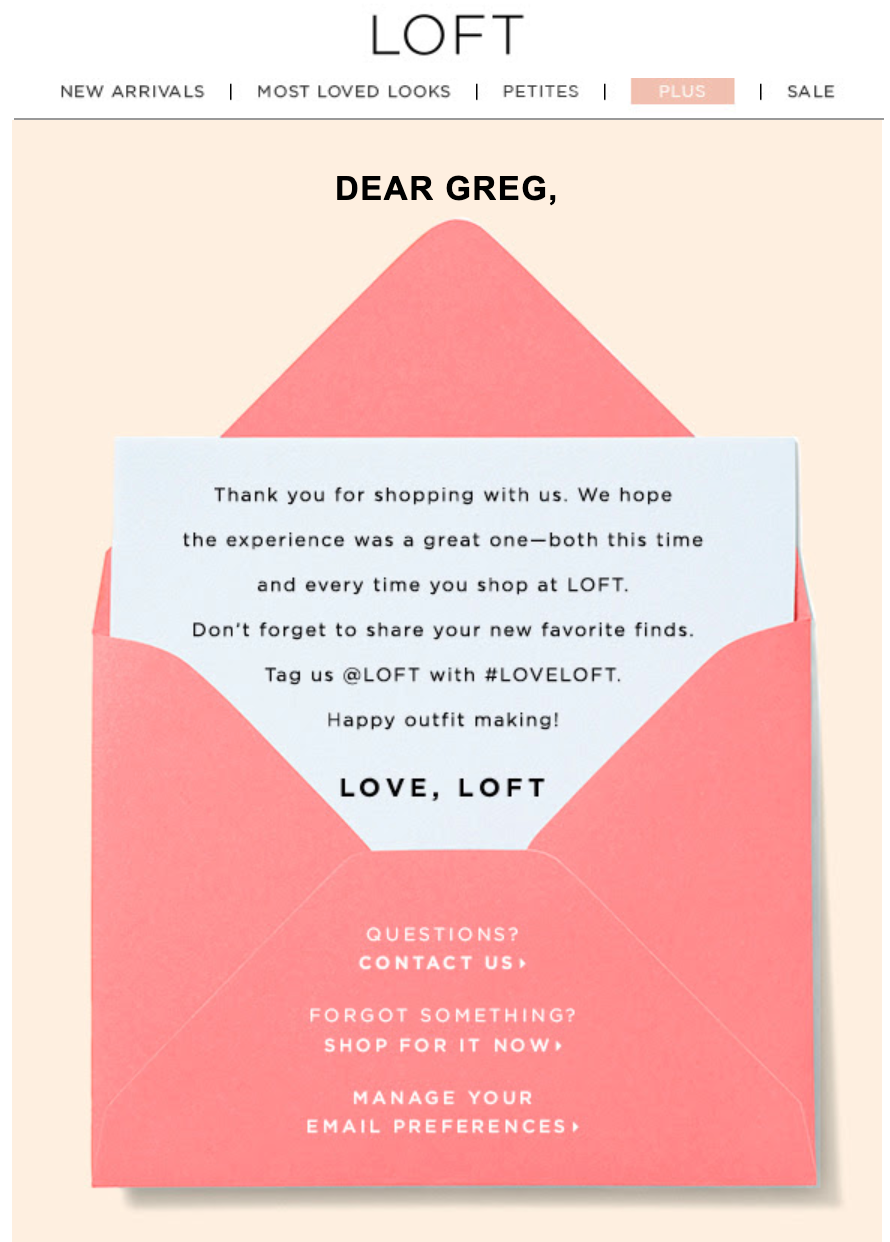
“Thank you” message (w/ or w/o an incentive).
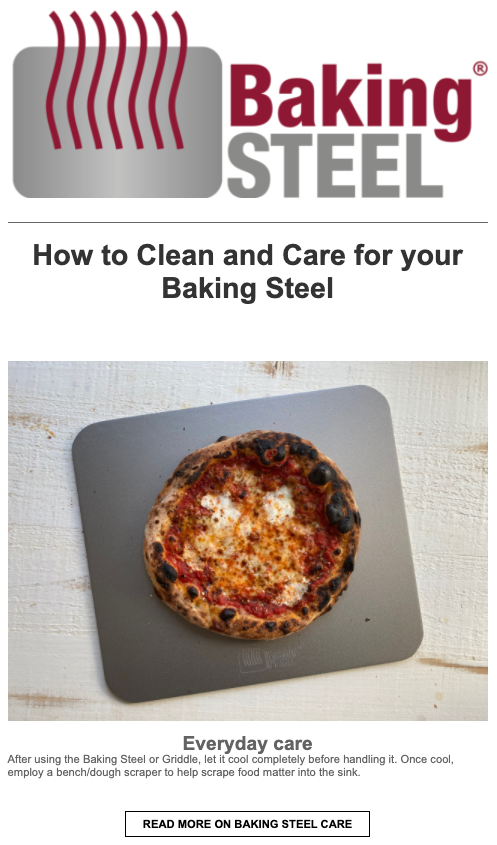
Product care/tips and tricks.
How-to resources.
Customer service info/guarantees.
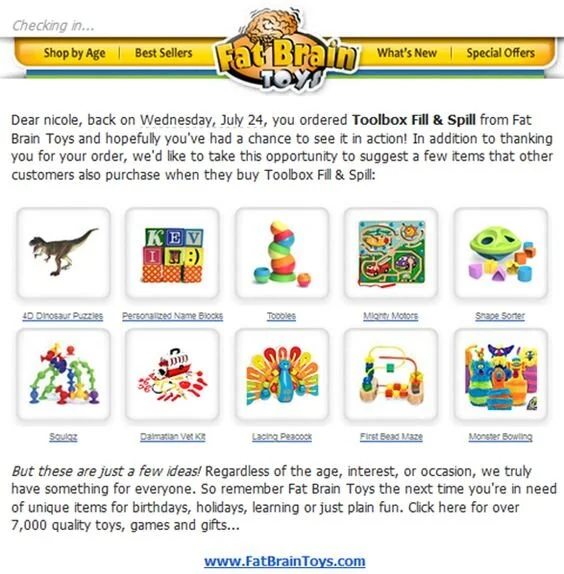
Product recommendations or cross-selling opportunities.
Social invites or crowdsourcing (Share a photo with us!).
Manage preference request.
Product reviews.
Reorder reminders.
Gift-giving or date reminder requests.
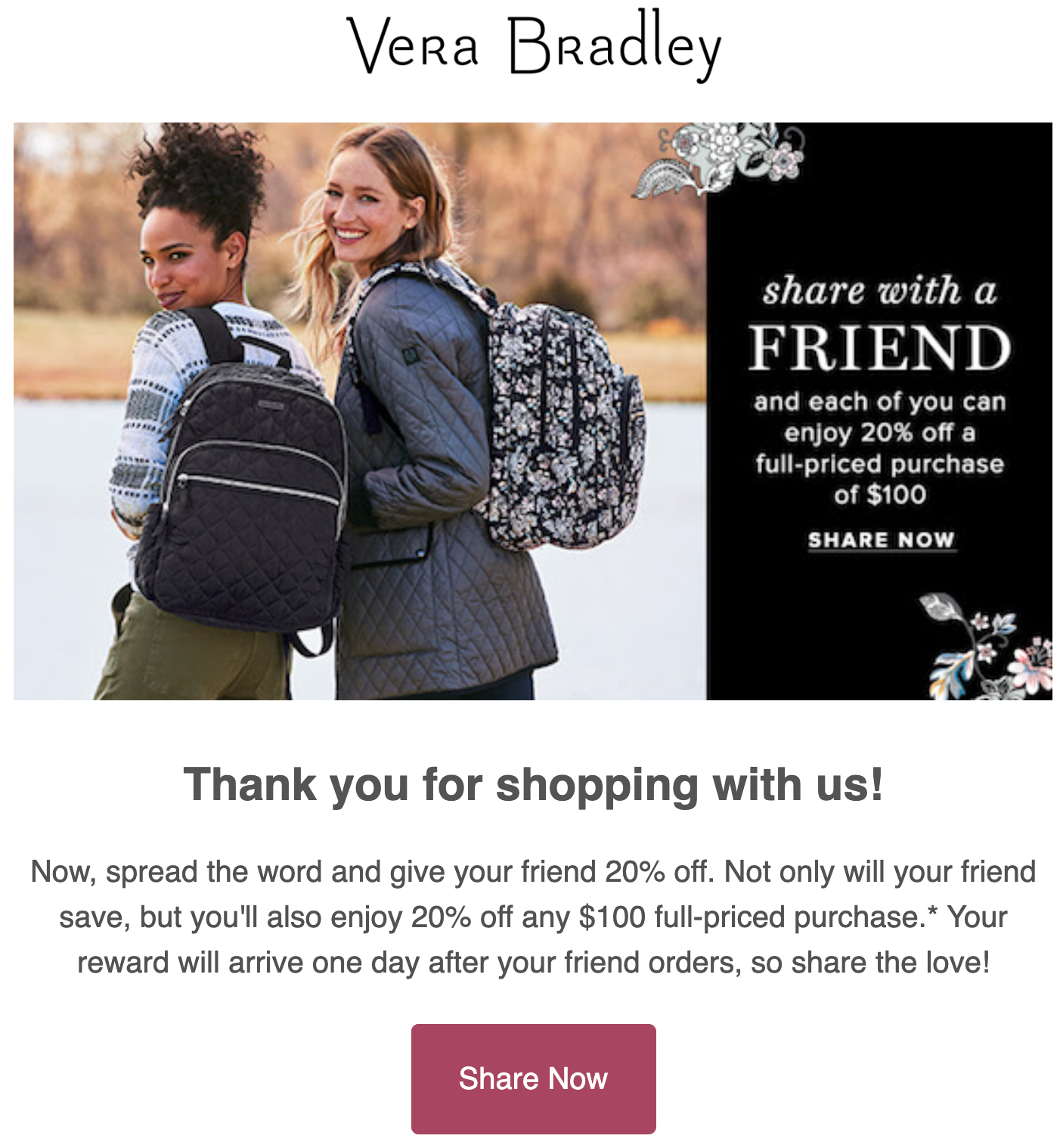
Refer-a-friend invitations.
When building your automated post-purchase marketing program, have fun, be creative, and, most importantly, make your customers’ purchase experience better.
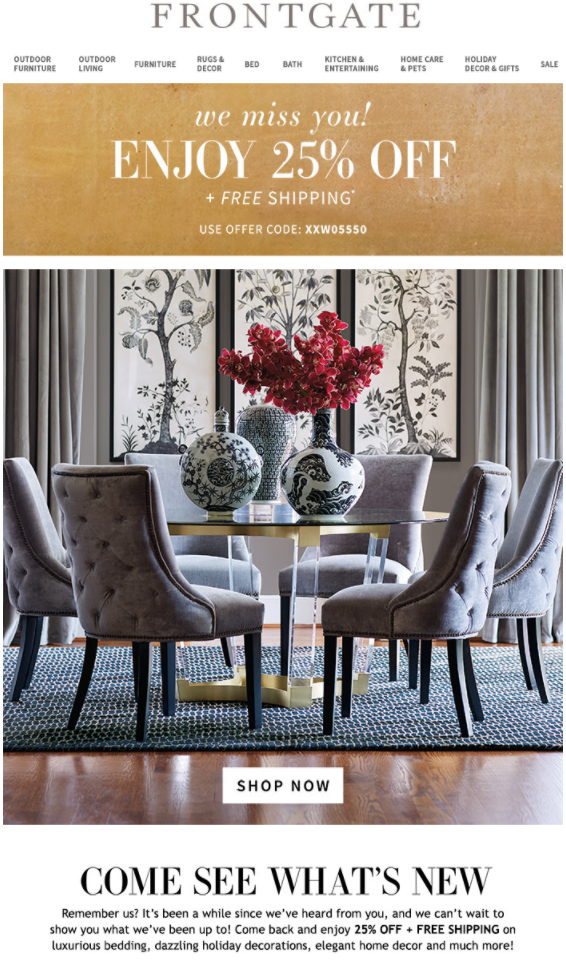
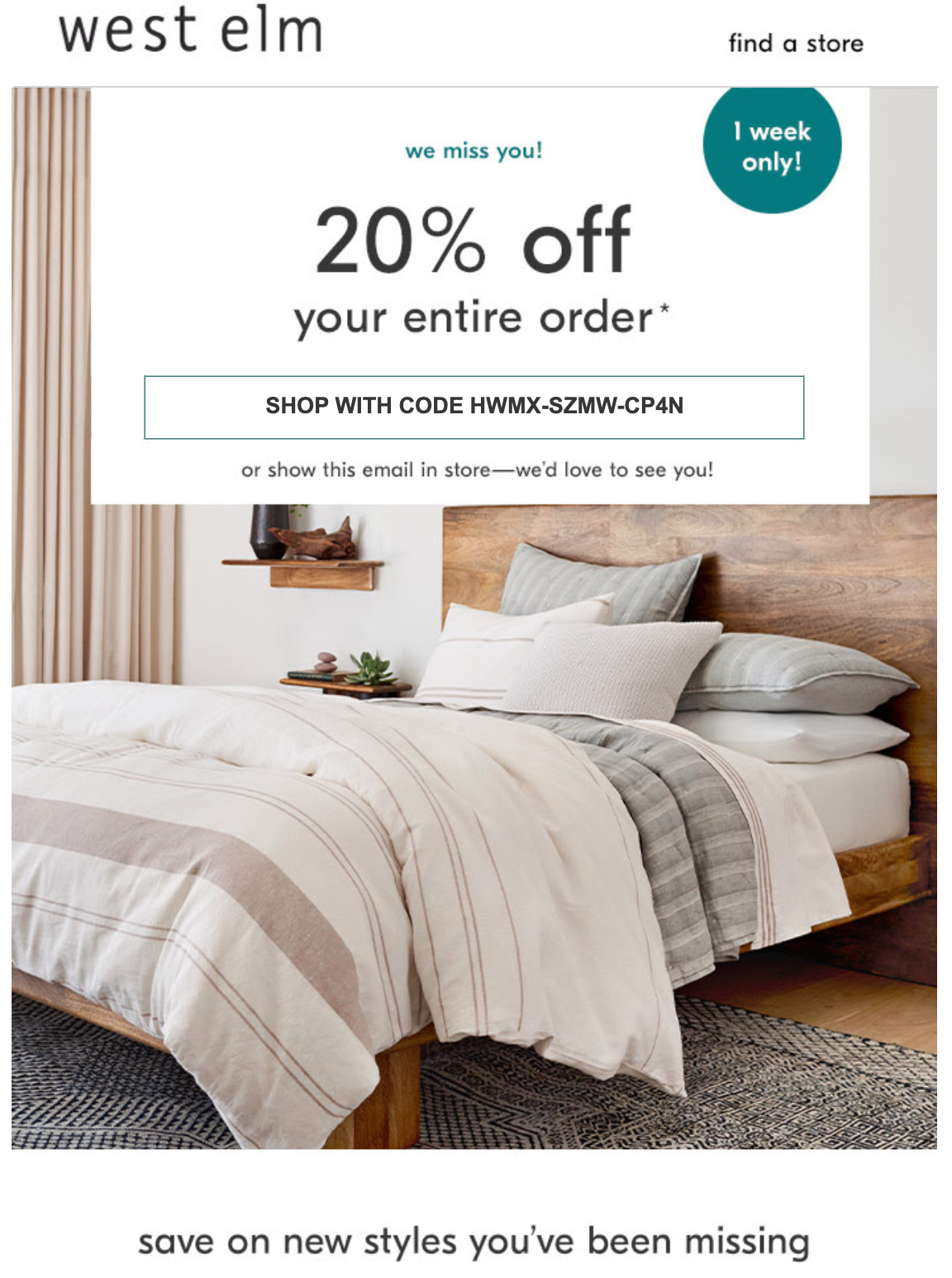
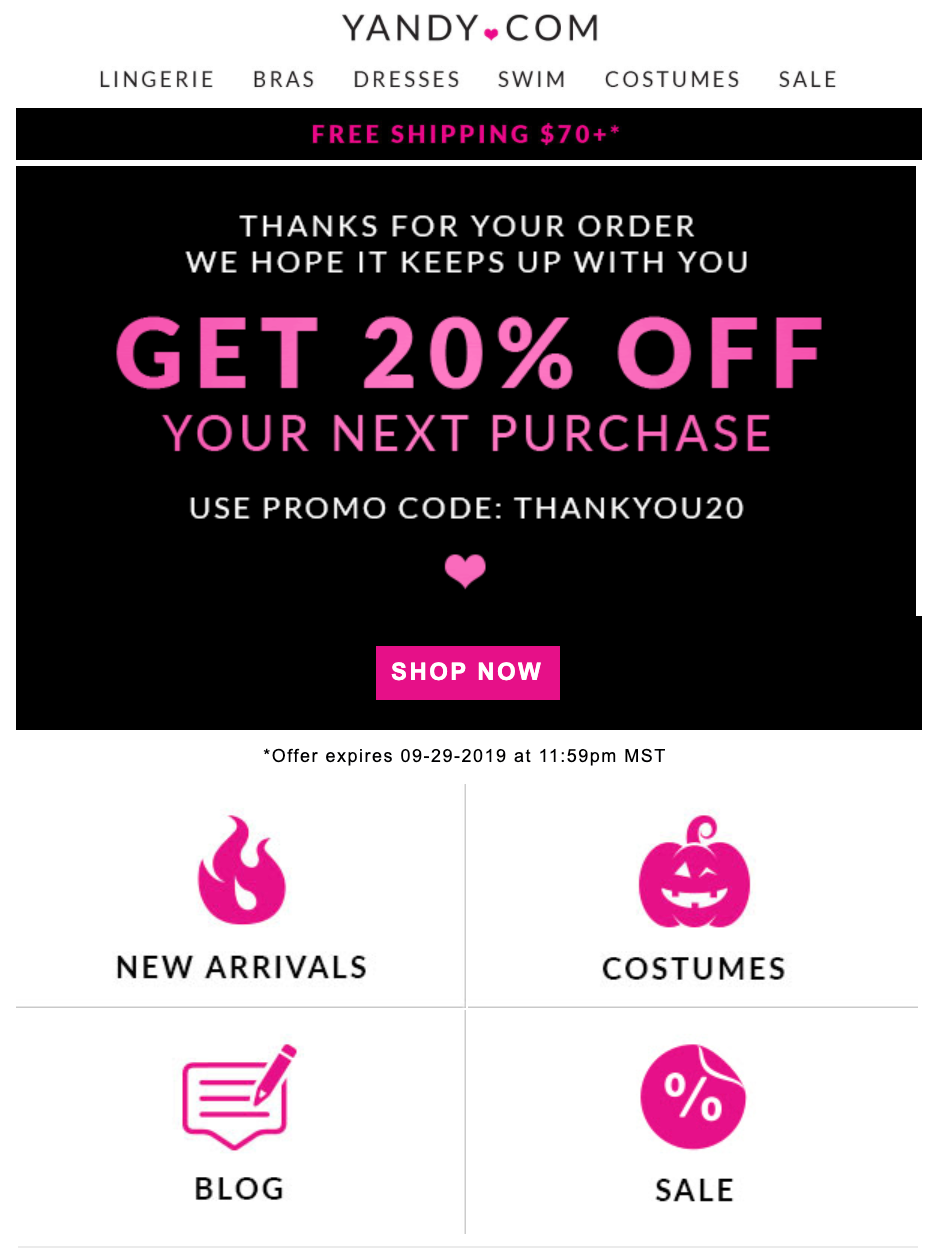
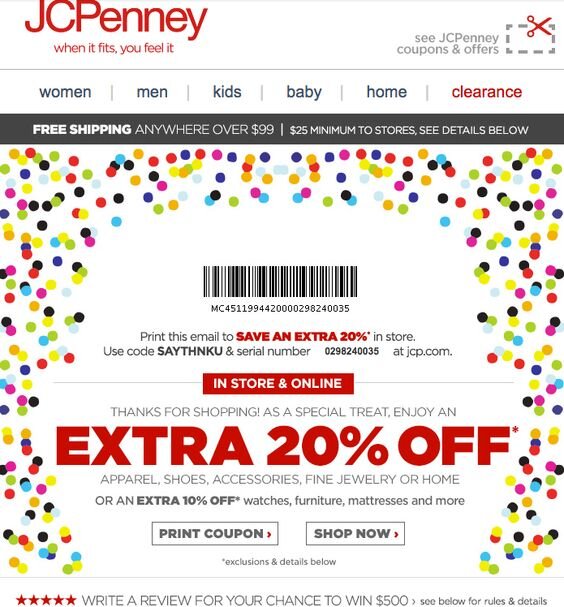
Post-Purchase Email Marketing Examples:











Post-Purchase email subject lines
Wow, thank you again! 💋
Seafood Grilling Tips That Set You Up for Succulent Success
Thanks For Your Order. Enjoy This Gift For You
Tips to make the most of your Bosch appliance
It’s happening – Your custom orthotics are on their way!
This is so exciting! Your impression kit is here.
Your personal exercise plan, Greg!
Thanks for your purchase – here’s a BONUS coupon to use the next time you shop!
Greg, read this before you set up your new TV.
Stick Up Cam 101: Tips and Tricks
How to Clean and Care for Your ______
Our Best Recipe(s) Ever!
Thank You!
Meet Your Perfect Pair 😍💕
Thank you for your recent purchase!
Thank you for shopping at _____!
[Video] Your Recent Coelho Purchase
Has anyone ever told you that you're incredible!
20% OFF | Our Thank You Gift To You 💕
Thanks again for your order
Thank you for making a LEGO® purchase. (message 1 of 4)
We hope yer hooked… (message 2 of 4)
Captain Brickbeard is ready for ya… (message 3 of 4)
1 month 'til you find the treasure... (message 4 of 4)
Other post-purchase articles:
Creating a Post-Purchase Email Strategy with Simple, Smart Segmentation
3 Ways to Cultivate Post-Holiday Customer Loyalty
Why Post-Purchase Marketing Is So Important
How to Create Post-Purchase Emails that Renew the Customer Journey
»» Have any questions about post-purchase email marketing? Let me know.
Examples of Back in Stock Email Marketing, Complete with Subject Lines
Back-in-stock notifications may be the highest-performing automated emails a brand sends. In this post, you’ll find top-tier example subject lines, performance stats (60% open, 19% click, 5.8% conversion), and five immediate tactics you can apply to your e-commerce email flows.
How Effective are back-in-stock messages?
In 2024, Back-in-stock messages had a 59.2% open rate, 19.5% click rate, and a 5.3% conversion rate. This was the highest conversion rate of ANY automated message, by far. Consider these must-have automated email messages for brands — both automated and scheduled campaigns.
Here are a few tips for ecommerce brands looking to use back-in-stock messages to increase sales.
Provide early access with back-in-stock automation
Use a sense of urgency and fear of loss in your messaging
Don’t feel the need to discount
Tailor messages to specific products when necessary
Include product recommendations
Back-in-Stock Email Marketing Examples








What’s the best back-in-stock subject line to use?
The best back-in-stock subject line uses a sense of urgency and combines it with the term “back.” This combines the urgency with social proof (they sold out once, they will again). A good example is “Back in Stock, But Not For Long.”
Examples of The Perfect Back-in-stock email subject line
Here are some back-in-stock email message subject lines used by real brands:
Top Sellers Back in Stock😍
🐍Back in ssssssssstock
Restocked! Ribbed Cotton Range Is BACK
Back in Stock: Lafeber Products
BACK IN STOCK: The Henley
THEY’RE BACK ⚡
URGENT: It’s Back In Stock!
Back in Stock 🌿 CBD Truffles
Back In Stock? Enough Said.
The wait is over: ramen is back!
Greg, SILK BEDDING BACK IN STOCK
Your fave Birkenstock style is BACK!
Back In Stock...
Back & Selling Fast!
Your fave camera bag is back in new colors!
LOOK WHO'S BACK 👀
Your favorite is back!
Favorites Back in Stock!
Everyone's adorable bestie is back 🎀
Your Favorite Lingerie is Back! (But not for long 👀)
Missed me? Back in stock
Back in Stock: A Knit to Know
WOW! Back In Stock: But Not For Long
Love Everybody 🖤 Back In Stock
MUST-HAVE BACK IN STOCK
Back in stock and going fast 💨
BACK IN STOCK You Have Been Waiting
Our holiday gift to you: back-in-stock best sellers
Have any questions about back-in-stock email marketing? Let me know.
The Customer Journey Has Changed — Has Your Marketing?
Let’s face it; the traditional linear model of the customer journey is no longer accurate. Today’s consumers shop how they want, where they want, and when they want—all while facing distraction at a moment’s notice. They are choosing how they interact with brands and on which channels they do so. They have all of the power. Who said being a marketer is easy?
Let’s face it; the traditional linear model of the customer journey is no longer accurate. Today’s consumers shop how they want, where they want, and when they want—all while facing distraction at a moment’s notice. They are choosing how they interact with brands and on which channels they do so. They have all of the power. Who said being a marketer is easy?
Today’s model more closely resembles that of a spiderweb, with its zigs, zags, and non-uniform strands. As chaotic as it may look, everything is connected and working in concert with one another.
This is the new digital customer journey—unique, non-uniform strands that are all connected to serve a common goal.
Because of the multitude of siloed channels, the distraction, and increased global competition, marketers need to rethink how multiple channels, like email and SMS, can work in unison with one another to create a relevant experience that meets consumers’ ever-increasing expectations of retailers.
How The Journey is Moving Beyond Single Channels
According to a report by Omnisend, marketing campaigns utilizing three or more channels have a 287% higher conversion rate than campaigns relying on a single channel. For retailers, ensuring that campaigns have multiple cohesive channels working together can have a significant impact on the bottom line. Multiple channels matter, but how they’re delivered matters more.
While retailers are using multiple channels to communicate with and retarget consumers, many of them are working in silos. For example, an email subscriber may click on an email and then abandon the website. In response, they begin seeing ads on their social media platforms. But if the consumer comes back and makes a purchase, often these retargeting ads follow them around the internet, sometimes for days or weeks, while still receiving generic promotional email messages.
Consumers increasingly expect communications from brands to be both timely and relevant. The example above is not that.
Retailers need to understand how consumers naturally interact. Take Gen Z, for instance. These digital natives make up more than a quarter of the US population, and being digital natives means SMS is a natural communication channel. Even so, 83% expect to increase or maintain their email usage over the next several years. Both channels hold importance to them.
Retailers who have adopted SMS as a marketing channel have reported over a 2,700% ROI, and omnichannel campaigns that involve SMS are 47.7% more likely to end in conversion.
It’s time for retailers to break down these silos and make available additional channels for customers to opt into. Adding channels that appeal to their customers is just the first step. Creating relevant messaging is another.
The Rise of Multi-Channel, Behavior-Based Messaging
Consider that customer who is on a website and browsing products only to leave without placing an item in the cart. The consumer has shown some level of interest. Recognizing this, a retailer would traditionally continue sending them standard promotional emails and retarget the customer through search and social media. But this experience has challenges. Paid retargeting can be expensive, the strategy is siloed, and standard promotional emails are not always relevant.
But this relevance matters. The same Omnisend report showed that that segmented campaigns earned 62% higher order rates than non-segmented ones. The reason—segmented messages are more relevant.
This is where automated behavior-based, multi-channel messaging can deliver a more user-friendly experience and guide the customer along their purchase journey.
Consider the impact of sending abandonment messages via the channel(s) of the customer’s choosing—after all, no one chooses to see ads on their social feeds. Retailers can easily send automated reminder messages (e.g., email, SMS, push) for the products they were viewing via any, or all, channel(s)—and if the consumer completes their order, the other channels recognize and cease their retargeting efforts.
Automated behavior-based messaging, such as browse abandonment, delivers segmented, relevant, and timely messaging to customers. Consumers recognize the value in them. That’s why it is not uncommon to see retailers drive over 25% of their email revenue on these messages alone.
This is just one example of automated, behavior-based messaging. Others include cart abandonment, welcome series, post- and lapsed-purchase, and re-engagement messages. I expect to see a continued increase in behavior-based automation adoption and the use of data, such as cart total or purchase history, to make these messages even more relevant than they naturally are.
Paving the Way for the Future
Utilizing behavior-based marketing automation to create relevant messaging and delivering it via the channel(s) of the customers’ choosing is going to be essential for catering to the modern-day online customer journey.
Tomorrow’s successful retailers will be those who cohesively incorporate other channels into their traditional siloed pillars of email, paid search, and paid social to create one unified, spiderwebbed e-commerce journey. After all, if you’re trying to catch flies, it’s good to be the spider who makes the web.
How to Use Video in Email Marketing
For years, marketers have said video in emails will be the next evolution in email marketing, but the challenges of implementing it have held it back. Email clients not supporting it, file size restrictions and video production time have been too much to overcome.
Now, 98% of email clients support video, the number one type of content to inspire consumer research, and the time has never been better to bring new life to your email marketing with video.
Here are ways to incorporate video in your email marketing program.
For years, marketers have said video in emails will be the next evolution in email marketing, but the challenges of implementing it have held it back. Email clients not supporting it, file size restrictions and video production time have been too much to overcome.
Instead, we’ve gotten animated GIFs and static images with overlay play buttons. While serviceable, it’s not the video experience we imagined.
Now, 98% of email clients support video, the number one type of content to inspire consumer research, and the time has never been better to bring new life to your email marketing with video. Here are ways to incorporate video in your email marketing program.
In this article, I’ll discuss:
Using Video in Automated Lifecycle Messages
Combining Social Media and Email Videos
Promotional Emails and Other Uses
Top Marketing Podcasts of 2019
As host of the Commerce Marketer Podcast, I conduct a lot of interviews. But choosing my favorite episodes is like choosing a favorite child (if my kids are reading this, I love you both the same). However, I forced myself to choose some of the episodes that really resonated with me for one reason or another.
Here are some of my favorite marketing conversations from 2019, in order of episode number. I hope you enjoy.
As host of the Commerce Marketer Podcast, I conduct a lot of interviews. But choosing my favorite episodes is like choosing a favorite child (if my kids are reading this, I love you both the same). However, I forced myself to choose some of the episodes that really resonated with me for one reason or another.
Here are some of my favorite marketing conversations from 2019, in order of episode number. I hope you enjoy.
Episode 043: Super Bowl Commercial Recap Roundtable
More than 100 million people watch the Super Bowl each year, but the commercials have become the must-see event within the event. This episode discusses the Super Bowl from a marketing and entertainment perspective. We’ll revisit the commercials, halftime show, and even how we interacted with our mobile devices during the big game - after all, what good is a $5 million commercial if everyone is checking their Instagram feed?
Why I chose this episode: This episode was a three-person roundtable. The guests were fun, brought great perspective, and episodes like this are just fun to do because no one takes themselves too seriously.
Episode 046: Email Deliverability: Everything You Need to Know
Did you know that having good email deliverability does not mean your emails reach the inbox? Understanding email deliverability is crucial, yet many marketers do not fully understand what goes into it.
Why I chose this episode: My guest, deliverability expert Chris Kolbenschlag, tackles myths, best practices, things marketers shouldn’t do and other elements around email deliverability in an easy-to-understand manner — which is what I love about this episode.
Ep. 050: How Lifecycle Email Marketing Is Like a Fine Wine
This episode discuss how one compani built their email program from the ground up using lifecycle email marketing to drive nearly half of their 2018 email revenue. We cover the strategies behind triggered campaigns, how to avoid the pitfalls of email fatigue with segmentation, mistakes made with their lifecycle campaigns, and lessons learned.
Why I chose this episode: My guest was Ben Argov, president of International Wine Accessories (IWA). Ben and I met several years back and he is one of the nicest people I know. Ben is honest about what works, what doesn’t, and what needs to be improved in his email program. What made this one special was that he sent me a spreadsheet of his email metrics to help guide the conversation. If you’re into email marketing, this episode is a must-listen!
Ep. 054: How Ikonick Uses Modern-Day Marketing to Drive Success
I’m joined by Mark Brazil, co-founder of the canvas art company Ikonick, to discuss how he created a multimillion-dollar business in less than two years by combining email, video, social, and influencer marketing. Mark covers everything from social media, email marketing, content marketing, storytelling strategies, and how they measure success.
Why I chose this episode: I met Mark while speaking at a conference in Quebec City in early 2019. After our initial conversation I knew I had to have him on the show. Mark is brutally honest, in a Gary V type of way (after listening you’ll know why), and shares some amazingly useful insights. This episode is great for entrepreneurs, and email and social media marketers alike. I forgot to mention, this dude is funny as heck!
Ep. 059: How Vera Bradley Designs a Modern-Day Retail Experience
I’m joined by Harry Cunningham, vice president of retail brand experience at Vera Bradley, to discuss what goes into designing modern-day brick-and-mortar stores that appeal to consumers. Harry explains some of the driving forces behind Vera Bradley’s redesign of their storefronts, explains how the store design revolves around solving shopper challenges, and shares everything you can think of when it comes to the in-store experience.
Why I chose this episode: It’s such a cool topic — and one I find fascinating. Harry is an engaging speaker and really brings you into his world of how he approaches store design concepts through stories that demonstrate the how and why he makes the decisions he does.
Ep. 60: The Behavioral Science of Marketing
Nancy Harhut is a behavioral science marketer and chief creative officer at HBT Marketing, discusses how marketers can use behavioral science — like “eye magnet” words, the Von Restorff Effect, proper use of charts and images, tactile experiences, and landing page techniques — to nudge their customers and encourage purchase decisions.
Why I chose this episode: Again, this topic is fascinating! This was a topic I had been wanting to cover for some time, and was fortunate enough to mention it to another guest of mine who coincidentally knew someone. That someone was Nancy. And boy, did she deliver! Nancy discussed so many tactics in an easy-to-understand manner, while providing specific use-cases for each. This episode has so many practical takeaways for marketers.
Find out more about The Commerce Marketer Podcast
Back to blog home
2018 Email Marketing Sends - By Day and Month
The chart below reflects the daily email send volume of 2018. The daily lift and declines reflect the average number of emails retailers sent on that day of the week compared to the overall number of emails sent during the entire year.
As you can see, retailers sent …
Top Email Send Days of 2018
The chart below reflects the daily email send volume of 2018. The daily lifts and declines reflect the average number of emails retailers sent on that day of the week compared to the overall number of emails sent during the entire year.
For example, retailers sent 8.61% fewer emails on Sundays than the average number of 2018 daily email sends. As you can see, Thursdays was the most popular day for retailers to send marketing emails, followed by Friday and Tuesday.
Weekends were the least popular days to send marketing emails, with Saturday being the day of the week where the fewest emails were sent.
Continue reading to see monthly and daily breakdowns. You can view 2019 results here and see how daily send patterns changed. Stay tuned for ongoing 2020 updates.

Does this chart tell you that you should avoid sending marketing emails on weekends? Absolutely not. Again, each business will have their own unique circumstances. Some retailers might look at this as an opportunity to increase their sends on lower-volume days as a way to stand out in an otherwise crowded inbox, especially during the holiday season. Others may choose to follow the crowd and send on those higher send days.
Test your email send days, but remember, people do shop on the weekends.
Monthly Email Marketing Sends
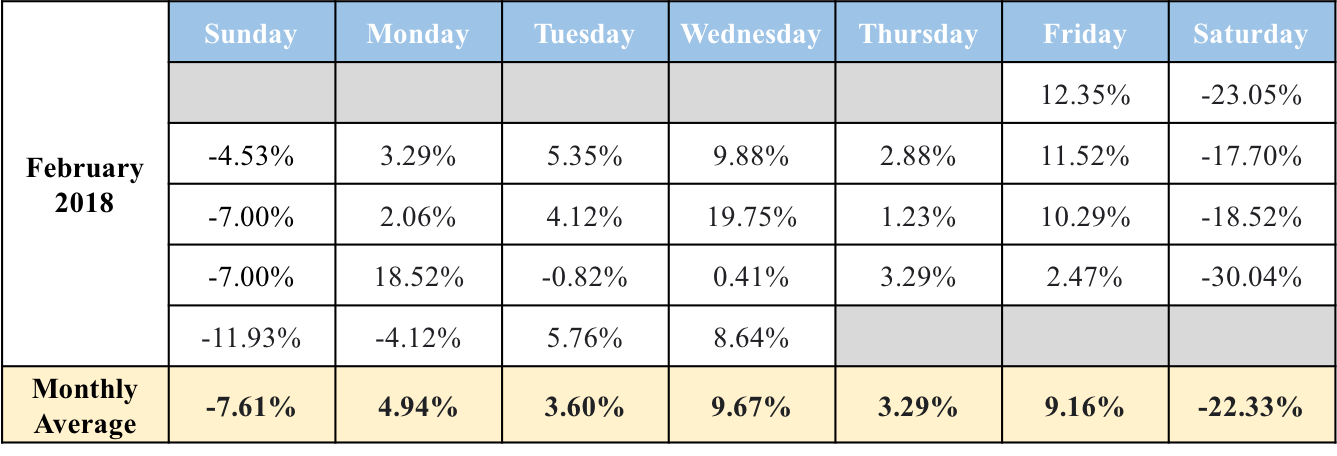
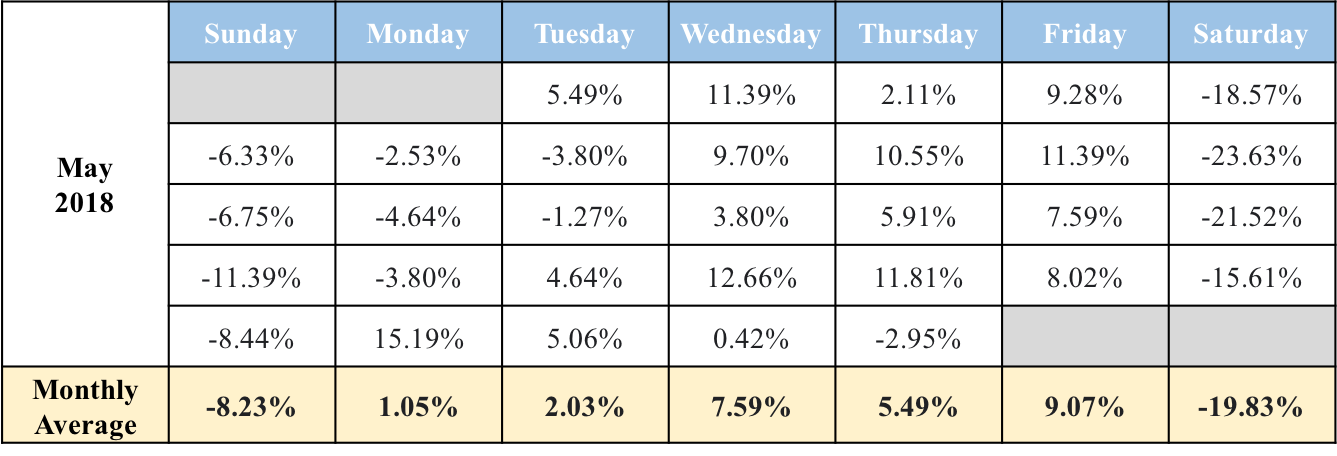
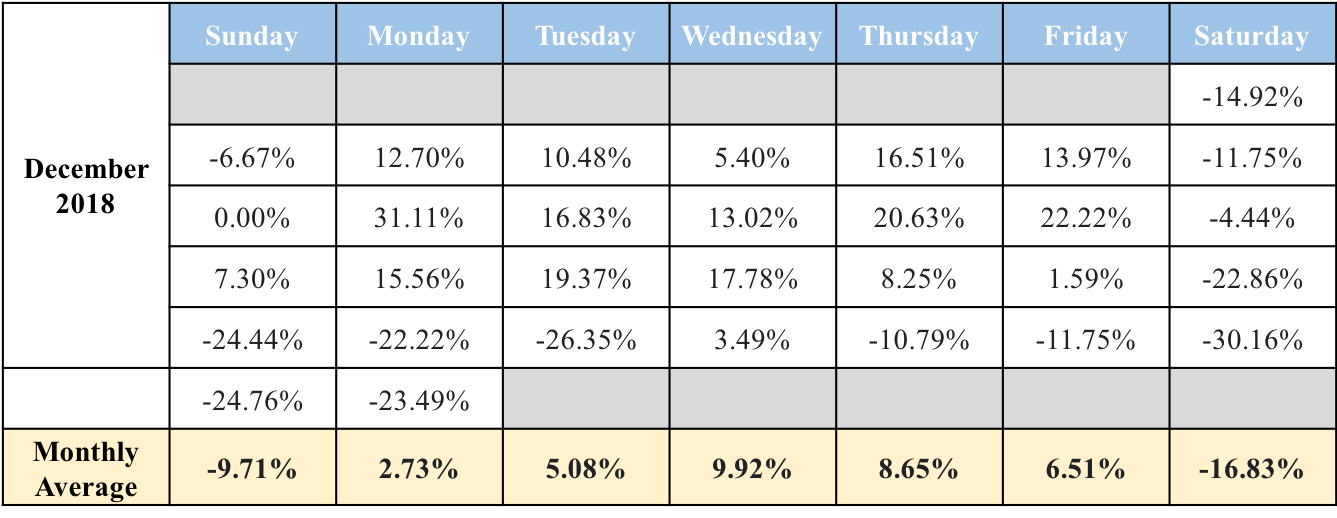
This monthly and daily breakdown is based on monthly results. The lifts and declines are based on the average number of sends for that day compared to the average number of emails send that month.
In this example, January’s highest send patterns are slightly different than the daily sends for the entire year. You’ll continue to see these daily shifts throughout the year.





Five Often-Overlooked Holiday Email Marketing Tips
As the holidays approach email marketing teams are busy determining promotional schedules, designing messages, and inputting coupon codes into their e-commerce platforms among a slew of other items. With all of this work happening behind the scenes, there are a few holiday items that all-too-commonly fall by the wayside. When preparing your email marketing program for the season, don’t overlook some of the items that can help you deliver a better customer experience and generate more sales. Here are five items to not overlook this holiday season.
As the holidays approach, email marketing teams are busy determining promotional schedules, designing messages, and inputting coupon codes into their e-commerce platforms, among a slew of other items. With all of this work happening behind the scenes, there are a few holiday items that all too commonly fall by the wayside. When preparing your email marketing program for the season, don’t overlook some of the items that can help you deliver a better customer experience and generate more sales. Here are five items not to overlook this holiday season.
1. Optimize transactional messages
Messages like order and shipping confirmation messages are some of the most read email messages. At a minimum, be sure these messages are branded, aesthetically appealing, and have clear and obvious customer service information. To make these messages do more for you, include other elements, such as product recommendations, suggested upsells or cross-sells, sister brand promotions, a customer-only promotion, and a callout to subscribe to your email marketing program. Remember, all customers receive these messages, not just email subscribers.
2. Audit lifecycle messages
Consider your current lifecycle messages, their automation rules, and how they impact the customer experience during the holidays. For instance, let’s say your welcome series spans four days and withholds new subscribers from receiving promotional emails. Do you really want to withhold new subscribers from marketing emails on Black Friday or Cyber Monday?
You may want to make adjustments to the series, which could include:
Sending only the welcome message and suspending the series.
Create a new welcome series that reinforces holiday content, such as gift guides, hot products of the season, extended return policies, BOPIS services, or other value-adds.
Continue to send the welcome series, but allow subscribers to receive promotional messages.
This is just one example. Look at your other automated messages. Do you have a purchase anniversary message sent each year on Black Friday, offering a worse incentive than your Black Friday promotion? I receive one of these each year, and it provides no value to me as a subscriber. Do you need to adjust the timing, number of, or discounts with your abandoned cart messages? Remember, automated messages should never be considered “set it and forget it.”
3. Audit forms
You are going to receive increased traffic during the holidays, so be sure to audit each of your forms to ensure they work properly. These include embedded email subscription forms, pop-up signups, manage preference pages, and unsubscribe forms.
To audit the forms, go through the process of accessing the form like a web visitor, email subscriber or customer would. Do they display (and not display) as they should, do they close properly, are the landing pages correct, and do the desired actions (e.g., list assignment) function appropriately? You want to ensure the forms are not only functioning properly, but they are also assigning contacts to the correct lists.
When you are auditing your forms, don’t forget to test on mobile devices. Last year, for the first time, more than half of all retailer web traffic during the holidays was from smartphones. Ensure you test the forms not only on a laptop but also on smartphones.
Be sure to document where each of these forms lives on the backend, which employees have access to them, and how customers access the forms. This will give you the ability to quickly identify and resolve any issues that might arise during the season.
4. Preach your differentiators
During the holiday season, why should someone choose to shop with you and not someone else, especially seeing as many retailers are matching deep discounts with one another? You need to give consumers a reason to choose you by preaching your competitive differentiators. Some of these customer-first differentiators include free shipping, free returns, extended return policies, price matching, satisfaction guarantees, and buy online, pick up in-store (BOPIS).
Prominently advertise these value-adds with banners or dedicated sections of your email, on your websit,e and your social pages. And when it comes to email, prominently showcase these in high-consideration messages, such as welcome, abandoned cart, and browse recovery messaging.
By focusing on what the customer wants and how you, as a brand, can deliver that can mean the difference between securing a holiday sale or losing it to your competitor.
5. Plan for the unexpected
Things rarely go as planned, and good email marketers prepare for those times. When it comes to the holiday season, there are a few specific ways to prepare for those “what if” moments, whether that be a slow website, lagging sales, or errant promo code.
Prepare back-up promotions: Projections are just that, projections. If you find your sales through the season are lagging, sending another promotion can help jump-start those orders coming in. Create emails that utilize alternate incentives (such as tiered discounts, or free shipping with no minimums) or tried-and-true discounts that you know will resonate with your customers. By preparing these promotions in advance, you will prevent those last-minute scrambles and rush errors from your creative team.
Promo codes: Set any promo code you plan on using in your e-commerce platform before you need it. While you may not need to use some of the alternate or extra promotional codes, it provides the ability to easily deploy email campaigns as needed.
“Oops” message: Websites and e-commerce platforms have become more reliable, but there is still one of those “oops” moments each year. Some of these include a slow or crashed website, a wrong promo code, and order processing errors. Creating an anticipatory email ahead of those moments will allow you to send a correction email as soon as possible. When errors like this occur, every second can cost you a sale.
Planning for the holidays means more than just creating a few emails and sending them off to your subscribers. It is ensuring all aspects of your program is optimized, and you are prepared for every scenario. Making sure every “I” is dotted, and every “t” is crossed means you are doing everything you can to maximize your holiday sales.
How to Use Social Proof in Email and on Your E-commerce Site
Using social proof, a type of conformity where one person copies the action of another, as a part of the on-site e-commerce experience can be an effective strategy for increasing sales. A social proof strategy is essentially influencer marketing, except the focus is on real customers.
Luckily for companies — especially online retailers — they already possess a lot of content that can be used for social proof. Here are a few ways retailers can utilize this content in their email marketing programs and on their e-commerce site to influence purchases.
Using social proof, a type of conformity where one person copies the action of another, as a part of the on-site e-commerce experience can be an effective strategy for increasing sales. A social proof strategy is essentially influencer marketing, except the focus is on real customers.
Luckily for companies — especially online retailers — they already possess a lot of content that can be used for social proof. Here are a few ways retailers can utilize this content in their email marketing programs and on their e-commerce site to influence purchases.
In these two articles, I write about ways to use social proof in both email marketing and on your website, and cover topics such as:
How to Use Product Reviews in Email Marketing
How to Use Social Media in Email Marketing
How to Use Your Employees in Email Marketing
Using product reviews, website Q&A sections, and employee picks on your e-commerce site
Using social proof in other channels
READ ABOUT USING SOCIAL PROOF IN EMAIL MARKETING
READ ABOUT USING SOCIAL PROOF ON YOUR WEBSITE
Crafting A More Robust Cart Recovery Strategy
ommon industry statistics indicate that more than 70% of all online shopping carts are abandoned. Yet retailers generally treat all shoppers who abandon carts the same, regardless of what items they were shopping for. While this one-size-fits-all approach may work for many, it doesn’t work for everyone. The reasons for abandoning a cart tend to vary based on cart total, and the needs of the shopper also tend to change as the cost increases. So, using a blanket approach for cart recovery emails is likely costing retailers valuable sales.
Common industry statistics indicate that more than 70% of all online shopping carts are abandoned. Yet retailers generally treat all shoppers who abandon carts the same, regardless of what items they were shopping for. While this one-size-fits-all approach may work for many, it doesn’t work for everyone. The reasons for abandoning a cart tend to vary based on cart total, and the needs of the shopper also tend to change as the cost increases. So, using a blanket approach for cart recovery emails is likely costing retailers valuable sales.
Here’s an example: I was recently in the market for a dishwasher and began by shopping online. I browsed via laptop and smartphone, read reviews, carted (and abandoned) products, and viewed products in stores. In the midst of my journey, I started receiving abandoned cart emails. What stood out to me is that they were not at all helpful. As close as I was to making a purchase, none of these messages helped convince me to do so. They failed.
Failure to Launch
These messages failed because they did not consider the buyer’s motivation and obstacles to conversion. Someone shopping for a $30 item likely has different needs and hesitations than someone considering a $700 item. Higher priced items typically generate more comparison shopping and a longer buying cycle, and they might need services attached to their purchase, such as delivery, installation and haul-away. For consumers that have filled a cart with items that equal a high-dollar figure, there often comes the natural hesitation of, “Do I really need all of this?”
Knowing Your Buyer
Consider these two cart recovery emails. They were sent from the same retailer, but the price points of the abandoned products are vastly different.
The abandoned products should have determined not only the main messaging but also the recommendations inside the emails. The free shipping callout in the example with the $30 EarPods works well, as my cart total is less than the required threshold. However, the recommended products feature items that cost hundreds to thousands of dollars. These recommendations simply don’t make sense.
In the dishwasher example, however, the prominently displayed free shipping callout is not appropriate for this message. And while the recommendations are more in line with what I am actually shopping for, they don’t help convert me on the dishwasher purchase.
And in both cases, the main messaging tells me they can help, but they fail to mention exactly how. What’s my next step?
This is just one retailer of many whose messaging strategy could use refining. Had any of these companies considered the product I was shopping for or my cart total, they may have directly addressed the obstacles that caused me to abandon my purchase in the first place. In the case of the Earpods, give me some logical product recommendations to bump me over the free shipping threshold. With the dishwasher, include information about how their staff could help me decide on the perfect model, or give me more information on their haul-away and installation services. Without meaningful supporting content, the brand turned these highly relevant messages into something that was mostly useless.
Optimizing Your Cart Recovery Strategy
Abandoned cart messaging should be used to remove conversion obstacles and encourage the customer to purchase. By factoring in details such as cart total, carted items, and their categories and/or the number of items in the cart, you can begin to customize messaging that better targets the individual shopper. Your messaging can reinforce appropriate value-adds, such as free shipping or links to resources, that can be used to determine how many messages should be sent, the timing of those message,s and if or when an incentive should be included.
Retailers today should be focused on providing the right kind of messaging based on the kinds of products left in the cart. For smaller items, the options are simpler – recommendations to help reach a free shipping threshold or maybe even a discount. For larger, non-impulse purchases, focus on information that encourages shoppers to choose your store over the competitors. By overcoming obstacles and encouraging purchases at this final stage of the online checkout process, you can take the most effective approach to recovering those abandoned carts and converting the shoppers behind them.
This was originally published on Multichannel Merchant.
How to Give Your Lifecycle Messages a Holiday Refresh
With the holiday season comes a natural increase in the number of lifecycle messages sent. Think about it. More site visitors lead to more email sign-ups, which trigger more welcome series sends. An increase in shoppers means an increase in browse and cart recovery messaging and post-purchase emails for those holiday buyers. And all of these messages affect the overall user experience.
With the holiday season comes a natural increase in the number of lifecycle messages sent. Think about it. More site visitors lead to more email sign-ups, which trigger more welcome series sends. An increase in shoppers means an increase in browse and cart recovery messaging and post-purchase emails for those holiday buyers. And all of these messages affect the overall user experience.
Have you reviewed your lifecycle messaging lately? What's the current experience like for your customers? It’s important to analyze it, particularly during the time of year when consumers will likely be browsing and buying more.
Here are three lifecycle series that are often significantly affected by the holidays and some suggestions for adjusting them for the busy shopping season.
1. Welcome Series
Consider shortening the time between messages. During this time of year, consumers have so much information readily available to them, and they tend to make purchase decisions quicker. Combine this with a natural increase in promotional send cadence, and you may want to shift your messages from every three days to every one or two.
Include a top gifts section or stand-alone message. Why not speak to what many customers, especially new subscribers, may be looking for during the holidays? Rather than showing generic content, provide some simple gifting recommendations by category or price point.
Shift your sign-up incentive. Instead of offering a blanket 10% discount for signing up (especially if this pales in comparison to your standard holiday discount), be creative and offer a better deal to customers. With the rise in self-gifting, consider a tiered discount that rewards the subscriber with a larger discount the more they spend. This allows them to purchase for themselves as well as others. You might also consider offering a free gift or gift card with purchase.
To be more daring, you could eliminate the series altogether, after the initial welcome, of course. This is not a tactic I would personally consider, as building brand value is especially important nowadays. However, this might be something to think about during the final push when you want to be sure your new subscribers receive the last round of great deals before the end of the season.
2. Cart Recovery
Think about timing. At this time of year, consumers may be making purchases quicker than usual. Look at the current gap between messages, and see if an adjustment makes sense. Moving your third message from four days to three may be just enough to recapture some lingering shoppers.
Consider testing promotions. Since we know consumers are buying for themselves as much as others, incorporate a tiered discount or free gift into the cart recovery message in an attempt to increase the purchase amount. You can even test discounting across several messages in the series, with an increase in the offer as you go. This allows the consumer to receive an incentive earlier, but still leaves you some room to offer your traditional discount.
Add more messages. That’s right! You're not limited to just three messages. Add a fourth or even fifth message to your series. Combining this with the other strategies above can give you even more options. Then you can shorten your window between messages, while still using your larger discount later in the series. You can also use a variation of discounts as you go to determine which one your audience responds to best.
3. Post-Purchase
As more people qualify to receive the post-purchase series, consider customizing it to speak to the seasonal purchaser.
Reconsider product review emails. These could be a waste at this time of year. It will likely vary based on the products you sell, but if people are buying for a gift, asking them to review the product is quite irrelevant. Consider sending these messages to those who purchase in November but suppressing those who purchase in December.
Highlight your extended return policy. If you offer one, share this everywhere you can. It’s not only a great value-add that can help drive the sale, but it’s also an excellent relationship-building tool once you complete the sale. Just think of the great impression you could leave with buyers from such a customer-centric policy.
Promote your gift reminder service. Don’t have one? Create one! One of the major challenges for retailers is getting seasonal shoppers to return. A gift reminder service can allow you to communicate with subscribers throughout the year, and it also puts your brand in consideration as a gift-searching destination.
Create a unique series for first-time buyers. This focused series can call out the fact that you do make a great gifting destination while focusing on your value-adds and recommending ways they can get the most from their purchase (e.g. resource centers, return policies). How you engage with the customer at this point may make all the difference between having a one-time purchaser or a loyal shopper.
Keeping the customer experience in mind during this time of year is critical. Review your lifecycle messages, and look for ways to make the user experience even better.
Hopefully, your adjusted strategy will not only help you increase sales around the holidays but all year round as well.
5 Ways to Prepare for the Holiday Season
You’ve likely got a list of to-dos longer than a kid’s wish list for Santa. And with the hustle of the season, it’s easy for some tasks to fall by the wayside, which could result in a poor customer experience or first impression, lost sales, or even an under-performing holiday season. Don’t let this happen to you. Here are five essential tasks that should be on every commerce marketer’s holiday preparation list.
You’ve likely got a list of to-dos longer than a kid’s wish list for Santa. And with the hustle of the season, it’s easy for some tasks to fall by the wayside, which could result in a poor customer experience or first impression, lost sales, or even an under-performing holiday season. Don’t let this happen to you. Here are five essential tasks that should be on every commerce marketer’s holiday preparation list.
#1: Audit Your Forms
During the holidays, you’re likely to get a lot of new visitors, so be sure that the forms that help turn these visitors into subscribers are ready to go. And once they subscribe, they need to be able to access the manage preference form, especially if your welcome series directs them there.
A couple of questions for your team:
Where do the forms live?
Who can edit them?
How does a customer reach them?
Are they optimized for mobile?
Are subscribers being assigned to the correct lists?
Are the forms generally working as intended?
I recommend documenting each form and sharing with your team. If something breaks during the height of the holiday season, you must be able to fix it as quickly as possible without having to ask a lot of questions. This documentation will also allow you to easily add more forms over time without confusing how that form may affect other processes already in place.
#2: Evaluate Your Content
At this time of year, consumers will be inundated with emails, so be sure your current email content is optimized for the busy season. Some items to review include:
Scanability: Can people quickly digest the email and find the call to action (CTA)?
Responsive Design: Are your emails mobile-friendly? If not, make them so!
Send From Name Consistency: Is your company’s brand uniformly expressed across all messages (triggered and scheduled)?
Preheader Text: Are you using it effectively and supporting the subject line (not repeating it)?
Calls to Action: For emails that features several pieces of content, are the CTAs easily identifiable?
Social CTAs: How prominent are they, and do they detract from the conversion CTAs? Are you clear about what you’re asking customers to do?
While these suggestions also apply to transactional messages, consider a few other things as well. For instance, are you using the promotional space wisely too, for instance, suggest stocking stuffers or other seasonal items? And don’t forget to highlight extended return policies and other holiday specific value-adds.
#3: Analyze Last Year’s Plan
Hopefully, you’ve already looked at last year’s plan. If you haven’t, here are some items to pay special attention to:
Your High Priority Campaigns: Why were they must-haves? Did these campaigns perform as expected? If they didn’t, can you tell why?
The Poor Performing Campaigns: Why did some campaigns fail? Was it due to timing of the send, or has that particular promo jumped the shark (or reindeer in this case) with your audience? Should you repeat it this year with a new spin?
The Sending Cadence: Did you send more emails than anticipated? If so, why? Was it because a campaign was not delivering expected results and you needed additional sends to make up for it? Did you notice your competitors sending much more than you expected, causing you to match them for fear of losing out on revenue? How were unsubscribe rates with the increase in sends? What type of emails were added (i.e. types of discounts/free gifts, length of promo)?
#4: Plan for All Scenarios
Stuff happens. The Internet says so, so it must be true! In your planning, especially after looking at the items above, you should be prepared for all “oh no” scenarios. Get ready with:
Back-up promotions: Remember last year when your plan went off the rails thanks to an underperforming campaign? Be prepared! Create extra promotions with different offers (tiered discount, dollar vs. percentage, free shipping) or additional free gifts to include. A great place to start is with your key campaigns for this season. Prepare the content in advance, build the email and have it ready to deploy at a moment’s notice.
Don’t forget: Set your promo codes up in advance as well! If you never need them, great. But it will be one less step to perform if you’re in reactionary mode.
An answer to your “Oops” moment: Anticipate that Steve Urkel moment. Create “oops” messages covering the most common issues well in advance. You can even leave an editable space that allows you to either provide more clarity or customize a promo code. Some of the most common reasons for sending an oops email? A non-functioning promo code, a website that’s slow or completely down, promotion of the wrong incentive, and broken links.
But be sure the error warrants sending a message. If there’s a typo in the subject line, you probably don’t need to address it. If the subject line advertises a 50% off sale when it should have been $50 off, you’ll probably want to do something about it.
#5: Evaluate Your Season
Yes, you read this right! Once the season is complete, you should immediately evaluate the season. You can analyze better when the work is fresh in your mind. Nine months from now, you may not remember that the reason a key campaign underperformed was because of an error or a send time glitch. It also protects you if a key team member involved with the planning leaves during the year. Analyzing the season immediately gives you the best view of the current season and the information you need to accurately determine must-haves for next year. When planning time rolls around, compare these seasonal results with trends you have seen develop over the past year and determine whether a pivot needs to be made.
Final Thoughts
While this is not an all-inclusive list for holiday planning, it should at least get you thinking. By executing these ideas, you’ll be better prepared to deliver a smooth customer experience, react at a moment’s notice, and plan for the following year. If nothing else, knowing you’re prepared may help you sleep better at night, like a warm glass of milk. Just be sure it’s not the “big guy’s” milk.
This was originally published on Multichannel Merchant.
Why Post-Purchase Email Marketing Is So Important
Imagine walking into a car dealership. You browse the cars on the lot, exchange info with the salesperson and then leave without buying. You then drive down the road to another dealership and repeat the process, but this time, you actually purchase the car on the spot. The next morning you wake up to two emails in your inbox, one from each salesperson. How would you feel if the messages were identical? Would you feel truly valued as a customer? Wouldn’t you prefer to receive something a bit more personalized?
Imagine walking into a car dealership. You browse the cars on the lot, exchange info with the salesperson and then leave without buying. You then drive down the road to another dealership and repeat the process, but this time, you actually purchase the car on the spot. The next morning you wake up to two emails in your inbox, one from each salesperson. How would you feel if the messages were identical? Would you feel truly valued as a customer? Wouldn’t you prefer to receive something a bit more personalized?
Customers face this scenario on a daily basis. Many retailers don’t craft specific messages specifically for recent purchasers, or they fail to suppress them from receiving promotional messages after a purchase. But this post-purchase period is a time when consumers are likely to be most receptive to your messaging. So why waste this opportunity by sending the same standard messages? Instead, take the time to consider what the customer might want or need after the purchase and craft your messages accordingly.
When commerce marketers hear post-purchase, they immediately think of order and shipping confirmations, and product review messages. While these messages are OK, and in some cases necessary, I am talking about a different way to engage a customer – providing value, offering help, introducing resources, or asking to continue the conversation.
Getting Started
A post-purchase message sent 3-5 days after purchase, simply thanking the customer, is a great way to start. I’ve found these to be some of the best-performing messages from a revenue standpoint. The beauty of the message is its simplicity. It thanks the customer for the recent order and either incentivizes them to make another purchase or provides a customer service-oriented call to action (CTA), such as linking to your customer service portal or a resource center.
If the message is incentivized, you can always create a second, non-incentivized version that sends if the contact makes another purchase over the next set number of days. Using this approach keeps the customer from expecting an incentive every time, although some retailers are fine with this approach as long as it drives revenue.
Creating a Series
Subsequent messages can have a variety of themes, but each one should be used to convey some sort of value proposition, such as:
Product care/tips and tricks.
How-to resources.
Customer service info/guarantees.
Product recommendations or cross-selling opportunities.
Social invites or crowdsourcing (Share a photo with us!).
Manage preference request.
Product reviews.
Reorder reminders.
Gift-giving or date reminder requests.
Refer-a-friend invitations.
Social Engagement
While we talk about retailers enhancing the customer experience, it can be difficult to implement in an online world. However, social media is the great equalizer in that respect. It allows retailers to humanize their brands and actually create a dialogue with purchasers. Consider implementing socially-themed messages into your post-purchase messaging, such as:
Crowdsourcing/Share with us (e.g., Selfie submissions).
Social site introduction.
Facebook review requests.
User-generated content (UGC) contests based on products purchased (e.g., Post a photo wearing your new socks with our hashtag for a chance to win!).
Loyalty Programs
If you have a loyalty program, talk about it. Include loyalty points in each of your emails, or use specific messaging to ask people to sign up for the program. If your program is spend-based, consider messaging that introduces these tiers and triggers messages when contacts are close to reaching the next level. You can even include specific product recommendations to encourage the next purchase.
Balance Your Messages
When constructing your post-purchase messaging, be sure to balance promotional content that encourages another purchase with other useful content that offers value to the customer. For instance, product care tips and additional resources benefit the customer, whereas cross-sell and reorder reminder messages benefit you. Remember: If all of your messages ask customers to purchase from you, you’re not really providing that value to the subscriber. But if every message only benefits the consumer, you’re likely leaving money on the table. Aim for a 50/50 or 60/40 consumer-to-company ratio, so you both have something to gain in the process.
Complete the Experience
As mentioned earlier, while a customer is receiving this series of messages, it’s best to suppress them from your standard promotional messages. This way, you can control the purchase experience for the customer and ensure they receive messages relevant to them at that time. Since some of your post-purchase messaging will be promotional, you’ll still have opportunities to increase sales. Just keep in mind that if you’ve scheduled a product review message to send 45 days after a purchase, and your post-purchase series ends after 10 days, you don’t necessarily have to prevent the customer from receiving promotional messages after the 10-day mark. Just don’t overwhelm your subscribers. Use your best judgment.
Customer loyalty is no longer assumed; it must be earned. Consumers now view their interaction with a brand as part of an overall experience and expect relevant communications, which is why targeted post-purchase messaging is not only successful in driving revenue but is an essential component in creating customer loyalty.
This was originally published on Multichannel Merchant.