Featured Post: My Reading & Podcast List
Here are recent books I’ve read and podcasts I enjoy. If you’re looking for something interesting to listen to or read, these are a few that have stood out to me. Let me know if you have a recommendations.
Holiday 2025 Shopper Mindset: What Marketers Need to Know
Shoppers are still buying this holiday season, but they’re taking a more careful, value-driven approach. Greg Zakowicz shares a few observations from his MarTech Cube guest article on how shopper behavior is shifting and what it means for marketers heading into the holidays.
Holiday Shopping 2025: What Marketers Need to Know
The holiday season always brings surprises, but this year feels different. Shoppers are still buying, but they’re doing it with more intention. Prices remain high, budgets are tighter, and people are weighing decisions a bit longer than they used to.
I recently wrote a guest post for MarTech Cube, digging into this shift in shopper mindset. Here’s a quick look at what stood out.
Shoppers Are More Careful With Their Money
People haven’t stopped spending, but they’re more cautious. They’re sticking to budgets, comparing more, and thinking harder before committing.
For brands, that means your value story has to be clear. Customers want to know why your product is worth it, not just that it’s on sale.
Promotions Still Matter but Not in the Same Way
Holiday discounts will always grab attention, but blanket markdowns aren’t the only way to win.
Smarter incentives like early access, bundles, or tiered offers tend to resonate more with today’s value-focused shopper. It’s less about racing to the bottom and more about showing that your promotion actually makes sense.
Convenience Goes a Long Way
The easier you make the purchase experience, the better. Clear delivery timelines, smooth returns, and straightforward policies all influence buying decisions. These aren’t “extras” anymore — they’re part of what shoppers expect.
Email and SMS Still Deliver
Despite all the noise in the market, lifecycle messaging remains reliable. Email and SMS continue to drive strong results during peak shopping periods.
Well-timed sends and solid automation, such as cart abandonment messages, back-in-stock alerts, and post-purchase series, matter. a lot.
Read the Full Article
You can read the complete post on MarTech Cube here:
»» Holiday 2025: What Marketers Need to Know About Shoppers’ New Mindset
47 Ways to Prepare Your Email Marketing and Ecommerce Store For The 2020 Holiday Season
The holiday shopping season is fast approaching there is a lot of uncertainty about what will unfold. Questions surrounding the health of the economy and what a resurgence of COVID-19 might have on the supply chain make planning for this holiday season unique. Here are 47 ways you can prepare your marketing program and e-commerce store for the holiday shopping season.
The holiday shopping season is fast approaching there is a lot of uncertainty about what will unfold. Questions surrounding the health of the economy and what a resurgence of COVID-19 might have on the supply chain make planning for this holiday season unique.
One thing I do expect from this season is for ecommerce to further increase its already-increased share of retail sales. We saw email become a go-to channel for consumers during the COVID pandemic with a nearly 23% lift in conversion rates, and I expect this to carry over into the holidays. If you are an email marketer, here are 47 ways you can prepare your marketing program and ecommerce store for the holiday shopping season.
General:
- Start marketing early — e.g., late October
- Pay attention to the Cyber 10
- Pay close attention to the feel of the nation (COVID, economy) and adjust your marketing copy accordingly
- Don’t wait until Black Friday to start marketing—again, start early
Technical Prep:
- Collect SMS numbers along with email addresses—grow your trusted marketing channels
- Audit website forms (e.g., sign-up, exit-intent)—how to edit them and who has access to do so
- Test sign-up forms and ensure they work properly
Email Design:
- Use emojis in subject lines
- Use emojis in the preheader text
- Make your emails mobile-friendly
- Include a “top gifts” or similar section in your nav bar
- Create a custom, holiday-themed header
- Keep the CTA obvious in emails (let people digest the message quickly)
- Make sale exclusions obvious—avoid misleading people and frustrating them at checkout
- Acknowledge that self-gifting is real and design your messaging to account for it
Promotional Marketing Messages:
- Promote value-adds/differentiators in your emails (e.g., extended return policies, always free shipping)
- Use remails—but not every time (think about when it makes sense)
- Send multiple emails on peak days (Thanksgiving Day, Back Friday, Cyber Monday)
- Utilize SMS marketing, both as a stand-alone channel and to complement email
- Utilize a sense of urgency (subject lines, CTA, copywriting)
- Use product recommendations in your emails (for self-gifting, of course)
Automated Email Marketing Messages:
- Adjust workflow timing (are you suppressing new signups from Black Friday emails?)
Welcome series
Cart abandonment
Lapsed-purchaser
Product review emails - Create seasonal automated messages (e.g., holiday-specific welcome series)
- Optimize your transactional messages for sales (shipping and order confirmation)
- Adjust abandoned cart timing rules
- Increase the number of abandoned cart messages
- Adjust the discounting strategy in your cart abandonment messages (is the discount worse than your holiday everyday promotion?)
- Use browse/product abandonment messages—please, use them!
- Integrate SMS messages into your email automation workflows, especially cart abandonment
Paid Search/Social:
- Monitor your ROAS
- Retarget email contacts on social and paid search
- Test different/new social channels and search engines (e.g., Bing, Pinterest, YouTube)
- Use influencers
Customer Service:
- Implement live chat on your website
- Extend your return policies
- Solidify your BOPIS strategy/expand BOPIS offerings
- Collect info for gift-reminder messaging
Discounts/Benefits:
- Test different incentives (% off, & off, tiered discounts, deals of the day, X days of deals, flash sales, free shipping, free express shipping, VIP-only, SMS-only, email-only, for BOPIS-only orders, etc.)
- Understand that free shipping has increasingly being used as THE incentive as the season winds down. Test it and save yourself some margin.
- Make a holiday playlist on Spotify (for both your customers and employees)
- Offer free gift wrapping
Prepare for the Unexpected:
- Prepare an “oops” email in advance
- Have backup promotions and coupon codes already created and loaded in your ecomm platform
- Identify potential shipping challenges and have a contingency plan in place
- Identify possible supply chain chokepoints and prepare for the “what if”
- Prepare for a pandemic resurgence — and what that measns for your business
Finally:
- Have fun and enjoy the season!
If you have any specific questions around the holiday season, please feel free to contact me!
And, of course, some of these tips from 2019 may still be useful, so check out this post, “Top Holiday Email Marketing Planning Resources”
2019 Email and E-commerce Holiday Season Recap
The 2019 holiday season has concluded, and once again ecommerce experienced record-breaking sales. This online holiday season registered just above $142 billion in online sales, a 13% increase from last year, according to Adobe Analytics.
But what made the 2019 holiday season so successful, and which trends have become the new normal? In this recap I’ll discuss the Cyber Five, the Cyber Ten, smartphone growth, the value of email marketing, daily sales benchmarks and more.
The 2019 holiday season has concluded, and once again ecommerce experienced record-breaking sales. This online holiday season registered just above $142 billion in online sales, a 13% increase from last year, according to Adobe Analytics.
But what made the 2019 holiday season so successful, and which trends have become the new normal? In this recap I’ll discuss:
The Subtle Nuances of November
The Cyber Five expanding into the Cyber Ten
The new daily online sales benchmark to be aware of
The growth in smartphones
Why email marketing is so important during the holidays
Top takeaways and how to use them
Click here to continue reading “2019 Holiday Season Takeaways and Ecommerce Marketing Action Items”
The Best Day to Send Your Marketing Emails
Which days are best for sending marketing emails and which days are most popular for retailers? Should you send on the same high-volume days as other retailers, or send on lower-volume days so you can more easily stand out in the inbox?
Now, you may finally have an answer.
I am signed up for hundreds of retailer email programs and monitor my inbox for daily send volume. While each retailer will have their own unique requirements, here are some tools you can use to help you determine which days might be best to send your marketing emails.

2019 Email Marketing Sends
2019 marketing email send volume broken down by day and month. Check out which days were the most and least popular days to send marketing emails.
2018 Email Marketing Sends
2018 marketing email send volume broken down by day and month. Check out which days were the most and least popular days to send marketing emails.
2019 Email Marketing Sends - By Day and Month
(IN PROGRESS): The chart below reflects the daily email send volume of 2019. The daily lifts and declines reflect the average number of emails retailers sent on that day of the week compared to the overall number of emails sent during the entire year.
For example, retailers sent …
Top Email Send Days of 2019
The chart below reflects the daily email send volume in 2019. The daily lifts and declines reflect the average number of emails retailers sent on that day of the week compared to the overall number of emails sent during the entire year.
For example, retailers sent 8.32% fewer emails on Sundays than the average number of 2019 daily email sends. As you can see, Thursdays was the most popular day for retailers to send marketing emails, followed by Friday and Tuesday.
Weekends were the least popular days to send marketing emails, with Saturday being the day of the week where the fewest emails were sent.
Continue reading to see monthly and daily breakdowns. In 2019, Fridays saw a decrease in email sends while Tuesdays saw an increase compared to 2018. You can view 2018 results here and see how daily send patterns may have changed.

Does this chart tell you that you should avoid sending marketing emails on weekends? Absolutely not. Again, each business will have their own circumstances. Some retailers might look at this as an opportunity to increase their sends on lower-volume days as a way to stand out in an otherwise crowded inbox. Others may choose to follow the crowd.
Test your email send days, but remember, people do shop on the weekends.
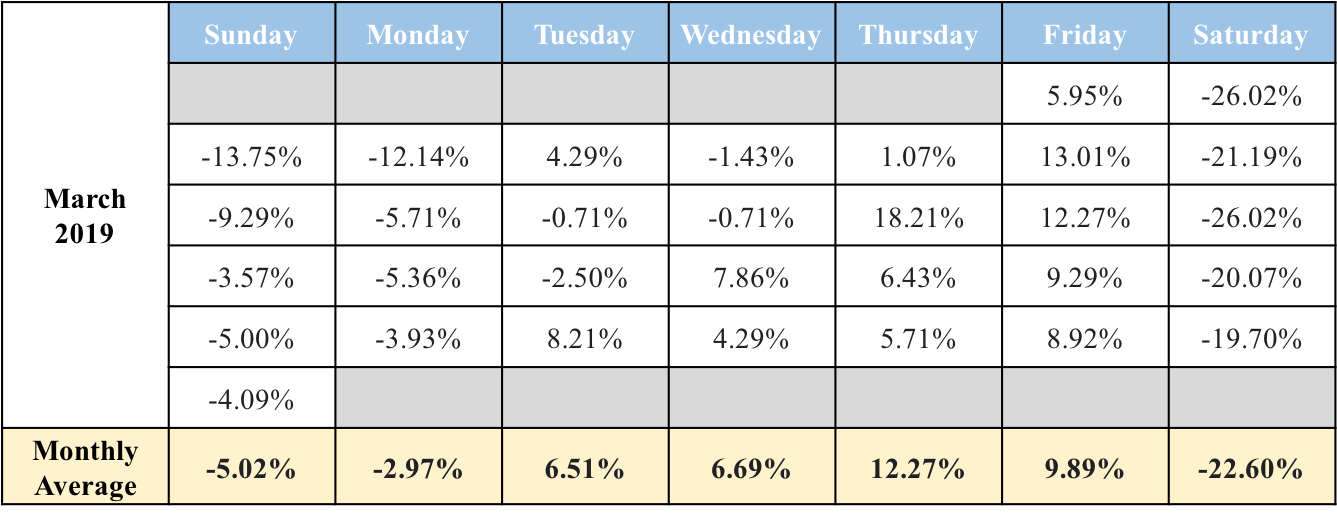
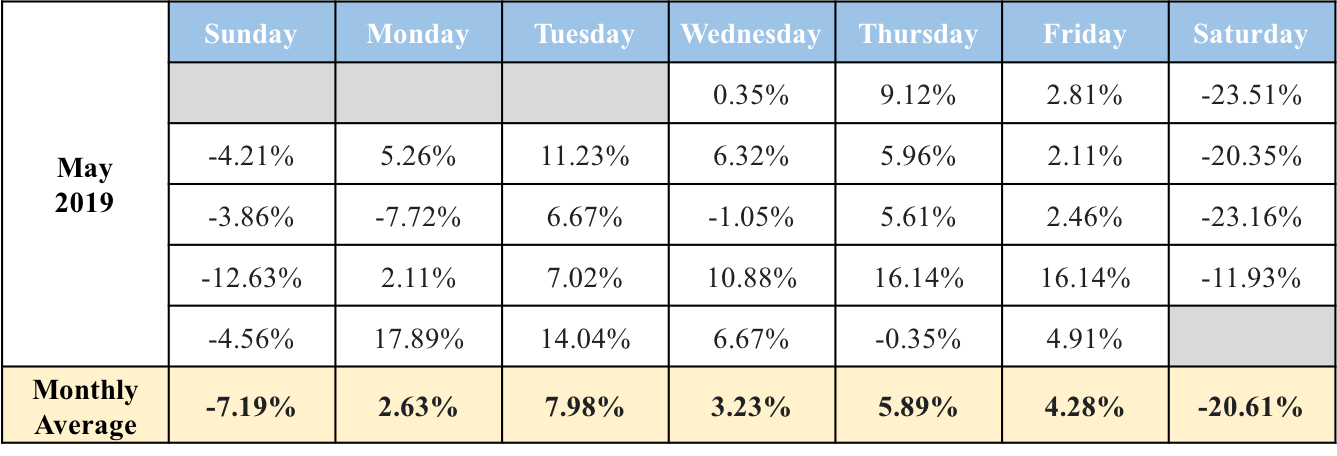
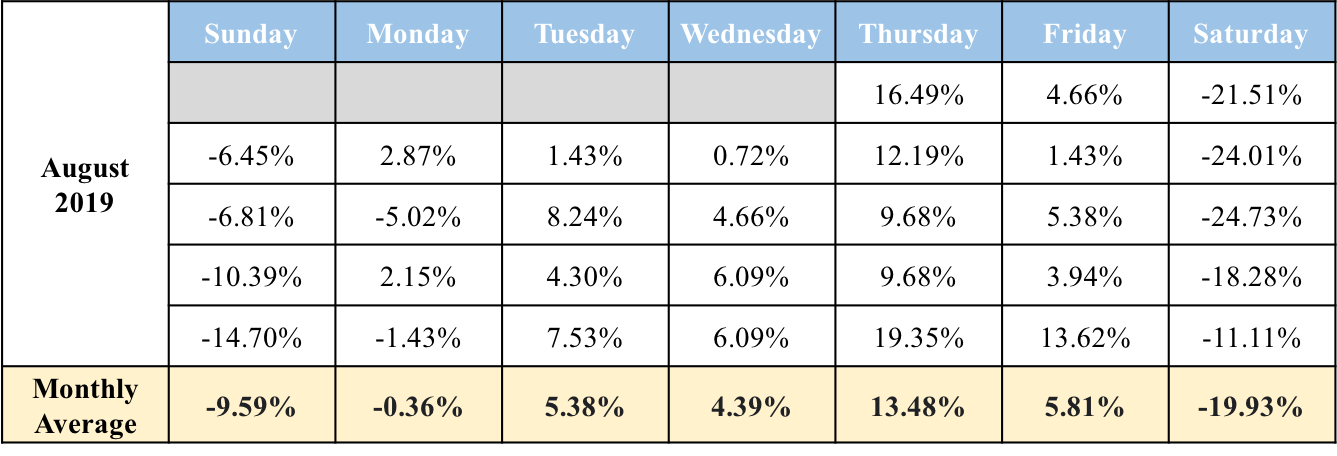
Monthly Email Marketing Sends
This monthly and daily breakdown is based on monthly results. The lifts and declines are based on the average number of sends for that day compared to the average number of emails send that month.
In this example, January’s highest send days are slightly different than the daily sends for the entire year. You’ll continue to see these daily shifts throughout the year.







Using Behavioral Science in Marketing
Stop guessing what makes customers click. In this post, you’ll dive into real-world behavioral science applied in marketing, from headline hooks and social-proof nudges to decision-making shortcuts and conversion strategies. Science meets strategy, ready to plug into your campaigns.
What is Behavioral Science in Marketing?
Behavioral science in marketing focuses on how people think, feel, and make decisions, then applies those insights to influence engagement and conversions. By using cognitive biases, social proof cues, and decision-making shortcuts, marketers can create more persuasive messages and higher-performing campaigns.
Using Behavioral Science in Marketing
If you ask a hundred people what makes a good article headline or email subject line, you may get a hundred different answers. After all, it’s subjective, isn’t it?
Not entirely, as many marketers know. There’s a science behind what makes a consumer open an email, click on a call to action (CTA), and make a purchase. Whether it’s writing an attention-grabbing headline or getting someone to “click and convert,” understanding that people rely on certain decision-making defaults helps marketers nudge them to take a desired action.
In this article, I discuss how to use behavioral science to improve marketing campaigns. Topics include:
Strategies to write effective headlines and subject lines
Using social proof
Content and landing pages
Choosing compelling images
Use of charts and graphs
Principle of authority
The science behind pricing
CTA colors
The science behind “possession” and how it can reduce returns
Tactile experience
CLICK HERE TO CONTINUE READING
3 Holiday Promotions That Keep Subscribers Opening Your Emails
There’s no shortage of promotions retailers can choose when planning their holiday email marketing strategy. However, the holiday season is long, so retailers need to find ways to not only increase sales but also keep subscribers opening their emails.
Here are three kinds of promotions that I expect will be heavily-used by retailers throughout this upcoming holiday season to accomplish these goals.
There’s no shortage of promotions retailers can choose when planning their holiday email marketing strategy. However, the holiday season is long, so retailers need to find ways to not only increase sales but also keep subscribers opening their emails.
Here are three kinds of promotions that I expect will be heavily used by retailers throughout this upcoming holiday season to accomplish these goals.
1. Category and Daily Deals
Category-specific sales, promotions where one category of products is discounted, have been an increasingly popular holiday promotion over the past several years. With Black Friday sales now lasting the entire week for many retailers, category-specific sales are a way to keep the discounts new and exciting, which keeps consumers checking their emails.
If you do plan to offer daily deals, there’s no need to leave them a mystery. Consider letting people know early on which categories will be on sale and when. This approach allows the consumer to better plan their purchases.
Sure, they may want to wait two days to purchase sweaters at an additional discount, but many will want to consolidate purchases, especially if there’s a free shipping threshold they need to reach. Use a sense of urgency in your marketing by reminding people that items may sell out quickly to encourage order consolidation.
Offering daily category sales can also help you plan additional ad campaigns and year-end promotions later in the holidays. By knowing that one category of products didn’t sell as expected, you can begin to offer deeper discounts on these products throughout the season or feature them in year-end closeout promotions.
2. Free Shipping
Free shipping has quickly become a consumer expectation. According to Deloitte, it was the second-most appealing discount to shoppers last holiday season, behind only price discounts.
This likely explains why, according to eMarketer, there was a year-over-year increase in holiday orders that were shipped free, starting with Black Friday week and continuing through Christmas Day.
Last season, there was a noticeable increase in retailers’ advertising free shipping as a primary incentive. Consumers will once again be drawn to free shipping, and you’ll want to be ready to take full advantage of it.
As the season begins to wind down and expedited shipping becomes necessary, consider offering free or upgraded shipping as the primary incentive, not as an add-on to another promotion. You may want to lower or remove the spend threshold to qualify for these offers, as many retailers did last season.
In a lot of cases, you may find consumers spend above the previous threshold as they round out their gift buying. Just be sure to promote free shipping in both the subject line and email body copy.
3. Buy Online Pick Up In-Store (BOPIS) is for everyone
Whether you’re an omnichannel retailer or not, BOPIS affects you. Forty-one percent of consumers used this service last holiday season, and 50% of consumers decided where to shop based on whether BOPIS was a fulfillment option.
If you are an online-only retailer, you need to account for your competition who offer it — and maybe even alter your free shipping strategy to account for it. If you’re a retailer who offers it, you’ll want to use this to your advantage.
According to the NRF, the No. 1 reason consumers chose BOPIS was to avoid paying for shipping. If you’re an omnichannel retailer, promote BOPIS as a stand-alone incentive, potentially offering a discount, gift card or free gift for BOPIS orders.
As the season winds down, focus on those holiday procrastinators by encouraging a sense of urgency and pitting free in-store pickup against costly next-day shipping offered elsewhere.

Source: National Retail Federation, “2018/2019 Winter Consumer View,” Jan, 2019
But this value-add does not have to be saved until the end of the season. Consider giving the service a little customer-friendly pizzazz, such as by offering free gift-wrapping on these orders or in-store coupons at time of pick-up to encourage unplanned purchases, or even by providing complimentary hot chocolate, coffee, tea, and holiday cookies.
If you offer BOPIS, be sure to promote it wherever you can:
In a dedicated section of your emails
Embedded into your primary email creative
Even in lifecycle messages, such as in a welcome series.
And, of course, clearly provide a link to a store locator in your emails, such as in the header or navigation bar.
Wrapping It Up
The holiday season is long, but by planning promotions that can last the whole season and provide competitive differentiation, you can keep subscribers opening your emails and be ready to earn as much of the shoppers’ wallet as possible.
Top Holiday Email Marketing Planning Resources
Email marketers are always looking for holiday-related content, and me — I provide a few pieces this time of year. Between sifting through and analyzing tens-of-thousands of holiday emails in my personal inbox, charting daily emails received, identifying reoccurring themes, looking through the previous years' online sales data, reading industry analysis, interviewing podcast guests, and talking to industry peers, I am left connecting dots with what retailers and email marketers will be promoting this holiday season.
Email marketers are always looking for holiday-related content, and I provide a few pieces this time of year. Between sifting through and analyzing tens of thousands of holiday emails in my personal inbox, charting daily emails received, identifying recurring themes, looking through the previous years' online sales data, reading industry analysis, interviewing podcast guests, and talking to industry peers, I am left connecting dots with what retailers and email marketers will be promoting this holiday season.
As a former email marketing consultant, I know email marketers are always looking for as many actionable holiday resources as they can get. So here you are — a collection of my holiday resources (so far — there's more to come), including articles, podcasts, and webinars, all in one place. I will continue to update this as items become publicly available. I hope you find these to be useful!
2019 Holiday PLANNING RESOURCES:
Cyber 10: The Holiday Shopping Sprint You REALLY Need to Prepare For (article, GrowWire)
3 Holiday Promotions That Keep Subscribers Opening Your Emails (article)
Five Often-Overlooked Holiday Email Marketing Tips (article)
How to Use Free Shipping to Boost the Power of Your Holiday Emails (article, Multichannel Merchant)
Holiday Email Lookbook - 2019 Edition (download)
The Most Important Things to Know About Holiday Email Planning (article, Multichannel Merchant)
Ready, Set, Sell: 7 Tweaks Retailers Can Make Now to Maximize Holiday Profitability (article, Brainyard)
2019 Consumer Insights: 6 Trends Dominating This Year’s Holiday Shopping Season (Whitepaper, Shopkick)
Holiday Webinars:
Holiday Email Marketing Trends, Tips, and Tactics for 2019 (Bronto Marketing Platform)
Call-To-Action! Top 2019 Holiday Email Marketing Trends and Tactics (RetailWire)
Holiday Email Marketing 2019: Trends, Tips and Tactics (Retail Dive)
Holiday Podcast:
The Commerce Marketer Podcast: Ep. 061: Preparing Email Marketing for the Holidays
Listen on: Spotify, Apple Podcasts
2019 HOLIDAY RECAP:
2019 Holiday Season Takeaways and Ecommerce Marketing Action Items
Five Often-Overlooked Holiday Email Marketing Tips
As the holidays approach email marketing teams are busy determining promotional schedules, designing messages, and inputting coupon codes into their e-commerce platforms among a slew of other items. With all of this work happening behind the scenes, there are a few holiday items that all-too-commonly fall by the wayside. When preparing your email marketing program for the season, don’t overlook some of the items that can help you deliver a better customer experience and generate more sales. Here are five items to not overlook this holiday season.
As the holidays approach, email marketing teams are busy determining promotional schedules, designing messages, and inputting coupon codes into their e-commerce platforms, among a slew of other items. With all of this work happening behind the scenes, there are a few holiday items that all too commonly fall by the wayside. When preparing your email marketing program for the season, don’t overlook some of the items that can help you deliver a better customer experience and generate more sales. Here are five items not to overlook this holiday season.
1. Optimize transactional messages
Messages like order and shipping confirmation messages are some of the most read email messages. At a minimum, be sure these messages are branded, aesthetically appealing, and have clear and obvious customer service information. To make these messages do more for you, include other elements, such as product recommendations, suggested upsells or cross-sells, sister brand promotions, a customer-only promotion, and a callout to subscribe to your email marketing program. Remember, all customers receive these messages, not just email subscribers.
2. Audit lifecycle messages
Consider your current lifecycle messages, their automation rules, and how they impact the customer experience during the holidays. For instance, let’s say your welcome series spans four days and withholds new subscribers from receiving promotional emails. Do you really want to withhold new subscribers from marketing emails on Black Friday or Cyber Monday?
You may want to make adjustments to the series, which could include:
Sending only the welcome message and suspending the series.
Create a new welcome series that reinforces holiday content, such as gift guides, hot products of the season, extended return policies, BOPIS services, or other value-adds.
Continue to send the welcome series, but allow subscribers to receive promotional messages.
This is just one example. Look at your other automated messages. Do you have a purchase anniversary message sent each year on Black Friday, offering a worse incentive than your Black Friday promotion? I receive one of these each year, and it provides no value to me as a subscriber. Do you need to adjust the timing, number of, or discounts with your abandoned cart messages? Remember, automated messages should never be considered “set it and forget it.”
3. Audit forms
You are going to receive increased traffic during the holidays, so be sure to audit each of your forms to ensure they work properly. These include embedded email subscription forms, pop-up signups, manage preference pages, and unsubscribe forms.
To audit the forms, go through the process of accessing the form like a web visitor, email subscriber or customer would. Do they display (and not display) as they should, do they close properly, are the landing pages correct, and do the desired actions (e.g., list assignment) function appropriately? You want to ensure the forms are not only functioning properly, but they are also assigning contacts to the correct lists.
When you are auditing your forms, don’t forget to test on mobile devices. Last year, for the first time, more than half of all retailer web traffic during the holidays was from smartphones. Ensure you test the forms not only on a laptop but also on smartphones.
Be sure to document where each of these forms lives on the backend, which employees have access to them, and how customers access the forms. This will give you the ability to quickly identify and resolve any issues that might arise during the season.
4. Preach your differentiators
During the holiday season, why should someone choose to shop with you and not someone else, especially seeing as many retailers are matching deep discounts with one another? You need to give consumers a reason to choose you by preaching your competitive differentiators. Some of these customer-first differentiators include free shipping, free returns, extended return policies, price matching, satisfaction guarantees, and buy online, pick up in-store (BOPIS).
Prominently advertise these value-adds with banners or dedicated sections of your email, on your websit,e and your social pages. And when it comes to email, prominently showcase these in high-consideration messages, such as welcome, abandoned cart, and browse recovery messaging.
By focusing on what the customer wants and how you, as a brand, can deliver that can mean the difference between securing a holiday sale or losing it to your competitor.
5. Plan for the unexpected
Things rarely go as planned, and good email marketers prepare for those times. When it comes to the holiday season, there are a few specific ways to prepare for those “what if” moments, whether that be a slow website, lagging sales, or errant promo code.
Prepare back-up promotions: Projections are just that, projections. If you find your sales through the season are lagging, sending another promotion can help jump-start those orders coming in. Create emails that utilize alternate incentives (such as tiered discounts, or free shipping with no minimums) or tried-and-true discounts that you know will resonate with your customers. By preparing these promotions in advance, you will prevent those last-minute scrambles and rush errors from your creative team.
Promo codes: Set any promo code you plan on using in your e-commerce platform before you need it. While you may not need to use some of the alternate or extra promotional codes, it provides the ability to easily deploy email campaigns as needed.
“Oops” message: Websites and e-commerce platforms have become more reliable, but there is still one of those “oops” moments each year. Some of these include a slow or crashed website, a wrong promo code, and order processing errors. Creating an anticipatory email ahead of those moments will allow you to send a correction email as soon as possible. When errors like this occur, every second can cost you a sale.
Planning for the holidays means more than just creating a few emails and sending them off to your subscribers. It is ensuring all aspects of your program is optimized, and you are prepared for every scenario. Making sure every “I” is dotted, and every “t” is crossed means you are doing everything you can to maximize your holiday sales.
Cyber 10: The Holiday Shopping Sprint You REALLY Need to Prepare For
Most digital marketers have heard of the Cyber Five, the five shopping days from Thanksgiving Day through Cyber Monday. These five days happen to be the top five online sales days for the entire holiday season, accounting for 19% of all online holiday sales.
And now, within Gray November comes another consumer shopping evolution that will become a holiday season norm — the Cyber 10.
The holiday season is upon us, and, once again, it’s expected to set online sales records to the tune of $142 billion, according to eMarketer estimates. As online sales rapidly increase year-over-year, trends evolve and retailers adapt.
Take Gray November, for example. Over the past couple of years, we have seen those signature stand-alone online shopping days like Black Friday and Cyber Monday morph into a month-long series of discounts leading up to those days.
And now, within Gray November comes another consumer shopping evolution that will become a holiday season norm — the Cyber 10.
In this article, I discuss why marketers need to look beyond the Cyber Ten and pay attention to the Cyber Ten. Topics include:
Which days make up the Cyber Ten
Why the Cyber Ten is no longer a trend, but an annual occurrence
Which days in the Cyber Ten are seeing the biggest year-over-year growth
Why Cyber Monday, even with all of the changes, remains king
CLICK HERE TO CONTINUE READING
Key Holiday Trends That Keep on Giving
Commerce marketers seem to start preparing for the holiday season earlier and earlier each year – and with good reason. Consumers now start their holiday shopping earlier than ever. Getting ready for such an early shopping season can come with great challenges, but there’s no need to reinvent the wheel. Take a look at the trends over the past couple of years, especially those from last year, and identify opportunities for success. Here are two of the trends I noticed last year that can help you set the stage for a successful season.
Commerce marketers seem to start preparing for the holiday season earlier and earlier each year – and with good reason. Consumers now start their holiday shopping earlier than ever. Getting ready for such an early shopping season can come with great challenges, but there’s no need to reinvent the wheel. Take a look at the trends over the past couple of years, especially those from last year, and identify opportunities for success. Here are two of the trends I noticed last year that can help you set the stage for a successful season.
Trend 1: Self-Gifting and Discounting
While people are shopping earlier in the season, it’s not necessarily for others. The trend of self-gifting has been increasing over the years for a variety of reasons, including early access to discounts, social influence, the economy, and constant consumer connectivity.
In 2016, 57 of 61 days in November and December generated $1 billion in online sales, including 29 of 30 days in November. To put this into perspective, Cyber Monday 2010 was the only billion-dollar day that season.
Retailers who want to secure sales before their competitors have been offering deeper discounts earlier in the season, which has turned what was once a month leading up to the ever-popular Black Friday and Cyber Monday into Gray November, a month-long discounting period. Now, those two days, while still prominent, are merely a part of it.
Takeaways:
Start your marketing early! Waiting until Black Friday rolls around means you’ll be losing out on sales and leaving money on the table. Consumers will shop early, so plan to start your holiday push in late October or very early November. But just because you start marketing early doesn’t mean you need to run your deepest promotions from the get-go.
If you plan on discounting, start by offering sales and promotions that can help protect margins. Test promotions such as tiered discounts, where you earn a deeper discount by hitting certain spend thresholds. Consider offering free gifts, flash sales, or special sales on specific categories or groups of products. They can all encourage shoppers to buy for themselves and for others while doing more to protect your overall margins.
Trend 2: Black Friday, Cyber Monday and Other Key Dates
As I said, Gray November has dethroned Black Friday as the start of the shopping season, but that doesn’t mean Black Friday and Cyber Monday are dead. While they’re no longer the standalone days of yesteryear, they’re still popular with shoppers and remain marquee shopping days. Last year, they were the two biggest online shopping days in history, with Cyber Monday leading the way.
According to Adobe Digital Insights, Black Friday generated $3.34 billion in online sales (and was the first day ever to do $1 billion in mobile commerce), while Cyber Monday saw $3.45 billion in online sales. Interestingly, Black Friday saw a 21% increase in online sales from the year before versus just 12% for Cyber Monday. From an online sales perspective, Black Friday is growing faster than Cyber Monday. If this trend continues, expect Black Friday 2017 to become the biggest online shopping day in history.
Online retailers have a tendency to focus on Cyber Monday, but doing so is a mistake. If you wait until Cyber Monday to run your peak deals, you may miss the chance to capture sales. Come December, the shopping season is only getting started. Remember, 57 of 61 days in the last two months of the year had over $1 billion in online sales. Once the calendar flips to December, don’t let up. If customers are self-gifting, they still have lots of room to buy for others.
But December also brings procrastinating shoppers and shipping deadlines. You must create a sense of urgency when deadlines are approaching. The last thing you want is for consumers to run off and sign up for Amazon Prime to get quick, free shipping because they waited too long.
Brick-and-mortar retailers have been making a conscious effort to drive buy online, pick up in-store purchases. After all, it’s a win-win approach. It satisfies the consumer’s need for immediacy, and 65% of customers make additional purchases when picking up orders in the store. If you offer this service, be sure to advertise it all season long.
Takeaways:
When planning your best deals, consider not only the impact of Gray November but also how Black Friday and Cyber Monday are treated. Start early by marketing the week leading up to these days as Cyber Week. Many retailers already do this to get a jump on their sales while still taking advantage of named days, such as Black Friday. Considering Amazon accounted for 38% of all holiday sales last year, it’s critical to maximize revenue this holiday season.
If you have brick-and-mortar locations, focus on buy online, pick up in-store callouts. With UPS’s surcharge on holiday shipping, this may be even more important this year. If you can, use geolocation to identify the nearest store for the consumer inside your email or on the website itself. This tactic will be especially critical once shipping deadlines have passed. To encourage the use of this tactic, consider offering a free gift, such as stocking stuffers, for orders picked up in the store.
When it comes to email marketing, subject lines can tell a lot. Looking at my own inbox during the 2016 holiday season, three interesting things stood out to me:
On Thanksgiving Day, 34% of emails I received used the term “Black Friday” – only 20% used “Thanksgiving.”
On Sunday, November 27, “Cyber Monday” was used in 21.8% of emails, while “Black Friday” was still being used in 14.4%.
In late December, only 12 emails out of thousands included my first name. It’s much more important to focus on the value you’re offering in these messages than the recipient’s name.
There’s no magic formula for success when it comes to planning for the holiday season. But preparation is key. Look at consumer and retail trends, as well as your own historical data, to help determine what will be successful this season. Whether it’s online or in-store, consumers will find deals that suit them, and they’ll start shopping early. They just no longer need to throw elbows to get those deals, although someone probably will.
This was originally published on www.bronto.com
A Gray November Recap From My Inbox’s Point of View
With consumers shopping earlier, thanks to heavier discounting, earlier promotions, and a trend toward buying for themselves, Black Friday and Cyber Monday no longer kick off holiday shopping. They’re merely a part of it. Instead, we’re now seeing the rise of Gray November, a month-long start to the holiday shopping season.
With consumers shopping earlier, thanks to heavier discounting, earlier promotions, and a trend toward buying for themselves, Black Friday and Cyber Monday no longer kick off holiday shopping. They’re merely a part of it. Instead, we’re now seeing the rise of Gray November, a month-long start to the holiday shopping season. According to Adobe Digital Insights, over $1 billion in online revenue was generated on 27 of the first 28 days in November, for a grand total of $39.97 billion. And of those sales, 18% can be attributed to email.
As a subscriber to hundreds of email programs, I decided to look at my own inbox for indications that the Gray November trend is continuing. Here are some of my key findings.
Discounting
In an attempt to attract customers earlier in the season, retailers have begun offering discounts continuously throughout the year, with deeper discounts around the holidays. Consumers have come to expect these early discounts, and retailers have delivered.
Did the trend continue this year? From what I saw, the answer is yes.
In looking through my inbox for incentives advertised in the subject line*, discounts as high as 50% were among the top three incentives offered every single week since mid-October. Nearly two weeks prior to Black Friday, 50% became the most advertised discount. In fact, from Thanksgiving through Cyber Monday, the 50% discount was the most touted, with a minor exception on November 26, when it came in just 0.4% behind a free shipping offer.*
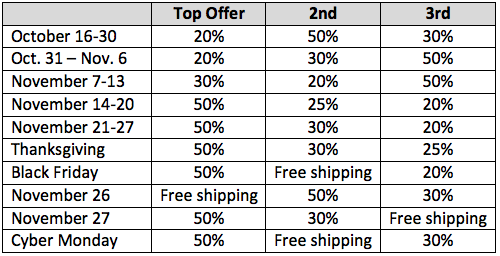
Please note: Subject lines may have contained multiple discounts, such as 20% and free shipping. This email was counted for both.
Cyber Weekend Send Volume
If companies are looking to gain customers earlier in the season, we assume they‘ll send more emails earlier. How did the rest of Gray November compare to the always busy Thanksgiving weekend?
The three highest send days in my inbox were, in order: Cyber Monday, Black Friday and Thanksgiving Day.
Even with a month-long shopping period, this should come as no surprise. These signature days are still synonymous with holiday shopping and continued to be the most popular sending days for retailers during Gray November. Black Friday sends were 39.4% greater than Thanksgiving Day, and Cyber Monday was 12.6% higher than Black Friday. Bronto Software also reported an 11.4% lift in emails sent on Cyber Monday compared to Black Friday.
Cyber Week Sends
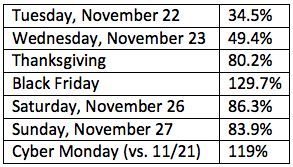
In looking at sends to my personal email, they began to dramatically increase during the week of November 14, and this increase only continued during the week of Thanksgiving. When I compare daily sends that week with the average number of sends for the same weekday during the three weeks prior, I saw these jumps in sending activity.
Subject Lines
I always enjoy seeing what subject line strategies marketers go with during the harried Cyber Weekend. Here are a few things I noticed from this year’s holiday email flurry:
Thanksgiving Day: “Black Friday” was used in 34% of subject lines, compared to only 20% for “Thanksgiving.”
Black Friday: The term “Black Friday” was used in 50% of emails sent.
November 26: “Black Friday” was used in 26% of emails, and 10% referred to the sale being “extended.”
November 27: “Cyber Monday” was used in 21.8% of subject lines, and “Black Friday” was still being used for 14.4%.
Cyber Monday: The term “Cyber Monday” was used in 46% of emails, which was slightly less than the 50% of Black Friday mentions that day.
November 23-28: Only 12 emails (of thousands) used my first name in the subject line.
The New Norm
Gray November continues to gain ground, as consumers are expecting and finding discounts earlier in the season. If retailers were late to adapt to this shift in consumer shopping behavior this year, they won’t likely do so next year. Gray November is the new norm.
How to Give Your Lifecycle Messages a Holiday Refresh
With the holiday season comes a natural increase in the number of lifecycle messages sent. Think about it. More site visitors lead to more email sign-ups, which trigger more welcome series sends. An increase in shoppers means an increase in browse and cart recovery messaging and post-purchase emails for those holiday buyers. And all of these messages affect the overall user experience.
With the holiday season comes a natural increase in the number of lifecycle messages sent. Think about it. More site visitors lead to more email sign-ups, which trigger more welcome series sends. An increase in shoppers means an increase in browse and cart recovery messaging and post-purchase emails for those holiday buyers. And all of these messages affect the overall user experience.
Have you reviewed your lifecycle messaging lately? What's the current experience like for your customers? It’s important to analyze it, particularly during the time of year when consumers will likely be browsing and buying more.
Here are three lifecycle series that are often significantly affected by the holidays and some suggestions for adjusting them for the busy shopping season.
1. Welcome Series
Consider shortening the time between messages. During this time of year, consumers have so much information readily available to them, and they tend to make purchase decisions quicker. Combine this with a natural increase in promotional send cadence, and you may want to shift your messages from every three days to every one or two.
Include a top gifts section or stand-alone message. Why not speak to what many customers, especially new subscribers, may be looking for during the holidays? Rather than showing generic content, provide some simple gifting recommendations by category or price point.
Shift your sign-up incentive. Instead of offering a blanket 10% discount for signing up (especially if this pales in comparison to your standard holiday discount), be creative and offer a better deal to customers. With the rise in self-gifting, consider a tiered discount that rewards the subscriber with a larger discount the more they spend. This allows them to purchase for themselves as well as others. You might also consider offering a free gift or gift card with purchase.
To be more daring, you could eliminate the series altogether, after the initial welcome, of course. This is not a tactic I would personally consider, as building brand value is especially important nowadays. However, this might be something to think about during the final push when you want to be sure your new subscribers receive the last round of great deals before the end of the season.
2. Cart Recovery
Think about timing. At this time of year, consumers may be making purchases quicker than usual. Look at the current gap between messages, and see if an adjustment makes sense. Moving your third message from four days to three may be just enough to recapture some lingering shoppers.
Consider testing promotions. Since we know consumers are buying for themselves as much as others, incorporate a tiered discount or free gift into the cart recovery message in an attempt to increase the purchase amount. You can even test discounting across several messages in the series, with an increase in the offer as you go. This allows the consumer to receive an incentive earlier, but still leaves you some room to offer your traditional discount.
Add more messages. That’s right! You're not limited to just three messages. Add a fourth or even fifth message to your series. Combining this with the other strategies above can give you even more options. Then you can shorten your window between messages, while still using your larger discount later in the series. You can also use a variation of discounts as you go to determine which one your audience responds to best.
3. Post-Purchase
As more people qualify to receive the post-purchase series, consider customizing it to speak to the seasonal purchaser.
Reconsider product review emails. These could be a waste at this time of year. It will likely vary based on the products you sell, but if people are buying for a gift, asking them to review the product is quite irrelevant. Consider sending these messages to those who purchase in November but suppressing those who purchase in December.
Highlight your extended return policy. If you offer one, share this everywhere you can. It’s not only a great value-add that can help drive the sale, but it’s also an excellent relationship-building tool once you complete the sale. Just think of the great impression you could leave with buyers from such a customer-centric policy.
Promote your gift reminder service. Don’t have one? Create one! One of the major challenges for retailers is getting seasonal shoppers to return. A gift reminder service can allow you to communicate with subscribers throughout the year, and it also puts your brand in consideration as a gift-searching destination.
Create a unique series for first-time buyers. This focused series can call out the fact that you do make a great gifting destination while focusing on your value-adds and recommending ways they can get the most from their purchase (e.g. resource centers, return policies). How you engage with the customer at this point may make all the difference between having a one-time purchaser or a loyal shopper.
Keeping the customer experience in mind during this time of year is critical. Review your lifecycle messages, and look for ways to make the user experience even better.
Hopefully, your adjusted strategy will not only help you increase sales around the holidays but all year round as well.
A Guide to Choosing the Best Template for Your Holiday Emails
How do you showcase your best offers? More than any other time of the year, the holiday season involves lots of special offers, discounts, new products, and even new categories. Combine this with increased sending cadence and reduced subscriber attention spans, and you’ve got a prescription for poor-performing emails.
But there is an answer.
How do you showcase your best offers? More than any other time of the year, the holiday season involves lots of special offers, discounts, new products, and even new categories. Combine this with increased sending cadence and reduced subscriber attention spans, and you’ve got a prescription for poor-performing emails.
But there is an answer. Spend the time now thinking about how your messaging aligns with the layout of your email, and consider which type of layout works best with the message you want to convey. Here are five email layouts and the types of messages that tend to work best with them.
1. Single Hero Image
Probably the most common layout used today is a single-image email focusing on one clear call to action (CTA). This layout is designed to allow a subscriber to digest the message and decide on an action in 3 seconds or less. It may be most effective for:
Black Friday and Cyber Monday – generic email linking to deals on the homepage.
Flash sales – straightforward sale with a limited duration.
Sale expiration – last chance reminder.
Web-based gift guides – introducing gift guides that can be viewed online.

2. Product Boxes as a Secondary CTA
This email, a popular style for Q4, commonly has a hero image followed by product (or category) boxes below the primary content. You can manually create these specific recommendations or generate them using a recommendation engine. The layout allows the reader to not only browse for those people on their gift list but also identify products of interest to themselves. This layout is most commonly used for:
Highlighting gifts under a certain dollar value.
Advertising a stocking stuffer section.
Offering subscriber recommendations.

3. Extended Content Sections
Similar to using product boxes as secondary CTAs, this design allows you to feature image-based secondary and tertiary content in addition to your primary promotion. With these larger sections, you have more space to promote larger areas of themed content (e.g. gift guides, value props), and you can use more visual creativity to grab a subscriber’s attention.
This layout is also more effective on mobile devices, as the sections remain a user-friendly size when scaling. This layout could be used in any capacity where you have more generic secondary content to promote, such as:
Gift guides.
Gift cards.
Extended return policy notices.
Shipping deadline estimates.

4. Product Only
Commonly sent throughout the year as a recommendation or new item email, this style is slowly gaining traction as a go-to during the holiday season. This message is often very basic graphically, with the focus solely on promoting specific products or categories, sometimes even with personal recommendations in the recovery section of the email.
While there may not be a lot of glitz and glamour around this style, it can be quite effective for driving sales, as it allows subscribers to find a specific product they’re looking for. It is used for:
Promoting top gifts for the season.
Offering gifts under a certain amount.
Personalized recommendations.
Top Black Friday/Cyber Monday deals.

5. Extended Scroll
These messages are designed around engaging the subscriber in an extended scroll down the email. Emails like this work well on mobile phones because of a person’s natural tendency to thumb scroll. This layout can be most effective when walking people through something step by step, such as building the perfect holiday outfit, or by creating some sort of email game, such as a “See what’s under the Christmas tree” game. The extended scroll works well for:
Specific product style guides.
Top gifts.
Step-by-step or numerical order guides/recommendations.
Contest/gamification.
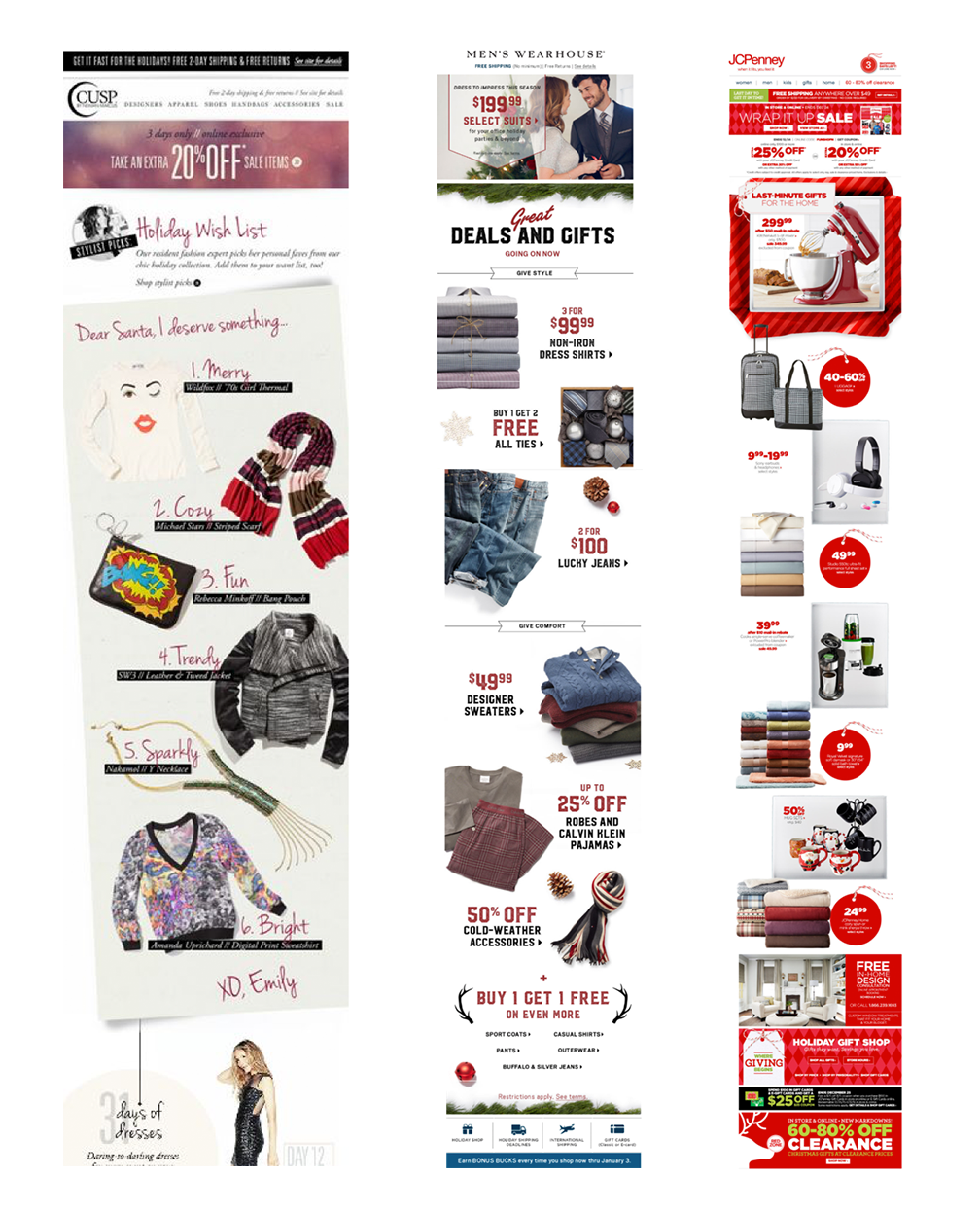
So there you have it – five email layouts that can be tuned to add some spice to your email program during the holiday season. When trying to determine which style may be best for you, think through the ultimate goal of the email and ask yourself, “Does the layout accomplish this goal?”