Featured Post: My Reading & Podcast List
Here are recent books I’ve read and podcasts I enjoy. If you’re looking for something interesting to listen to or read, these are a few that have stood out to me. Let me know if you have a recommendations.
Email Expectations vs. Reality: Are You Letting Your Customers Down?
Consumer expectations versus reality. It is a complex topic for all retailers, but especially for those who sell online. Look at how Amazon has raised the bar on consumer expectations, such as with fast and free shipping. Consider how accessible mobile phones are, allowing consumers to find any product they are searching for, regardless of where they or the product is located. Social media, and its integration into the shopping experience, is providing a direct connection between brand and consumer.
Consumer expectations versus reality. It is a complex topic for all retailers, but especially for those who sell online. Look at how Amazon has raised the bar on consumer expectations, such as with fast and free shipping. Consider how accessible mobile phones are, allowing consumers to find any product they are searching for, regardless of where they or the product is located. Social media, and its integration into the shopping experience, is providing a direct connection between brand and consumer.
The best way to meet consumer expectations is to develop a more robust personalization program, especially when it comes to email marketing. According to a 2016 Flagship Research survey, nearly 60% of consumers expect gender to be used to make email messages more relevant. More than 60% of consumers expect emails to be personalized based on interests they gave in their profile, their birthday, purchases they made online, and what they looked at on their website. While these figures are telling, what is even more daunting for retailers is that 40% of consumers expect offline purchases to be used to make email marketing more relevant. I repeat, offline purchases!
The good news is that many of the necessary data points are already being collected by retailers. When it comes to email marketing, retailers often ask for this data at signup or inside of messaging itself. Consumers who provide this information do so willingly, but expect something in return: relevance.
Perception is Reality
Retailers aren’t meeting that expectation. Instead, consumers find marketing emails consistently useful only 15% of the time, and at the same time, consistently find emails not useful nearly 60% of the time. This is a drastic difference between expectations and reality.
The primary reason for this gap is the prevalence of batch-and-blast messaging. Too often, retailers have limited internal resources that prevent them from sending deeply segmented emails to their subscribers. The result is generic messaging aimed at the masses rather than the individual. Whether a subscriber purchased yesterday, last month, or never, they get the same message.
Retailers can upend that habit by honing in on those data points that can make their email marketing more relevant. For instance, retailers can look at the source of the email subscriber. The person signing up from the maternity section of the website is likely much different than the one signing up from the men’s clothing section. The same holds true for those clicking inside emails. The person clicking on maternity links in a message should receive different messaging than the men looking at button-down shirts. After all, they have different needs from your store.
Sixty-two percent of consumers expect their website browsing data to be used to personalize the emails they receive. Give them what they expect by implementing a browse recovery strategy. These messages can be a significant revenue driver for any email program. While these messages are generally clothed as promotional messages (pun intended), they are immediately relevant to the recent online window shopper.
What’s It All Worth?
At the end of the day, does this all really matter? The answer is yes! One retailer did just this and implemented a unique second welcome series message based only on a specific link click in the first message. This targeted message was sent to just 3% of the new subscribers, but generated a 140% lift in total message revenue, compared to the generic second welcome series message. This is the power of relevance!
Only 15% of consumers say that marketing emails are consistently relevant. Your competitors likely know this. Take the initiative to meet consumer expectations before they do.
This was originally published on Multichannel Merchant.
Retail Predictions: How Amazon and Giant Retailers Will Change In 10 Years
In the year 2027, it’s hard to imagine going to the same big box grocery store when already so many technological advancements are making its way into each business. Beyond grocery stores, similar changes can been found in the fashion and general merchandise industries. This poses the question, what will happen to the largest of retailers over the next 10 years? Will there be a shift in physical size? Will experiences become more meaningful than general displays and product availability?
In the second part of a three-part series, find out how I predict giant retailers may change over the next 10 years.
FUTURE OF ECOMMERCE: HOW AMAZON AND GIANT RETAILERS WILL CHANGE IN 10 YEARS
Physical retail stores are closing at a record pace, all while giant brands such as Amazon and Walmart are expanding their digital footprint. Of the largest retailers, they too are shifting to an omnichannel world, though many remain lagging behind. Even grocery stores, the goliaths that commonly take up more physical real estate compared to that of any other retailer, may feel safe for the time being, but disruption is on the horizon. Between grocery deliveries, smaller specialty shops, and online ordering with store pickup, grocery stores of today will function differently in the years to come.
In the year 2027, it’s hard to imagine going to the same big box grocery store when already so many technological advancements are making their way into each business. Beyond grocery stores, similar changes can be found in the fashion and general merchandise industries. This poses the question: What will happen to the largest of retailers over the next 10 years? Will there be a shift in physical size? Will experiences become more meaningful than general displays and product availability? These are the kinds of questions we asked our partners, and here is what they came up with:
FOR GIANTS BRANDS (AMAZON, COSTCO, HOME DEPOT), HOW WILL THEY CHANGE OR ADAPT TO MEET CONSUMER DEMAND IN 10 YEARS?
Greg: From a consumer demand perspective, Amazon is leading and will continue to lead in many of these areas. Their distribution centers and warehouses have put them in a position to provide quick and cheap delivery. However, in 10 years, Amazon may be seen as more than just a retailer, as they are today. Today, they have plenty more to offer, but people think of them as a store. I think they will be seen as more of a media company that sells products. I believe they will continue offering TV-type services, such as network shows, original content, sports programming, and movies.
For big-box retailers, like Home Depot, they will be more aligned to execute on changes in consumer demand. Consumers expect their online and in-store inventory to be accurate and for customer service reps to have a full view of product locations to assist customers. We also expect associates to have a connected device so they can assist as needed. The thing to watch is how they control the user experience after someone leaves the store. Will installers and hired third parties deliver better service than they do now? These hired guns become the face of the organization, and in many cases, they ruin a relationship between the consumer and the brand. The store itself had little to no control over that experience, other than sourcing that third party.
HOW WILL CONSUMERS RECEIVE ITEMS PURCHASED FROM A VIRTUAL OR ONLINE PLATFORM IN 10 YEARS?
Greg: This will depend on areas of the country. In places where there is one mall, and shipping times are longer, I think you’ll see similar footprints as you do now. For larger metropolitan cities, I think the changes will vary a bit by product vertical. As a whole, I believe there will be a shift to smaller store footprints, which will predicate smaller inventories. But this is a double-edged sword because smaller stores are only sustainable with fast and free shipping for the consumer.
I do believe that as consumers become more integrated with technology, their desire for human interaction in-store will grow. This makes the sales associates in these stores more valuable. They become the face of your brand. They become your customer service department. Because they hold more value for the brand, they likely become more of a career position than an hourly worker.
I would not be surprised to see more cohabitation of storefronts, where you have two complementary brands in a single storefront. This can bring the allure of “one-stop shopping” to the offline world, without competing products like you would find in Walmart or Target. It also allows retailers to save on the cost of the physical storefronts while effectively doubling their marketing efforts, as each store would have two marketing departments.
I think the pickup centers will be the most adopted of all of these. These centers may turn into a requirement for free shipping. Shipping is expensive for retailers, especially the last mile, so we could see more free shipping to centers, while having to pay a small fee to have it delivered to your doorstep. Again, this provides consumers a choice of cost versus convenience.
Robots may be employed by select stores to deliver in-store pickups, but retailers should view this as an opportunity to put a human face to the brand. When in-store pickup is managed by a robot, retailers create a very sterile interaction. At that point, what is the emotional connection to the brand?
I am skeptical of drones and don’t believe them to be a long-term delivery solution. There are too many obstacles, such as the potential for lawsuits, terror threats, and general public safety issues, to make this a viable strategy.
LASTING THOUGHTS
Greg: Retail technology is advancing faster than adoption at this point. While exciting times are ahead, 10 years is an eternity for technology. What we see from a shopping perspective in 10 years may be completely alien to us now. I expect browserless commerce (voice control) will have a much larger footprint than it does now. Kids today use Siri and other voice-controlled devices as normal, everyday tools. When they are in their teens and ordering something using their voice, it won’t seem like a new concept. They will already have assimilated the use of that mode of communication.
CLICK HERE TO VIEW OTHER EXPERTS' 10-YEAR PREDICTIONS
VIEW MY 5-YEAR PREDICTIONS FOR MID-SIZED RETAILERS HERE
VIEW MY 20-YEAR PREDICTIONS FOR SMALL RETAILERS HERE
Bridging the Online-Offline Personalization Gap
Consumers are so keyed in about personalization that a recent study found 40% of online shoppers expect that multichannel merchants know about their offline purchases and factor those into their marketing emails. Let me repeat, we’re talking about offline purchases!
Retailers recognize this as a challenge, and are eager to solve it. But realistically, too many retailers struggle to connect their consumer profile data, purchase data, and email data — much less bridge the gap between the online and offline world. Consumers are coming to expect something most retailers are not yet poised to provide.
Consumers are so keyed in about personalization that a recent study found 40% of online shoppers expect that multichannel merchants know about their offline purchases and factor those into their marketing emails. Let me repeat, we’re talking about offline purchases!
Retailers recognize this as a challenge and are eager to solve it. But realistically, too many retailers struggle to connect their consumer profile data, purchase data, and email data — much less bridge the gap between the online and offline world. Consumers are coming to expect something most retailers are not yet poised to provide.
Retailers today need to use the options available to bridge the online-offline personalization gap.
Location-Based Targeting on the Web
Geotargeting is sometimes thought of as exclusively a brick-and-mortar tool – but it shouldn’t be thought of that way. Location-based options exist that can provide a customized and relevant user experience for the online shopper. For example, if a user visits an online clothing retailer’s website in December, the content should be tailored based on their location. Buffalo-dwelling Kyle should have a different online experience than Miami-based Kevin.
What if you only sell warm-weather clothing? User location can help you guide a user not only to a purchase, but also to a higher order total. For example, if Kyle in Buffalo is visiting the site, it may be an indication that he is planning a trip to escape the cold. Your product recommendations may be tailored to upsell complete outfits, or frequently forgotten vacation items, such as sunglasses, waterproof camera cases, or beach bags.
These same principles can apply to marketing emails. Detecting not only an email reader’s location, but also the device they are on, allows you to serve up user-specific content. For example, if they are an avid runner and rain is forecast three days out, you can display content and/or product recommendations showcasing top-rated gear for running in the rain. You might even combine this with an upgraded shipping offer to speed the product to their door – and secure the deal. If they are on a mobile device, you can change the content to be more streamlined, and maybe more interactive, such as offering a video or user-generated content.
The consequences of not doing this can put off customers. Outdoor furniture company RST Brands learned that when it sent out a “Dreaming of Summer” email during the winter and heard back from a Miami customer who pointed out that this is the time of year when people in his area enjoy the outdoors. RST responded with a geotargeting strategy that avoids those kinds of miscues.
Offline Location-Based Targeting
If done right, geotargeting can be a great way to provide a better in-person experience. Let’s say I abandon my shopping cart. Instead of just sending me the general abandoned cart message, I receive a note about the abandoned products and information about a nearby store where I can try on the items I abandoned. That is a great way to create a terrific in-person experience. But retailers need to understand how to provide actual value to nearby consumers to make this work.
Unfortunately, that isn’t always the case. Recently, Yelp announced the acquisition of Wi-Fi marketing company TurnStyle Analytics. At a high level, TurnStyle allows retailers to require a login to access a company’s free Wi-Fi. This allows consumers to opt-in to receiving emails, SMS or social messages from that retailer in exchange for Wi-Fi access. The consumer gets free Wi-Fi and, perhaps, some location-based promotions. The retailer gets to grow their subscriber list. This method offers a lot of benefits for both retailers and consumers, but it also has challenges.
The biggest challenge is that consumers have come to expect free Wi-Fi in public establishments. I know I certainly do! It can be a point of friction for consumers to turn over info just to use Wi-Fi for a brief period. I know if offered the choice, I often opt to use cellular data rather than go through the hassle of inputting my data and deleting messages I don’t want. Consumers have shown they will provide access to their data, but the immediate and long-term value needs to be there.
While this type of geo-targeting can be beneficial, it may lose its long-term effectiveness. Retailers may choose to take the Starbucks method and ensure their Wi-Fi is accessible to everyone, and instead focus on providing excellent customer value through every other stage of customer interaction.
Ultimate adoption and tolerance will be determined by value. If a retailer is not rewarding consumers for providing info, then the ongoing marketing messages, and potentially their entire view of the retailer, may lose their luster.
Connecting the Data
So, while there is value in each example mentioned above, these connection points need to work together to provide a more cohesive consumer experience. Connecting the data is the critical part. Otherwise, your marketing efforts will continue to be fragmented, less valuable, and will leave consumers where they are today…wanting and, more importantly, expecting more.
This was originally published on Multichannel Merchant.
Retail Predictions: How Mid-Size Retailers May Change By 2022
Over the next five years, mid-size retailers such as L.L. Bean, Hasbro, and Wayfair will see large impacts and face the most challenges. While we may not have a crystal ball, industry experts, like Greg Zakowicz, have a direct tap into the changing landscape of retail, so we asked them how they see mid-size retail and ecommerce shifting over the next five years. From emerging technology to shifts in how consumers receive their goods, there are a lot of iterative changes that our industry is likely to see.
In the first of a three-part series, find out how I predict mid-sized retailers may change over the next 5 years.
FUTURE OF ECOMMERCE: HOW MID-SIZE RETAILERS MAY CHANGE BY 2022
Now that emerging technology like virtual reality, beacons, and voice assistants is finding its way into more consumer homes, what role will these play in the future of ecommerce? Not only is hardware improving and creating new ways for consumers to buy goods, but the software, such as artificial intelligence, is improving how products directly correlate with needs and wants.
Over the next five years, mid-size retailers such as L.L. Bean, Hasbro, and Wayfair will see large impacts and face the most challenges. While we may not have a crystal ball, industry experts, like Greg Zakowicz, have a direct tap into the changing landscape of retail, so we asked them how they see mid-size retail and ecommerce shifting over the next five years. From emerging technology to shifts in how consumers receive their goods, there are a lot of iterative changes that our industry is likely to see.
HOW WILL MID-SIZE RETAILERS CHANGE OVER THE NEXT 5 YEARS?
Greg: I don’t expect we’ll see drastic changes from many of them. I think retailers will do more behind the scenes to integrate data sources and share. We might see retailers put more emphasis on improving the overall value they provide to customers by providing more personalization and value-driven loyalty programs, for example. Of course, much of this requires accurate, integrated data. Without that, marketing programs likely will fall short of expectations.
WHICH IF ANY EMERGING TECH WILL BECOME WIDELY ADOPTED WITHIN THE NEXT 5 YEARS?
Greg: In some cases, yes. In most cases, no. I believe virtual reality will be more prominent, but I don’t think people will be wearing headsets to do the majority of their shopping. For brick-and-mortar stores, beacons will probably become more mainstream than they are today, but it will take some time for retailers to figure out how to use them to provide value to their shoppers. They need to make sure they get it right – almost from the start. Otherwise, consumers won’t adopt them readily over time. Again, it’s all about value for the consumer.
Some online retailers will likely rely on some technologies more than others. Looking at ways furniture retailers can help people picture items in their house is a great example. How much more can this be improved than what we see today? Who knows. Does it need to be improved drastically? I am not sure it does.
Voice assistants are an intriguing topic because that technology puts us at the front end of “browserless commerce.” No one really knows what the user’s experience will be. Will we be able to shop using voice commands? Already, we can purchase items on Amazon using our voices. But will our daughters use it to purchase a prom dress? I don’t think so. I don’t think anyone can predict this, but the run-of-the-mill ecommerce retailer will not be using it on a day-to-day basis the way Amazon users do now.
As with any technology, simply implementing it does not improve the shopping experience. If the technology makes the experience better, then it will be adopted. If the experience is about the technology, ultimately, it will fail.
HOW WILL SHIPPING CHANGE IN THE NEXT 5 YEARS?
Greg: Wow, great question. U.S. consumers already expect free shipping, and their tolerance for longer shipping windows, even with free shipping, is lessening. We will likely end up in a place where free shipping in 3 or fewer days is expected. There will always be exceptions for custom products. However, I would not be surprised to see a slow revolt against the “big guys” where consumers purposely choose to wait the extra day, or pay a little more so they can buy from a smaller retailer. People love the underdog, and when mass consolidation happens, many times consumers have pivoted in the opposite direction.
This is all predicated on domestic purchasing. As more consumers participate in the global marketplace, they might be willing to wait a little longer for their product to be delivered. This could help train people that immediate shipping is not needed, and their tolerance for slightly longer shipping windows or cost could be expanded.
For brick-and-mortar retailers, I think we will see a bigger push to drive people in-store. These retailers may stick to a shipping charge or longer shipping windows for at-home delivery, while quicker and free delivery will happen for in-store pickup. This would provide consumers the option to receive fast and free shipping, while providing retailers with what they want – in-store traffic.
Click here to view other experts' 5-year predictions
VIEW MY 10-YEAR PREDICTIONS FOR GIANT RETAILERS HERE
VIEW MY 20-YEAR PREDICTIONS FOR SMALL RETAILERS HERE
Why fast fashion retailers should slow down and emphasize trust
Consumers are on the move, and their expectations are higher than ever, thanks to supply chain innovations pioneered by fashion industry front runners. Speedy product development and great logistics management have helped brands like Zara and Uniqlo expand their brands’ presence and popularity in North America, bringing new benefits to consumers and new challenges to retailers.
Consumers are on the move, and their expectations are higher than ever, thanks to supply chain innovations pioneered by fashion industry front-runners. Speedy product development and great logistics management have helped brands like Zara and Uniqlo expand their presence and popularity in North America, bringing new benefits to consumers and new challenges to retailers.
Today’s consumers expect far more speed and accuracy from the brands that market to them. The challenge: How do fast fashion retailers balance speed with consumer preferences and incorporate both into their digital marketing strategy?
It’s About Balance
There’s no denying that speed is an important part of the equation. Expectations are on the rise, and consumers want the latest fashion trends yesterday. But when it comes to your digital marketing strategy, it’s relevance – not simply speed – that will win over shoppers.
For example, it’s always a good idea to recommend a new product that you know will get customers excited. But don’t promote or recommend a product that is at dangerously low stock levels. You don’t want to get a customer excited about buying that cool new jacket, only for that jacket to no longer be available come checkout time. It leaves a bad impression and can cause irreparable damage to your reputation with your customers.
The above is a prime example of retailers needing to balance their desire to make speedy recommendations for new products with their ability to deliver the goods.
Build Trust With Relevant Recommendations
Consumer trust is a crucial component for any retailer, but it’s doubly important in the fast fashion industry. How does your brand build trust with consumers? One way is to provide relevant product recommendations.
And it’s not hard to see why this is key for retailers.
If I purchase items from your online store and you continue to provide me with recommendations that are tailored to my needs, three things are likely to happen. I’m going to appreciate getting personalized recommendations based on what I like. I’m going to start trusting your recommendations and enjoy opening the emails you send me. And I’m going to be more likely to purchase from you.
Dive Into Your Data
Great, you may say, but how do you actually put that into action, and which customer data points do you need to evaluate to ensure your recommendations are relevant?
The most obvious data point to monitor is customer purchase activity. If a customer is purchasing sandals, T-shirts, and swim trunks, chances are they’re not interested in a down jacket.
Likewise, if you have a male customer who, as I do, exclusively shops for men’s products, the likelihood of them being interested in women’s products is slim. If you continue to send product recommendations designed for women, that customer’s trust in your recommendations will erode quickly.
Email activity is another source of indicative data. If a customer is opening their emails but not following through to your site, then perhaps there is some disconnect with your content or messaging for that customer. Perhaps your lack of compelling imagery, mobile rendering, or aesthetic design of the email is the problem.
Pick Up the Pace
Speed isn’t the most important factor when it comes to delivering a positive consumer experience, but make no mistake: speed is an important factor.
Purchase activity gives you a sense of the importance of speed to a shopper. To find out how much your customers value speed and to meet their expectations accordingly, try to answer these questions:
Has your customer paid for expedited shipping in the past, or do they always choose standard delivery?
Have they responded to upgraded shipping promotions? Try testing different speed thresholds to see where the breaking point is. Consider offering promotions at intervals of 7 days, 5 days, 3 days, or 2 days, and monitor the results.
Race to the Front
The fast fashion industry operates at breakneck speeds, but that doesn’t mean you’ll be left in the dust if you sacrifice a bit of speed to ensure the experience is personalized and optimized. Consumers are flocking to the fast fashion industry in droves, but they still expect a positive, relevant shopping experience. Delivering new, unique, and exciting products isn’t enough – and it isn’t anything if those products are mistargeted.
Take the time to emphasize and establish trust with consumers and build that relationship by continuing to deliver relevant recommendations to each customer. After all, if you don’t do it, someone else will.
This was originally published on Internet Retailer.
Why Mobile Payments Are Killing the Checkout Form
A colleague recently told me over lunch how much he loves pizza apps. “They’re just so easy.” When I asked him what was so easy, he said that while picking from the menu is part of the ease, the bigger part has to do with paying. It’s one touch.
Now before you run out and hire a team to create an app for your brand, let’s think about how to make paying easier – whether someone visits your website from a desktop or wants to take advantage of email offers directly from their mobile device.
A colleague recently told me over lunch how much he loves pizza apps. “They’re just so easy.” When I asked him what was so easy, he said that while picking from the menu is part of the ease, the bigger part has to do with paying. It’s one touch.
Now, before you run out and hire a team to create an app for your brand, let’s think about how to make paying easier – whether someone visits your website from a desktop or wants to take advantage of email offers directly from their mobile device.
We talk a lot about omnichannel and the customer experience – making sure the cart is available, regardless of device, and providing a seamless shopping experience. But simply making shopping easy is just step one. Making it easier to pay is the key to conversion.
Mobile Shopping Is Here to Stay
According to eMarketer, 58% of mobile sales came from smartphones in 2016, and that number is expected to grow. Overall, mobile made up 29% of all ecommerce sales. But by 2021, it’s predicted that mobile will make up more than half of all ecommerce sales.
Retailers need to consider what this means for their sales. When consumers are looking to purchase on their devices, they expect a frictionless experience. And what provides more friction than being asked to enter an endless stream of billing and shipping details, often moving manually from box to box, all while on a small mobile screen?
Another colleague tells me she frequently abandons items at checkout when trying to buy on her mobile device. “Those forms are better than a strict budget for keeping my spending in check.’’ She recently recounted how she suffered through one form on a national retailer’s site solely because her too-busy-to-shop teenage daughter actually liked one of the dresses she had selected, and she couldn’t bear to abandon the shopping trip after thumbing through 120 sleeveless mini-dresses. She completed her purchase out of necessity, not convenience. If she could have found that baby blue skater dress on Amazon, she might have been tempted to bail altogether.
If your competitor offers a frictionless purchase experience and you do not, you may not only lose a sale now, but customers may remember this and bypass you altogether the next time they shop.
Security Plays a Key Role In Mobile Payment Behavior
The counter-argument is that most retailers allow users to save their credit card information on their site to make future checkouts easier. However, online security issues have minimized the usage of this tool. In fact, due to hacking concerns, 33% of consumers never save their credit card information, and 30% only use trusted payment methods, such as PayPal.
The result? More and more consumers are storing their payment information in their phones. There are one million Apple Pay accounts being activated weekly worldwide. As consumers continue to adopt mobile payments on their primary connected device, creating an easy way to allow consumers to check out will be an essential requirement in the very near future.
An intriguing facet to mobile payments is that Amazon’s U.S. patent for one-click payment technology expires this year, leaving the door open for other retailers to implement their own one-click solutions without licensing the technology from Amazon. Google is reportedly working on a one-click payment system that integrates with the Chrome browser.
This integration with Chrome goes beyond just mobile, and that itself is telling of the power that mobile payment options hold. The purchase process between an app, a laptop, and a mobile version of a site is almost always different from one another, but the goal is symmetry. As mobile purchasing becomes the standard, non-mobile devices will be forced to match that experience. Storing payment info in Chrome will allow users to easily check out regardless of the device they are on. Creating a symmetrical experience not only allows for a quicker checkout (which should decrease abandonment), but also improves the customer’s overall experience with your brand.
The time is right for retailers to provide a more simplified, convenient checkout experience. Don’t think of it as simply a way to optimize for mobile. It’s not. Mobile is the norm. Think of it in terms of giving your customers what they want. Long checkout forms on mobile devices are a thing of the past. Don’t believe it? Ask 100 people if they’d rather fill out a long form on their phone or make their next mobile purchase with the simple touch of a thumb.
This was originally published on Multichannel Merchant.
Stop Slashing Prices, Start Connecting With Your Customers
The retail sector is going through drastic changes. Established names like The Limited are closing or filing for bankruptcy. Amazon and WalMart squeeze everyone’s margins. Special discount shopping days like Black Friday have morphed into Gray November, a month-long deep discounting period. As brands fight to keep up with competitor discounts, profits and customer loyalty are harder to earn.
I recently spoke with a fashion retailer who recognized the endless discount cycle dilemma. They had been stuck in this discounting rut, but did not want to be known as a discount brand. They prided themselves on making quality product at a decent price and this constant discounting was bad for their brand and devalued their product. This past holiday season, they made a straight forward business decision: No guts, no glory. At their busiest time of the year, they chose to not discount.
The retail sector is going through drastic changes. Established names like The Limited are closing or filing for bankruptcy. Amazon and Walmart squeeze everyone’s margins. Special discount shopping days like Black Friday have morphed into Gray November, a month-long deep discounting period. As brands fight to keep up with competitor discounts, profits and customer loyalty are harder to earn.
It is unrealistic for retailers to continue to increasingly discount and remain viable. After all, if a retailer offers 50% off, they’ll need double the sales to reach the same margins. And, oftentimes, the unit sales immediately after the promotion ends suffer as a result. But with global competition increasing, what are retailers to do? Keep up with the Joneses and hope to remain viable, or take a risk and go against the grain to try to increase profits? While some retailers need to rely on discounting, I’d argue that most don’t.
I recently spoke with a fashion retailer who recognized the endless discount cycle dilemma. They had been stuck in this discounting rut, but did not want to be known as a discount brand. They prided themselves on making quality products at a reasonable price, and this constant discounting was bad for their brand and devalued their product. This past holiday season, they made a straightforward business decision: No guts, no glory. At their busiest time of the year, they chose not to discount.
Hello Guts, Meet Glory
While their competitors were running 30%, 40% and even 50% off specials during the busiest shopping period of the year, this retailer resisted the urge. As the season played out, they saw a 10% growth in total revenue until the last week of December (more on that below). On top of the 10% growth, their margins were protected. They generated 30% to 40% greater profits for those units sold.
This retailer also runs an annual day-after-Christmas and clearance sale. This year was no exception. But how would the previous non-discounting impact this sale? As it turns out, one side effect of the non-discounting strategy was that it created and satisfied the demand for a discount. This year’s clearance sale set records in volume of units sold, selling 10 times more year over year. It satisfied the demand of those looking for a deal while not taking away from their traditional after-Christmas strategy.
Having this conversation can be scary. Before you pull the ditch-the-discounts ripcord, first look at ways to strengthen your current brand positioning.
Focus on Your Brand
What does the brand stand for? How consumers perceive your brand can ultimately determine whether they will purchase from you without a discount, much less become a loyal customer. Consider brands that have a cause, like TOMS Shoes. Consumers connect with their cause and, because of that, they are generally willing to spend more on a product.
Does your brand focus on quality, value, customer service, personalized services, etc.? Do you have social causes? Do you convey this within your messaging on your website, email, and social profiles? If you remove or lessen discounts, consider whether you offer customers enough value-adds to purchase from you and not a competitor.
Planning for The Long Haul
Since you will no longer be relying on sending a generic 30% off promotion to drive sales, your general batch and blast email strategy will likely need to become a little more refined. You’ll need to maintain a more relevant customer experience. Focus on segmenting where you can. Include intuitive product recommendations inside your emails and on your website. Analyze your lifecycle messaging and determine how you can redesign them to provide the most value to the end user. Engage, I mean really engage, with your audience on social media. Ask questions, proactively comment, and deploy user-generated content to make the site and email experience better.
Evaluate Your Automated Marketing Strategy
When making the decision to pull back on promotions, the next step is to evaluate this strategy with your automated messages. If you have discounts in your welcome, post-purchase, shopping cart, or other automated message series, determine whether you want to maintain this strategy. In some cases, you may, as these messages are triggered from user actions. Since these messages are sent to single contacts, you may decide it is worth “rewarding” subscribers for engaging.
The Aftermath
Just because you no longer set the expectations of continuous discounting doesn’t mean you have to end discounting altogether. Occasional sales may ultimately carry more weight with consumers as they know deals are few and far between with your brand. This will also appeal to those consumers who specifically look for deals.
By avoiding blanket price discounts, you can experiment in configuring promotions. Consider free or expedited shipping promotions, for instance. These carry weight with consumers while protecting margins. Retailers can run promotions on grouped items instead of single SKUs, therefore increasing average order value while still protecting margins.
There is no one strategy for fighting back against deep discounting. Retailers will need to determine how far they are willing to commit to the strategy, and to what extent their customers are willing to tolerate the pullback. While the retailer I mentioned earlier plans on enhancing their overall strategy by refining their segmentation and timing of messages, I did ask him if there was anything he would do over again based on his experience. His answer, “Not really.” That answer is quite telling. Whether the success of this strategy is sustainable, only time will tell. But right now, this retailer is enjoying the glory.
This was originally published on Multichannel Merchant.
Why an Email Unsubscribe Can Be a Good Thing
It’s a fact. Someone will unsubscribe every time you send a batch promotional email. And while we all hate to see our subscribers go, wouldn’t you be open to a higher unsubscribe rate if it meant increasing your revenue? How you view your unsubscribes not only affects your email strategy and its revenue potential but also influences improvements you should make to your automated messages and your yearly list growth goals. Let’s discuss.
It’s a fact. Someone will unsubscribe every time you send a batch promotional email. And while we all hate to see our subscribers go, wouldn’t you be open to a higher unsubscribe rate if it meant increasing your revenue? How you view your unsubscribes not only affects your email strategy and its revenue potential but also influences improvements you should make to your automated messages and your yearly list growth goals. Let’s discuss.
People unsubscribe for a variety of reasons. The most common include receiving too many emails and irrelevant content. Often, the “too many” threshold is actually determined by the proportion of irrelevant content, such as those situations when the content is meaningless to the reader or fails to change from one message to the next. I know of retailers who send every day, or even multiple times daily, whose unsubscribe rate is no different than the retailer sending only a few times each week. While there may be an opportunity to drive additional revenue by increasing sends, we need to recognize the full impact of those sends on a subscriber database.
At what point do the inevitable unsubscribes begin to hurt your bottom line? Determining the cost of the unsubscribe is an important step to answering that question. Knowing the cost can help you optimize your sending strategy throughout the year, particularly when planning for periods of increased sending, such as the holiday season.
What Do Unsubscribes Cost?
First, look at your weekly and monthly unsubscribes and their order history. How many unsubscribes were non-buyers, one-time buyers, or frequent buyers? How much revenue did they account for? This is your potential lost revenue on a per email basis. Now that you have this number, determine how much revenue an average email generates. These totals will give you some basic data to figure out how much unsubscribes are really worth.
In the example below, the number of unsubscribes over a one-week period (assuming four sends) was 300, and they accounted for $10,400 in past revenue.

How to calculate the cost of an email marketing unsubscribe
However, we know only 100 of the 300 contacts accounted for that revenue. Using these figures, on a per-send basis, we can assume a loss of $2,600 in past revenue from unsubscribes. However, if each email sent generates an average of $15,000 in revenue, we are left with an overall net gain of $12,400 per email. So, increasing sends from four to five days per week should net roughly an extra $645,000 in yearly email revenue while resulting in an increased loss of 3,900 contacts (75 per week for 52 weeks) in unsubscribes.
In this scenario, the extra revenue driven for every unsubscribed contact was $165. That’s a nice figure, especially considering 2,600 of the 3,900 unsubscribes come from non-buyers.
Are Your Non-Buyer Opt-Outs Worth It?
You can take this one step further and analyze the length of subscription among your non-buyer unsubscribes. How many have been a part of your email program for less than 30 days, between 1-3 months, and so on? Are the non-buyer unsubscribes recently acquired prospects you have lost, or have they simply been dead weight on your email list all along? Now, look at your purchasers. How long has it been since their last purchase?
How Do Email Unsubscribes Affect List Growth?
If we know 300 contacts per week are unsubscribing (4 emails at 75 unsubscribes each), and we add one extra email each week, we assume we will lose 375 per week. Over one year, we will expect to lose 19,500 contacts due to unsubscribing. In order to maintain a positive subscriber churn, this should be the minimum goal for yearly subscriber acquisition. I say minimum because you will naturally see members of your list unsubscribe from other emails you send, such as automated messages.
Having a concrete acquisition goal is imperative for maintaining the health of your email program. If you’re not focused on the acquisition, you should be. Explore all areas for potential sign-ups, especially in the wake of Google’s recent pop-up changes.
What Can Opt-Outs and Converters Tell You About Automated Messaging?
Looking at the order history of your unsubscribes may also indicate engagement opportunities to address. For example, if most unsubscribes are one-time purchasers, you may need to strengthen your post-purchase program for first-time buyers or do a better job meeting overall customer expectations with orders. If the opt-outs are from recently acquired non-buyers, it may be a sign you need to strengthen your onboarding process to help drive conversions or more closely analyze your acquisition method.
Do the same with converters. Look at the makeup of purchasers on a per email basis. Did the conversions come from non-buyers making their first purchase, one-time buyers buying for a second time or three-plus repeat purchasers? Remember, each of your email converters should now funnel into a post-purchase campaign, which should either convert them once more or strengthen your brand loyalty prospects.
Gaining these insights will help you know when to strengthen areas of your post-purchase program specifically dedicated to first-time and returning buyers.
Final Considerations
Honestly, I never worried about unsubscribes. Frankly, if a contact opts out, they have made the decision to stop interacting with you via email well before pushing that button. If it wasn’t this email, it would have been the next one. Do your best to encourage subscribers to want to stay, but focus more on delivering quality to those who still open your messages. Here are some strategies and resources to guide you along this journey:
Focus on lifecycle messaging. Build a customer-centric post-purchase program that reinforces brand value and helps create loyalty, and create a relevant onboarding welcome series for newly acquired contacts.
Send relevant emails, especially to previous buyers. Segment where you can, and consider tactics like inserting product recommendations into your emails. Customized product recommendations can even make batch-and-blast messaging more relevant.
Focus on subscriber acquisition. If you are not creating a positive churn in subscribers, you need to get serious about list growth.
Consider offering pause or mute options to curb unsubscribes and give your contacts a temporary break from your emails.
Don’t let the communication end. Optimize your opt-out confirmation page to include invitations to connect in other ways, such as social media.
Start worrying less about unsubscribes, and begin paying closer attention to what those unsubscribes can teach you about how to strengthen your email program and drive more revenue.
Crafting A More Robust Cart Recovery Strategy
ommon industry statistics indicate that more than 70% of all online shopping carts are abandoned. Yet retailers generally treat all shoppers who abandon carts the same, regardless of what items they were shopping for. While this one-size-fits-all approach may work for many, it doesn’t work for everyone. The reasons for abandoning a cart tend to vary based on cart total, and the needs of the shopper also tend to change as the cost increases. So, using a blanket approach for cart recovery emails is likely costing retailers valuable sales.
Common industry statistics indicate that more than 70% of all online shopping carts are abandoned. Yet retailers generally treat all shoppers who abandon carts the same, regardless of what items they were shopping for. While this one-size-fits-all approach may work for many, it doesn’t work for everyone. The reasons for abandoning a cart tend to vary based on cart total, and the needs of the shopper also tend to change as the cost increases. So, using a blanket approach for cart recovery emails is likely costing retailers valuable sales.
Here’s an example: I was recently in the market for a dishwasher and began by shopping online. I browsed via laptop and smartphone, read reviews, carted (and abandoned) products, and viewed products in stores. In the midst of my journey, I started receiving abandoned cart emails. What stood out to me is that they were not at all helpful. As close as I was to making a purchase, none of these messages helped convince me to do so. They failed.
Failure to Launch
These messages failed because they did not consider the buyer’s motivation and obstacles to conversion. Someone shopping for a $30 item likely has different needs and hesitations than someone considering a $700 item. Higher priced items typically generate more comparison shopping and a longer buying cycle, and they might need services attached to their purchase, such as delivery, installation and haul-away. For consumers that have filled a cart with items that equal a high-dollar figure, there often comes the natural hesitation of, “Do I really need all of this?”
Knowing Your Buyer
Consider these two cart recovery emails. They were sent from the same retailer, but the price points of the abandoned products are vastly different.
The abandoned products should have determined not only the main messaging but also the recommendations inside the emails. The free shipping callout in the example with the $30 EarPods works well, as my cart total is less than the required threshold. However, the recommended products feature items that cost hundreds to thousands of dollars. These recommendations simply don’t make sense.
In the dishwasher example, however, the prominently displayed free shipping callout is not appropriate for this message. And while the recommendations are more in line with what I am actually shopping for, they don’t help convert me on the dishwasher purchase.
And in both cases, the main messaging tells me they can help, but they fail to mention exactly how. What’s my next step?
This is just one retailer of many whose messaging strategy could use refining. Had any of these companies considered the product I was shopping for or my cart total, they may have directly addressed the obstacles that caused me to abandon my purchase in the first place. In the case of the Earpods, give me some logical product recommendations to bump me over the free shipping threshold. With the dishwasher, include information about how their staff could help me decide on the perfect model, or give me more information on their haul-away and installation services. Without meaningful supporting content, the brand turned these highly relevant messages into something that was mostly useless.
Optimizing Your Cart Recovery Strategy
Abandoned cart messaging should be used to remove conversion obstacles and encourage the customer to purchase. By factoring in details such as cart total, carted items, and their categories and/or the number of items in the cart, you can begin to customize messaging that better targets the individual shopper. Your messaging can reinforce appropriate value-adds, such as free shipping or links to resources, that can be used to determine how many messages should be sent, the timing of those message,s and if or when an incentive should be included.
Retailers today should be focused on providing the right kind of messaging based on the kinds of products left in the cart. For smaller items, the options are simpler – recommendations to help reach a free shipping threshold or maybe even a discount. For larger, non-impulse purchases, focus on information that encourages shoppers to choose your store over the competitors. By overcoming obstacles and encouraging purchases at this final stage of the online checkout process, you can take the most effective approach to recovering those abandoned carts and converting the shoppers behind them.
This was originally published on Multichannel Merchant.
Customers Are King: Are You Giving Them the Royal Treatment?
As memories of the holiday season fade, the focus has now shifted to improving sales in the year ahead. But as competition expands globally and consumer expectations become even more demanding, this can be a daunting task.
Today’s consumers expect more from retailers: relevance, ease of purchase, mobile-friendly engagement, convenient shipping and return policies, availability, engagement, and overall value, just to name a few. While this may seem overwhelming, it’s likely you already provide some of
As memories of the holiday season fade, the focus has now shifted to improving sales in the year ahead. But as competition expands globally and consumer expectations become even more demanding, this can be a daunting task.
Today’s consumers expect more from retailers: relevance, ease of purchase, mobile-friendly engagement, convenient shipping and return policies, availability, engagement, and overall value, just to name a few. While this may seem overwhelming, it’s likely you already provide some of these features and services. Now take that next step and truly make 2017 the year of the consumer.
Audit Your Engagement Tactics
The first step in this plan is to analyze your marketing programs and find the gaps in your consumer touchpoints. Do you use social platforms, and if so, which ones? From an email perspective, how many messages do you send each week? Do you have lifecycle messaging, and if so, which messages are you sending? Which ones are missing? When was the last time you bought from your own brand? Go ahead and do it! Make a purchase and analyze every stage from the eye of the consumer, from transactional messages to packaging. Do you offer an experience that helps create loyalty? Identifying potential weak points in your customer journey can help you begin to fill your immediate needs.
Size Up Your Competition
Now that you have reviewed your own customer touchpoints, how do they compare to your competitors? What value do you provide that they don’t? How do your shipping and return policies differ, and are you communicating these differences to consumers? What marketing automation does your competition have in place? It’s easy to find out.
Sign up for their email programs, and wait for the messages to roll into your inbox. Take a look at their welcome series and their cart and browse recovery messaging. Reply to an email and ask a product-specific question to see what the response time is like.
How else do they communicate from a customer service perspective? Do they offer live chat, 24-7 phone support, or active social channels? Don’t forget to make a purchase and evaluate their customer experience. Do they have an automated post-purchase series? How does it compare to yours?
Adapt Your Lifecycle Messaging
Lifecycle messages are a great part of a customer-focused marketing plan, but as consumer behavior changes, your strategy behind those messages should shift accordingly. For example, does your welcome series speak to all newly acquired contacts with generic content or target them differently? Does your email content relate to what they were viewing when they signed up or what they clicked on in your welcome email?
If not, give such messages a try. Does your cart recovery strategy take into account the differences in your shoppers? For example, the abandoners carting $700 worth of products are much different than those abandoning $30 worth of products. Do you tailor your messages for each audience? Examine all of your automated messages to determine if your strategy needs to change at all.
Optimize Your Promotional Messaging
Now that you’ve identified your gaps and assessed your lifecycle messages, focus on improving your promotional emails. How can you make them more relevant, especially if you are sending batch-and-blast messaging? Including product recommendations, purchase data, or social media content can make these common messages more engaging for the subscriber and more effective for your brand.
Take Advantage of Social Media
Creating an online connection between brand and consumer has always been a challenge for retailers, but social media has significantly bridged that gap. What social platforms do you use? Are they the channels your customers use? Do you monitor your accounts and respond to inquiries? Do you proactively engage with users? Consumers are interacting with social platforms much more frequently than they do with your website and emails. Use them to your advantage and actively engage with your audience.
Implement a Browse Behavior Strategy
While I addressed automated email marketing, the process of capturing and using browse behavior is a strategy that deserves a little more focus. Much like cart recovery, these messages are naturally relevant to the recipient as they target subscribers with emails based on what they were browsing. But as they haven’t yet carted a specific product, you have more room to be creative with your messaging and cross-promote related items. After all, you know they are shopping, but you may not know for which specific product they are shopping for. If they are not yet part of your arsenal, you should strongly consider introducing them.
What’s It All For?
By offering an endless stream of discounts to attract customers, retailers have backed themselves into a corner. While this has implications all year round, this approach has dramatically reshaped the holiday shopping season by turning one-time stand-alone days, such as Black Friday, into a Gray November.
The offers never stop, and therefore, they no longer stand out. By taking the time to evaluate and optimize your strategy to focus on the customer, you’re giving them what they want, while attracting new customers and strengthening customer loyalty in the process. Having a dedicated focus on consumers allows you to test adjustments to your discounting strategy and attempt to retake your margins.
One retailer I recently spoke with took this approach and did not discount at all this past December. Not only did they see an increase in sales, they significantly increased profits. According to the retailer, it was a “gamble worth testing” that ultimately allowed them to take greater control of their own revenue destiny.
Consumers expect more. The ways they engage are evolving, and the competition is heating up. Being customer-centric is no longer a nice to have – it is essential. Dedicate time and effort to providing your customers with the best experience possible, and make 2017 the year of the consumer.
This article was originally published on www.bronto.com
How Retailers Are Redefining the Shopping Experience
I recently found myself popping in and out of stores in the SoHo section of New York City, and one thing stood out to me – the in-store experience left a lot to be desired. Too many times, I walked into a store only to be greeted with a very passive “Hello,” at which point the store associates turned back to whatever they were doing before. To maximize space, stocked items were often jammed together from floor to ceiling, making me feel like I was in some claustrophobic cave of color palettes. The experience wasn’t enjoyable; in fact, it felt more like an exercise in futility.
I recently found myself popping in and out of stores in the SoHo section of New York City, and one thing stood out to me – the in-store experience left a lot to be desired. Too many times, I walked into a store only to be greeted with a very passive “Hello,” at which point the store associates turned back to whatever they were doing before. To maximize space, stocked items were often jammed together from floor to ceiling, making me feel like I was in some claustrophobic cave of color palettes. The experience wasn’t enjoyable; in fact, it felt more like an exercise in futility.
Years ago, shoppers might have expected a grumpy sales associate and a cluttered sales floor. But as ecommerce and technology have evolved, the consumer has come to expect convenience, both online and in-store. We are increasingly less tolerant of experiences like the one I had in SoHo.
Technology has changed the face of retail. It has affected how consumers shop and interact with brands. Yet, even though ecommerce is growing, a TimeTrade survey revealed that 85% of U.S. consumers say they still prefer to buy from physical stores even if the same products are available online.
In an age where retailers can easily compete with other brands from every corner of the world, customer experience is more important than ever. Technology helped create this expectation for convenience, but it has also provided a means to deliver it. And forward-thinking retailers are really using it to their advantage.
Brick-and-Mortar
According to BloomReach, 88% of shoppers will use a smartphone to assist them when they shop in a physical store. The first instinct for many retailers is to remove the technology for fear of losing sales to competitors. But smartphone-browsing shoppers will spend 20% more than those not browsing online, according to InMoment. So instead of fretting about what customers are doing on their smartphones, give them something positive to do that enhances the shopping experience.
For example, Rebecca Minkoff’s New York location has smart dressing rooms that allow shoppers to interact with a display screen. They can customize their experience by viewing other sizes or colors of available products, adjusting the lighting, requesting assistance, and even saving the session information to their personal profile, which they can conveniently store on their smartphone. In this example, the associate is not driving the interaction but rather ensuring the shopper’s requests are met.
Lowes Home Improvement launched the HaloRoom Experience in some of its US stores, where customers can use a mixed reality environment to plan their kitchen remodel, select cabinetry, hardware, countertops, and appliances, and view what it will all look like in the end. This technology can eliminate some of the uncertainty many shoppers face when planning their new dream kitchen and help overcome obstacles to purchasing such a high-ticket project.
These are only two examples of how retailers are redefining the shopping experience. Retailers such as Neiman Marcus, Bloomingdale’s, Ralph Lauren, Kate Spade and Topshop are also offering, or at least testing, in-store technology.
But we’ve only scratched the surface of how in-store technology will revolutionize the in-store experience. As this technology develops and becomes easier to implement and maintain, it will become more commonplace, and retailers who hold back now will be playing catch-up for a long time to come.
Online Shopping Experience
Enhancing the in-person experience is one thing. Enhancing the online experience is another, especially given that users are ultimately in control and can leave or get distracted at a moment’s notice. While online shopping is as convenient for consumers as a few clicks on a smartphone, it has caused headaches for retailers, from increased global competition to processing returns. According to Shotfarm, 42% of customers returned something they bought online. These returns are costing retailers millions each year and can present logistical inventory and accounting nightmares.
But online shopping lends itself to uncertainty in knowing if an article of clothing will fit just right, or a piece of furniture will look good in the living room, which is precisely why consumers expect hassle-free returns. Retailers must look for ways to redefine the online shopping experience to reduce return costs and also provide customers with an experience that encourages customer loyalty.
Some retailers have begun experimenting with a variety of technologies to provide an easier and more reliable online shopping experience.
FitAnalytics provides a size recommendation engine that uses only a few pieces of information to recommend the perfect size for clothing. It also lets shoppers know how many people eventually returned the product in that size due to improper fit. This reassurance, much like a collection of customer reviews, can help offset any hesitation the buyer may feel when deciding which size to order.
Fashion Metric also offers a virtual sizer, both online and in-store via an app. Online, it allows users to input a few basic measurements, such as waist size for men, and delivers custom suit sizing in just moments. This eliminates the need for tape measures or for customers to keep up with fairly uncommon measurements, like chest size. I own suits but haven’t the slightest idea of my chest size. The entire process took me less than one minute to complete. For a complete suit, that’s pretty remarkable.
Zugara offers a technology that allows a user to virtually try on clothes using their webcam. Customers can select a garment and resize, reposition or change the color of the item they’re “wearing,” giving them a much better idea of how it will look on them.
One complication with these technologies is the disparity of the experience across devices. The shopping experience on a desktop or laptop easily accommodates these webcam features, but those may not be accessible on a smartphone or tablet. While shopping on mobile, from browsing to checkout, has become relatively easy, improving the experience to allow for such technology seems a bit far off yet.
The Good News and The Bad News
At the end of the day, ease of use will be the critical factor in determining whether users will accept or reject shopping technology. If it is easy to use and provides real value to the customer, they will flock to it. If it’s cumbersome or doesn’t significantly improve the shopping experience, they will quickly move on.
The good and bad news is the same, and that is we have only just begun with this retail technology arms race. Personally, I look forward to one day walking into a store and having everything I know about shopping completely turned upside down.
This was originally published on Multichannel Merchant.
The Next Generation of Batch-and-Blast Email Marketing
Miami-dwelling Joe likes the colorful Bermuda shorts and green boat shoes he found on your website. But when he gets the email promotion featuring the black winter jacket? Not so much.
Today’s consumers expect relevant communication from retailers, and in this example, Joe’s expectations were not met. It’s also the kind of example that’s been used to knock batch-and-blast emails as an ineffective strategy. But what if you could still batch-and-blast – and personalize?
Miami-dwelling Joe likes the colorful Bermuda shorts and green boat shoes he found on your website. But when he gets the email promotion featuring the black winter jacket? Not so much.
Today’s consumers expect relevant communication from retailers, and in this example, Joe’s expectations were not met. It’s also the kind of example that’s been used to knock batch-and-blast emails as an ineffective strategy. But what if you could still batch-and-blast – and personalize?
With segmentation tools, recommendation engines, and easy-to-use lifecycle messaging automation, you can actually make batch-and-blast emails relevant to the individual consumer. Let’s explore how you can use these tools to revive your batch-and-blast messaging.
Segmentation Tools
Tools for segmentation are now built into most marketing automation platforms and make audience segmentation easier than ever. They also put the data, such as web browsing, email, and purchase activity, along with information provided by the consumer, in the hands of the actual marketer, not the IT department. This immediate access to data can be used to seriously enhance the overall user experience in a variety of ways. For instance, location data can be used to insert local store information into emails or target customers in the area when a new store is opening.
Product Recommendations
Once you’ve gathered segmentation data, you can use it to determine which products to display to the individual user. Using product recommendations based on subscriber data as secondary content in batch-and-blast emails increases the relevance of your message, and it can all be done without developing multiple variations of the message. You can use them to recommend similar products, upsell products, suggest accessories, or increase average order value, among other things.
Lifecycle Messages
Lifecycle messaging automation is an extremely effective strategy for retailers and can be a great way to augment batch-and-blast messages. Lifecycle messages, such as a welcome series, post-purchase series, and shopping cart abandonment, are high-revenue drivers, and retailers now have the ability to automate these messages with ease. They’re already very relevant to your audience, but you can enhance the experience for your customers even further with meaningful product recommendations.
Since crafting unique versions of day-to-day emails is no longer required, consider spending that saved time on creating more specific messaging for these series based on other factors, such as the source of acquisition or the category of products purchased. For instance, a post-purchase series for my new television should be different than the one for my new headphones. Combining this unique messaging with recommendations can be a significant win-win.
Having these tools readily available gives you the ability to take a one-size-fits-all email message and make it increasingly relevant. Since that winter jacket email to Joe now also highlights the latest tropical warm-weather items he’s sure to love, he doesn’t have to worry about being left out in the cold by an irrelevant email.
Batch and blast isn’t dead. It’s just growing up.
This was originally published on Multichannel Merchant.
A Gray November Recap From My Inbox’s Point of View
With consumers shopping earlier, thanks to heavier discounting, earlier promotions, and a trend toward buying for themselves, Black Friday and Cyber Monday no longer kick off holiday shopping. They’re merely a part of it. Instead, we’re now seeing the rise of Gray November, a month-long start to the holiday shopping season.
With consumers shopping earlier, thanks to heavier discounting, earlier promotions, and a trend toward buying for themselves, Black Friday and Cyber Monday no longer kick off holiday shopping. They’re merely a part of it. Instead, we’re now seeing the rise of Gray November, a month-long start to the holiday shopping season. According to Adobe Digital Insights, over $1 billion in online revenue was generated on 27 of the first 28 days in November, for a grand total of $39.97 billion. And of those sales, 18% can be attributed to email.
As a subscriber to hundreds of email programs, I decided to look at my own inbox for indications that the Gray November trend is continuing. Here are some of my key findings.
Discounting
In an attempt to attract customers earlier in the season, retailers have begun offering discounts continuously throughout the year, with deeper discounts around the holidays. Consumers have come to expect these early discounts, and retailers have delivered.
Did the trend continue this year? From what I saw, the answer is yes.
In looking through my inbox for incentives advertised in the subject line*, discounts as high as 50% were among the top three incentives offered every single week since mid-October. Nearly two weeks prior to Black Friday, 50% became the most advertised discount. In fact, from Thanksgiving through Cyber Monday, the 50% discount was the most touted, with a minor exception on November 26, when it came in just 0.4% behind a free shipping offer.*
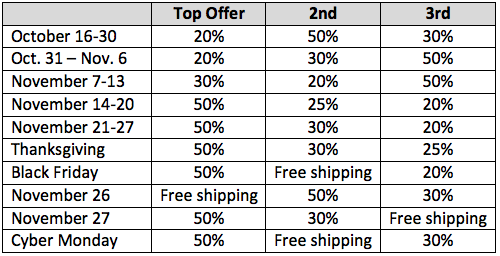
Please note: Subject lines may have contained multiple discounts, such as 20% and free shipping. This email was counted for both.
Cyber Weekend Send Volume
If companies are looking to gain customers earlier in the season, we assume they‘ll send more emails earlier. How did the rest of Gray November compare to the always busy Thanksgiving weekend?
The three highest send days in my inbox were, in order: Cyber Monday, Black Friday and Thanksgiving Day.
Even with a month-long shopping period, this should come as no surprise. These signature days are still synonymous with holiday shopping and continued to be the most popular sending days for retailers during Gray November. Black Friday sends were 39.4% greater than Thanksgiving Day, and Cyber Monday was 12.6% higher than Black Friday. Bronto Software also reported an 11.4% lift in emails sent on Cyber Monday compared to Black Friday.
Cyber Week Sends
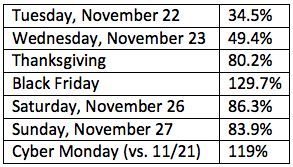
In looking at sends to my personal email, they began to dramatically increase during the week of November 14, and this increase only continued during the week of Thanksgiving. When I compare daily sends that week with the average number of sends for the same weekday during the three weeks prior, I saw these jumps in sending activity.
Subject Lines
I always enjoy seeing what subject line strategies marketers go with during the harried Cyber Weekend. Here are a few things I noticed from this year’s holiday email flurry:
Thanksgiving Day: “Black Friday” was used in 34% of subject lines, compared to only 20% for “Thanksgiving.”
Black Friday: The term “Black Friday” was used in 50% of emails sent.
November 26: “Black Friday” was used in 26% of emails, and 10% referred to the sale being “extended.”
November 27: “Cyber Monday” was used in 21.8% of subject lines, and “Black Friday” was still being used for 14.4%.
Cyber Monday: The term “Cyber Monday” was used in 46% of emails, which was slightly less than the 50% of Black Friday mentions that day.
November 23-28: Only 12 emails (of thousands) used my first name in the subject line.
The New Norm
Gray November continues to gain ground, as consumers are expecting and finding discounts earlier in the season. If retailers were late to adapt to this shift in consumer shopping behavior this year, they won’t likely do so next year. Gray November is the new norm.
3 Ways to Cultivate Post-Holiday Customer Loyalty
How do retailers turn seasonal gift buyers into year-round customers? The fact is, it’s a struggle. Some customers may not want to hear from you for another 365 days, while others may need more personalized suggestions before they’ll make another purchase. Either way, at the very least, you want them to come back next year. But too often, retailers don’t devise a plan and simply lump these customers back into the regular stream of batch-and-blast messaging.
How do retailers turn seasonal gift buyers into year-round customers? The fact is, it’s a struggle. Some customers may not want to hear from you for another 365 days, while others may need more personalized suggestions before they’ll make another purchase. Either way, at the very least, you want them to come back next year. But too often, retailers don’t devise a plan and simply lump these customers back into the regular stream of batch-and-blast messaging.
True story. My colleague used to buy a gift basket every year from the same company. She came to rely on their perfectly timed email with details of the previous year’s purchase and the option to reorder. It was so simple that she never bothered to shop around for a better deal. But last year, she didn’t receive that email. Instead, the company blasted her inbox with generic promotional emails. Figuring one of the promotions would help her get to the price point she’d enjoyed in the past, she started shopping. But she soon gave up. The promotions were all designed to promote a higher spend, so she ended up buying her gift basket from a competitor.
Instead of using the same old batch-and-blast strategy and expecting different results, you should be looking at every possible angle to exploit gift-giving opportunities well beyond the holiday season. Setting up a gift reminder email program is one of these opportunities. While common among online floral companies, it’s surprisingly underutilized by other retailers. Let’s change that.
Setting up such a service doesn’t have to be major undertaking. It’s actually quite easy to collect the necessary data and integrate it into your automated email process. Here are a few ways to begin turning those seasonal gifters into year-long buyers with a basic gift reminder program.
Optimize Your Forms
No need to start from scratch. Try tweaking your existing managed preference form. Update it to include fields such as occasion date, first name of possible recipient, relationship (e.g. child, parent) and occasion.
You can always create a new form and embed it on your purchase confirmation page. Just be sure to use warm, friendly language and let people know why you’re asking for this information. Those who find value in your products as gifts will typically see the value of your reminder service.
Optimize Your Transactional Messages
Take the time to incorporate promotional material into your order and shipping confirmations. Beyond the immediate upsell, create a section that calls attention to your gift reminder service. Not only are these messages opened at a high rate, but they are also sent to non-subscribers. This could double as a great way to grow your subscriber base.
Create Dedicated Messaging
Advertise your gift reminder service through stand-alone messaging. From an automated standpoint, include these messages in your engagement series, such as your post-purchase and welcome series. For a new subscriber, this is a value-add your site offers that your competitor might not. For those who just purchased, it might plant the seed that they should keep you top of mind the next time they’re looking for a gift. In addition to these automated messages, consider sending these messages to your entire audience once or twice a year.
No matter how you collect this important data, it will allow you to better target your messages and include product recommendations that cater to the specific recipient or the event. A subscriber searching for an upcoming anniversary gift will most certainly want to consider a different assortment of products than the parent shopping for a five-year-old’s birthday. Just imagine the personalization possibilities. Talk about relevant messaging!
A great user experience requires relevant content. A gift reminder service provides this relevance and helps build a connection between the consumer and the brand. Collecting more specific details from your customer creates so many opportunities to sell to these gift-buyers throughout the year, promote your brand as a go-to gift destination, and provide an overall better user experience.
This was originally published on Multichannel Merchant.
How to Give Your Lifecycle Messages a Holiday Refresh
With the holiday season comes a natural increase in the number of lifecycle messages sent. Think about it. More site visitors lead to more email sign-ups, which trigger more welcome series sends. An increase in shoppers means an increase in browse and cart recovery messaging and post-purchase emails for those holiday buyers. And all of these messages affect the overall user experience.
With the holiday season comes a natural increase in the number of lifecycle messages sent. Think about it. More site visitors lead to more email sign-ups, which trigger more welcome series sends. An increase in shoppers means an increase in browse and cart recovery messaging and post-purchase emails for those holiday buyers. And all of these messages affect the overall user experience.
Have you reviewed your lifecycle messaging lately? What's the current experience like for your customers? It’s important to analyze it, particularly during the time of year when consumers will likely be browsing and buying more.
Here are three lifecycle series that are often significantly affected by the holidays and some suggestions for adjusting them for the busy shopping season.
1. Welcome Series
Consider shortening the time between messages. During this time of year, consumers have so much information readily available to them, and they tend to make purchase decisions quicker. Combine this with a natural increase in promotional send cadence, and you may want to shift your messages from every three days to every one or two.
Include a top gifts section or stand-alone message. Why not speak to what many customers, especially new subscribers, may be looking for during the holidays? Rather than showing generic content, provide some simple gifting recommendations by category or price point.
Shift your sign-up incentive. Instead of offering a blanket 10% discount for signing up (especially if this pales in comparison to your standard holiday discount), be creative and offer a better deal to customers. With the rise in self-gifting, consider a tiered discount that rewards the subscriber with a larger discount the more they spend. This allows them to purchase for themselves as well as others. You might also consider offering a free gift or gift card with purchase.
To be more daring, you could eliminate the series altogether, after the initial welcome, of course. This is not a tactic I would personally consider, as building brand value is especially important nowadays. However, this might be something to think about during the final push when you want to be sure your new subscribers receive the last round of great deals before the end of the season.
2. Cart Recovery
Think about timing. At this time of year, consumers may be making purchases quicker than usual. Look at the current gap between messages, and see if an adjustment makes sense. Moving your third message from four days to three may be just enough to recapture some lingering shoppers.
Consider testing promotions. Since we know consumers are buying for themselves as much as others, incorporate a tiered discount or free gift into the cart recovery message in an attempt to increase the purchase amount. You can even test discounting across several messages in the series, with an increase in the offer as you go. This allows the consumer to receive an incentive earlier, but still leaves you some room to offer your traditional discount.
Add more messages. That’s right! You're not limited to just three messages. Add a fourth or even fifth message to your series. Combining this with the other strategies above can give you even more options. Then you can shorten your window between messages, while still using your larger discount later in the series. You can also use a variation of discounts as you go to determine which one your audience responds to best.
3. Post-Purchase
As more people qualify to receive the post-purchase series, consider customizing it to speak to the seasonal purchaser.
Reconsider product review emails. These could be a waste at this time of year. It will likely vary based on the products you sell, but if people are buying for a gift, asking them to review the product is quite irrelevant. Consider sending these messages to those who purchase in November but suppressing those who purchase in December.
Highlight your extended return policy. If you offer one, share this everywhere you can. It’s not only a great value-add that can help drive the sale, but it’s also an excellent relationship-building tool once you complete the sale. Just think of the great impression you could leave with buyers from such a customer-centric policy.
Promote your gift reminder service. Don’t have one? Create one! One of the major challenges for retailers is getting seasonal shoppers to return. A gift reminder service can allow you to communicate with subscribers throughout the year, and it also puts your brand in consideration as a gift-searching destination.
Create a unique series for first-time buyers. This focused series can call out the fact that you do make a great gifting destination while focusing on your value-adds and recommending ways they can get the most from their purchase (e.g. resource centers, return policies). How you engage with the customer at this point may make all the difference between having a one-time purchaser or a loyal shopper.
Keeping the customer experience in mind during this time of year is critical. Review your lifecycle messages, and look for ways to make the user experience even better.
Hopefully, your adjusted strategy will not only help you increase sales around the holidays but all year round as well.