Featured Post: My Reading & Podcast List
Here are recent books I’ve read and podcasts I enjoy. If you’re looking for something interesting to listen to or read, these are a few that have stood out to me. Let me know if you have a recommendations.
Key Holiday Trends That Keep on Giving
Commerce marketers seem to start preparing for the holiday season earlier and earlier each year – and with good reason. Consumers now start their holiday shopping earlier than ever. Getting ready for such an early shopping season can come with great challenges, but there’s no need to reinvent the wheel. Take a look at the trends over the past couple of years, especially those from last year, and identify opportunities for success. Here are two of the trends I noticed last year that can help you set the stage for a successful season.
Commerce marketers seem to start preparing for the holiday season earlier and earlier each year – and with good reason. Consumers now start their holiday shopping earlier than ever. Getting ready for such an early shopping season can come with great challenges, but there’s no need to reinvent the wheel. Take a look at the trends over the past couple of years, especially those from last year, and identify opportunities for success. Here are two of the trends I noticed last year that can help you set the stage for a successful season.
Trend 1: Self-Gifting and Discounting
While people are shopping earlier in the season, it’s not necessarily for others. The trend of self-gifting has been increasing over the years for a variety of reasons, including early access to discounts, social influence, the economy, and constant consumer connectivity.
In 2016, 57 of 61 days in November and December generated $1 billion in online sales, including 29 of 30 days in November. To put this into perspective, Cyber Monday 2010 was the only billion-dollar day that season.
Retailers who want to secure sales before their competitors have been offering deeper discounts earlier in the season, which has turned what was once a month leading up to the ever-popular Black Friday and Cyber Monday into Gray November, a month-long discounting period. Now, those two days, while still prominent, are merely a part of it.
Takeaways:
Start your marketing early! Waiting until Black Friday rolls around means you’ll be losing out on sales and leaving money on the table. Consumers will shop early, so plan to start your holiday push in late October or very early November. But just because you start marketing early doesn’t mean you need to run your deepest promotions from the get-go.
If you plan on discounting, start by offering sales and promotions that can help protect margins. Test promotions such as tiered discounts, where you earn a deeper discount by hitting certain spend thresholds. Consider offering free gifts, flash sales, or special sales on specific categories or groups of products. They can all encourage shoppers to buy for themselves and for others while doing more to protect your overall margins.
Trend 2: Black Friday, Cyber Monday and Other Key Dates
As I said, Gray November has dethroned Black Friday as the start of the shopping season, but that doesn’t mean Black Friday and Cyber Monday are dead. While they’re no longer the standalone days of yesteryear, they’re still popular with shoppers and remain marquee shopping days. Last year, they were the two biggest online shopping days in history, with Cyber Monday leading the way.
According to Adobe Digital Insights, Black Friday generated $3.34 billion in online sales (and was the first day ever to do $1 billion in mobile commerce), while Cyber Monday saw $3.45 billion in online sales. Interestingly, Black Friday saw a 21% increase in online sales from the year before versus just 12% for Cyber Monday. From an online sales perspective, Black Friday is growing faster than Cyber Monday. If this trend continues, expect Black Friday 2017 to become the biggest online shopping day in history.
Online retailers have a tendency to focus on Cyber Monday, but doing so is a mistake. If you wait until Cyber Monday to run your peak deals, you may miss the chance to capture sales. Come December, the shopping season is only getting started. Remember, 57 of 61 days in the last two months of the year had over $1 billion in online sales. Once the calendar flips to December, don’t let up. If customers are self-gifting, they still have lots of room to buy for others.
But December also brings procrastinating shoppers and shipping deadlines. You must create a sense of urgency when deadlines are approaching. The last thing you want is for consumers to run off and sign up for Amazon Prime to get quick, free shipping because they waited too long.
Brick-and-mortar retailers have been making a conscious effort to drive buy online, pick up in-store purchases. After all, it’s a win-win approach. It satisfies the consumer’s need for immediacy, and 65% of customers make additional purchases when picking up orders in the store. If you offer this service, be sure to advertise it all season long.
Takeaways:
When planning your best deals, consider not only the impact of Gray November but also how Black Friday and Cyber Monday are treated. Start early by marketing the week leading up to these days as Cyber Week. Many retailers already do this to get a jump on their sales while still taking advantage of named days, such as Black Friday. Considering Amazon accounted for 38% of all holiday sales last year, it’s critical to maximize revenue this holiday season.
If you have brick-and-mortar locations, focus on buy online, pick up in-store callouts. With UPS’s surcharge on holiday shipping, this may be even more important this year. If you can, use geolocation to identify the nearest store for the consumer inside your email or on the website itself. This tactic will be especially critical once shipping deadlines have passed. To encourage the use of this tactic, consider offering a free gift, such as stocking stuffers, for orders picked up in the store.
When it comes to email marketing, subject lines can tell a lot. Looking at my own inbox during the 2016 holiday season, three interesting things stood out to me:
On Thanksgiving Day, 34% of emails I received used the term “Black Friday” – only 20% used “Thanksgiving.”
On Sunday, November 27, “Cyber Monday” was used in 21.8% of emails, while “Black Friday” was still being used in 14.4%.
In late December, only 12 emails out of thousands included my first name. It’s much more important to focus on the value you’re offering in these messages than the recipient’s name.
There’s no magic formula for success when it comes to planning for the holiday season. But preparation is key. Look at consumer and retail trends, as well as your own historical data, to help determine what will be successful this season. Whether it’s online or in-store, consumers will find deals that suit them, and they’ll start shopping early. They just no longer need to throw elbows to get those deals, although someone probably will.
This was originally published on www.bronto.com
3 Holiday Trends: Prepare for the Marathon, Not a Sprint
The holiday shopping season is the ecommerce version of the Boston Marathon’s Heartbreak Hill. It’s a season that will challenge retailers, stress them, push them to their limits and, many times, either make or break them. Effectively planning for the final stretch requires not only looking at last year’s results, but considering what went well for your peers. Let’s look at three trends from last year that will keep you from hitting the wall this year.
The holiday shopping season is the ecommerce version of the Boston Marathon’s Heartbreak Hill. It’s a season that will challenge retailers, stress them, push them to their limits and, many times, either make or break them. Effectively planning for the final stretch requires not only looking at last year’s results, but considering what went well for your peers. Let’s look at three trends from last year that will keep you from hitting the wall this year.
Every Day Is a Holiday
Last year, 57 of the 61 days in November and December generated over $1 billion in online sales. In November, 29 of 30 days reached this major milestone. The rise of consumer self-gifting and the tendency of retailers to offer earlier and deeper discounts have contributed to this trend. Premier stand-alone days like Black Friday and Cyber Monday have increasingly given way to Gray November, a month-long discounting period, and consumers have quickly bought into it.
When preparing for the holiday season, don’t wait until Black Friday week. Treat the season as a marathon, not a sprint. Many of your competitors will begin their holiday marketing when the calendar flips to November, if not sooner. Planning for an extended holiday season will allow you to better balance the types of promotions and discounts you offer.
Mobile Is King
We all know mobile shopping is growing, and last holiday season really proved that. Mobile accounted for 30% of all online holiday sales, growing nearly 54% and outpacing that of not only retail (4.8%), but also ecommerce (17.8%). Mobile purchasing is becoming more prevalent each year. Expect this trend to continue.
If people are searching more via mobile devices, you would expect paid ad results to follow a similar trend. Predictably, they did. The percentage of paid search clicks on mobile devices has been steadily rising year over year. In Q4, it accounted for nearly 57% of all paid search clicks, with 47% coming from mobile phones. In 2015, those numbers were 48% and 32.6% respectively. When planning your paid search spend this holiday season, factor in which devices you are targeting with that budget.
The Resurgence of Black Friday … Online
Everyone knows Black Friday and Cyber Monday have historically been premier seasonal shopping days. But with the emergence of Gray November, they are no longer the “start” of the shopping season – they’re merely a part of it. In some respects, they even mark the final days before gift-giving and stocking stuffers become the major marketing theme.
As we know that promotions and consumer shopping now starts at the beginning of November, it’s important to plan your special sales around these key dates. Let’s look at what we’re seeing play out between these two premier days.
Last year, Black Friday online sales totaled $3.34 billion. At that time, it was the largest online shopping day in history. Not only that, but this was the first day ever to see $1 billion in mobile commerce.
The title of history’s largest online sales day lasted only a couple of days, however, as Cyber Monday edged it out with $3.45 billion in online sales. Online retailers might expect Cyber Monday to be the prime promotional day of the year, but I believe this is a mistake. Remember: While Cyber Monday is commonly regarded as an online retailer sales day, almost everyone is online nowadays. Cyber Monday is no longer the online version of Black Friday. Black Friday is.
Black Friday has been growing as an online sale day year after year. In fact, it’s growing faster than Cyber Monday. Even as close as they were in online sales last year, Black Friday grew nearly 22% year over year, whereas Cyber Monday grew only 12%. Expect Black Friday to be the biggest online shopping day of 2017.
If you are planning your peak sales or promotions around these mid-season days, I would make Black Friday the pinnacle. You don’t want to be late to the party and miss out because customers shopped other Black Friday deals. And don’t forget that many retailers will start their Black Friday deals prior to Black Friday. Welcome to Gray November!
Plan for Success
Even the best planning won’t guarantee success. The season is long, and the hill is steep. But we know consumers will shop – and shop early. We know they will browse and buy on mobile devices. And we know every day will be its own little holiday. A bit of internal analysis and time spent planning for these trends will give you the best chance of crossing the holiday finish line with ease.
This was originally published on Multichannel Merchant.
Greg Zakowicz is a eCommerce and retail marketing speaker, analyst, strategist, and award-winning podcaster whose experience spans email, mobile, and social media marketing. More about Greg here.
Alexa, Order Me Browserless Commerce
My five-year-old son recently uttered the phrase, “Why don’t you just ask Siri?” This was in response to my wife asking me a question. Even though my answer, “because I am smarter than Siri” wasn’t fully accepted, something occurred to me. This is his normal.
What does this mean for online retailers and brands that are accustomed to consumers navigating browsers rather than barking voice commands?
My five-year-old son recently uttered the phrase, “Why don’t you just ask Siri?” This was in response to my wife asking me a question. Even though my answer, “because I am smarter than Siri,” wasn’t fully accepted, something occurred to me. This is his normal.
Voice assistants appear to be poised to be the next big thing. After all, outside of emojis, speech is the most natural way to communicate. While assistants like Siri have been adopted for things like answering questions, texting, or setting reminders, the commerce capabilities are emerging. Amazon, Apple, Google, Microsoft, and Alibaba are all in, or getting into, the voice assistant market. While home voice-controlled devices are still new, consumers are showing their willingness to adopt this evolving technology.
What does this mean for online retailers and brands that are accustomed to consumers navigating browsers rather than barking voice commands?
Browserless commerce, or conversational commerce, is still in its infancy. No one really knows what it will look like for sure. I have no doubt that ordering items in bulk, such as diapers and wipes together, will become a reality sooner rather than later. Once that’s tackled, what’s next?
How do Brands and Retailers Fit Into Browserless Commerce?
The first company people think of when it comes to voice ordering is Amazon – and with good reason. But if voice control becomes a major part of people’s daily experience, how will traditional online retailers adapt? Will retailers and brands be forced to sell on Amazon or Jet to have product exposure to customers? Will they be able to create their own browserless commerce “site,” and if so, how will consumers navigate it? Or will more marketplace competitors spring up to compete with Amazon, Jet, and eBay?
There are hurdles. Comparison shoppers and those who use reviews aren’t necessarily going to trust the voice assistant to deliver the right product at the right price. This may be less of an issue for those growing up with these tools. But for today’s shoppers, there needs to be a high level of trust in the device and company.
And how will we browse the internet via voice? Can the voice assistant search reviews and read them to us when we are shopping for a refrigerator? What does this do to advertisements and retargeting strategies?
And more importantly, who controls all of this data, and what will they do with it? If browserless shopping and voice search become an everyday reality, could this lead to the resurgence of offline marketing, like direct mail? Think about it. The data needed by retailers to narrowly target customers will be owned by whatever company is collecting it through their device. Retailers could easily purchase/rent targeted data from these companies (hello revenue stream) for direct-mail or other types of advertising techniques. Theoretically, they would even be able to fine-tune the types of customers they are targeting, from location, lifestyle, and real-time browsing history, just to name a few.
What Does This Mean for Brand Value?
Hey voice assistant, order me glass cleaner. Does it send me Windex or generic glass cleaner? Interestingly, voice-assisted shopping could erode name brands. Voice-ordering glass cleaner from Amazon means you may be automatically shipped a private label brand versus a name brand. Or what if a user uses laundry detergent for sensitive skin, but tires of the price of the brand-name “free and clear” detergent? If they order another detergent for sensitive skin, who makes the decision of which one to send?
As this way of shopping becomes more common, this issue has the potential to expand even further than just these examples. How will retailers react? Will the consumer care, and if so, should they? Remember, older generations might have stronger brand loyalties, but consumers growing up when this is the norm may not. Ordering name brands may be a break from the norm, especially if they are more expensive.
What about searching for other goods, like clothing? How can the browserless experience incorporate visuals? A spoken command could open a synced TV (through a device like a fire stick) or the Echo Show. This would allow consumers to visually browse products initiated by speech. Your voice could control the navigation, allowing you to choose the brand-name product you want. This would allow a site, such as Amazon, to avoid alienating its marketplace sellers, continue to collect ad revenue for higher displayed products, and provide the consumer with a transparent purchase process.
Could Households Be Branded?
Voice assistants are designed to make life “easier.” But connectivity to other electronics in the house is what will truly make life easier. We may be looking at a future where homes are dominated by one brand, like Amazon, Google, or Apple. In this situation, you may have a Google Home device synced with your Nest and Chromecast devices. Intermixing Amazon or Apple products could potentially cause a disruption to your user experience, although a little competitive partnership will almost certainly be required. We may see a day when there are branded homes, with all household devices being synced and owned by one main company.
If there is consolidation around one company’s devices, will these companies go on a spending spree to purchase complementary systems to integrate, like alarm, appliance, or heating and air to provide an all-in-one home solution? I don’t think this will be the case, as fostering integrations seems the likeliest path to consumer adoption, but I wouldn’t be surprised to one day see companies experiment with a one-stop home connectivity approach.
While I may be living through the start of the spoken assistance era, my children will grow up with browserless commerce as the norm. Shopping via voice may seem unnatural for most of us, but it won’t be for them. I look back on pay phones as an example of something that was common when I grew up. Now, if I see one, I am startled at the sight. Ten years from now, my children may look back at smartphones in the same light.
This was originally published on Multichannel Merchant.
Why Your Email Program Sucks
Do your email subscribers find your marketing emails useful? I ran across a statistic from Fluent that suggests consumers think marketing emails are consistently useful only 15% of the time and not useful nearly 60% of the time. So how do you ensure your email program falls into the first category? By ramping up your sophistication.
Do your email subscribers find your marketing emails useful? I ran across a statistic from Fluent that suggests consumers think marketing emails are consistently useful only 15% of the time and not useful nearly 60% of the time. So how do you ensure your email program falls into the first category? By ramping up your sophistication.
I recently presented a session on “Why Your Email Program Sucks.” My goal: Offer my own research on where email marketing is lacking and make the group stop and think about their own brand’s email experience. To provide authentic examples, I signed up for the email programs of five well-known brands, using the same 5-7 email addresses. I wanted to not only assess their effectiveness but how each company used the information I provided (at sign-up, via the preference center, my click, browse, and purchase data) to better target me.
With one email address, I never opened a message. With another, I consistently opened but never clicked. For another, I opened and clicked on the same link in every message. I also used the accounts to manage my preferences, abandon my shopping cart and make purchases. Here are a few questions I wanted to answer:
Did the brand differentiate itself from competitors?
Did they influence me to purchase?
Were the messages timely and relevant?
Did they incorporate my purchase behavior?
The answer was generally a resounding “no.” I only received targeted messages in a few cases. And each time a brand asked for my gender at sign-up, they failed to use it. Post-purchase messaging was lacking in all instances. But this was just the tip of the iceberg. Here are some of my more interesting findings:
Welcome Email Messaging
Three of the five brands asked for my gender at sign-up. None customized the welcome message or series based on that information.
Only one brand sent a traditional welcome series. It was four messages long and contained a social invite and a message inviting me to manage my preferences.
One brand sent me a welcome message every single time I filled out a form and, for some reason, even sent one after I abandoned my shopping cart (two weeks after my original sign-up).
One brand sent two welcome messages. The initial message sent with a from name of “online” was in plain text and included no call to action. A well-designed, branded welcome was sent two days later.
General Messaging and Segmentation
Send cadence to the various email addresses was almost identical, regardless of shopping behavior. Only two brands had slight variations.
Only two of the five brands sent mobile-friendly emails. I was stunned!
No brands included product recommendations in their emails.
Almost all messaging was batch-and-blast.
Only one company sent me gender-based messaging more times than not.
Email open or click activity did not affect the marketing strategy for any of the five brands.
One company signed me up for three sister brands (all related to children) – but it was not for the address that clicked the maternity link in every email.
Abandonment Messaging
Only two brands had a cart recovery strategy. One had only one message, while the other sent two.
None sent browse recovery messaging.
Post-Purchase Emails
No brand included a true post-purchase series.
One brand sent me two product review messages on the SAME day. I should note these came two days after the company issued a return label to me.
Only one brand had optimized its transactional messaging by including sister-brand promos in the message.
One Not-so-fun Fact
One company removed my email address altogether after I updated my preferences. It was also the email from which I opened and clicked on every single message.
I encourage everyone reading this to thoroughly analyze your email program (and other digital marketing tactics) to see how well you’re connecting with your customers. If you see some of the same results, it’s time for a change. Consumers today expect you to listen to them and offer a relevant, personalized experience with your brand. If you don’t deliver, you can kiss those subscribers good-bye.
Why 2021 Is Your Mobile Strategy Doomsday
Change with the times, or the times will change you. These words have never been more true than they are today. That’s because mobile devices, especially smartphones, are changing the game for retailers. Mobile is more than just the way emails render. Mobile is the primary way people consume information. Consider this:
Change with the times, or the times will change you.
These words have never been more true than they are today. That’s because mobile devices, especially smartphones, are changing the game for retailers. Mobile is more than just the way emails render. Mobile is the primary way people consume information. Consider this:
eMarketer found that since 2013, mobile devices have gained more than one hour in major media consumption time, up to 3:17, while TV has declined to 4:01.
According to Fluent, the smartphone is the primary device (55%) used to access the internet, while only 26% prefer a laptop or desktop.
What does this all mean for commerce marketers? Has this trend toward mobile been overstated? How quickly are things changing? Let’s take a look at what the industry has been seeing and how you can prepare for what’s coming our way.
The Growth of Online Sales
Year over year, ecommerce is not only growing but taking an increased percentage of total retail sales. According to eMarketer, ecommerce sales accounted for $396 billion last year, which was more than 8% of total retail sales. That’s a significant increase from the year before, with ecommerce sales totaling $343 billions and accounting for 7.3% of total retail sales.

Ecommerce and retail sales 2012-2016
When we look at sales from mobile commerce, 2016 clocked in at nearly $116 billion in sales—29% of total ecommerce sales. In 2015, mobile commerce accounted for nearly $81 billion in sales and 23.6% of total ecommerce sales. Once again, you can see not only strong overall growth, but the increased contribution of mobile to online sales.

Mobile commerce sales 2014-2016
When we hear mobile commerce, we immediately think of smartphones—and rightfully so. They continue to be the go-to mobile device for consumers. In 2016, 58% of mobile sales were made on smartphones, up from 46% the year before. Smartphone purchasing is rapidly increasing year over year. This can’t be ignored.

Smartphone and mobile commerce sales 2014-2016
What’s Next For Mobile Commerce?
It’s time to get serious about mobile. It’s predicted that by 2021, mcommerce will make up more than 50% of total ecommerce sales. While it’s important today to optimize for mobile, not being fully optimized in only a few short years will officially leave you behind the times.
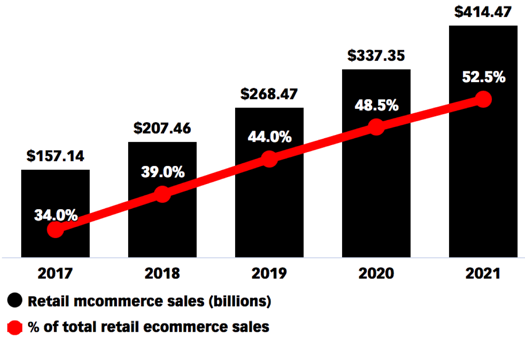
Retail mobile commerce sales 2017-2021
Be prepared. Take time to analyze where you might need improvement. Here are a few things to think about:
Are your checkout pages optimized for mobile? Are they integrated with mobile payment solutions, such as Apple Pay? The days of filling out long forms on mobile devices, manually moving from one box to the next, are on their way out.
Is your website completely mobile-friendly, from search to checkout?
Are your emails designed for mobile?
Are your communications relevant? If emails, recommendations, and search results are not relevant, consumers will simply move on.
According to Statistica, an average mobile user checks their phone 150 times each day. They can do whatever they want, wherever they want, whenever they want. They can find any product they are looking for, regardless of where in the world it’s located. If you don’t provide a frictionless, relevant, up-to-date user experience, someone else will.
Retail Predictions: How Small Retailers Will Change In 20 Years
In the year 2037 we may not quite be on planet Mars, but one thing is certain, the face of retail and ecommerce will have drastically changed, and this is particularly true for smaller retailers and mom and pop shops.
In the third installment of a three-part series, find out how I predict small retailers may change 20 years from now.
FUTURE OF ECOMMERCE: HOW SMALL RETAILERS WILL CHANGE IN 20 YEARS
Mom and Pop stores, once the bread and butter of the retail world, are all but becoming relics of a former time. As large retailers and big box stores sprawled across the country, undercutting prices while offering more inventory, smaller niche retailers simply couldn’t compete. Over the years, many of these shops that would try to plant their seed at a physical location have found that online or ecommerce offerings were more suitable to their needs and means.
From Amazon to Etsy, to Magento Community and Shopify, there are numerous outlets for smaller retailers to get their products in front of consumers. But what happens in 20 years time when these large retailers begin to consume one another, when name brands become less meaningful in place of price and quality, or as the desire for more meaningful experiences becomes vital to product sales? In the year 203,7 we may not quite be on planet Mars, but one thing is certain: the face of retail and ecommerce will have drastically changed, and this is particularly true for smaller retailers and mom and pop shops. I, along with other industry professionals, was asked about how small retailers will change over the next 20 years. Here is what I had to say.
WHAT ROLE WILL PHYSICAL RETAIL STORES PLAY IN CONSUMER BUYING, AND HOW WILL THEY HAVE CHANGED?
Greg: The concept of the store really hasn’t changed in 100 years. Stores have gotten bigger, but in most instances, the fundamentals are the same. You go there to purchase something and take it home the same day. I don’t think this model is doomed, even with advances in technology.
People are social by nature, and I think they will continue to want to touch, experience, and take home purchases on the spur of the moment. Assuming people will always be willing to wait for products is assuming people will no longer want immediate satisfaction. If anything, with the expectation of fast and free shipping, we are moving closer to consumers’ expecting immediate gratification.
It’s possible we will see an increase in store locations, but with less inventory. For this to be successful on a large scale, shipping costs will need to come down. Housing all inventory in several key locations around the country means retailers will have to ship one product at a time, rather than bulk ship to key stores. This might lead to one mega-store in each metropolitan city, with smaller showroom stores around the city. This will allow products to bulk ship locally without forcing retailers to build out distribution hubs around the country. As of today, Amazon and Walmart are probably in the best situation to execute this strategy.
The concept of checkout-less stores is sure to expand over the next 20 years. As technology improves in this space, I think more and more retailers will take to it. I am skeptical that it will be adopted widely by retailers. I think it is better suited to products like clothing than it is for groceries, for example.
WHAT DO YOU BELIEVE TECHNOLOGICALLY OR CULTURALLY WILL BE THE BIGGEST FACTOR IN HOW CONSUMERS BUY IN 20 YEARS?
Greg: Virtual reality and augmented reality will play the biggest role here. I think consumers will be shopping in their living rooms using headsets or other applicable technology, where they can try on products, see holograms, or 3-D views of themselves with products. Similarly, virtual in-store shopping certainly will be more advanced than it is today. People will be able to visually shop their local brick-and-mortar store using VR or AR and have orders shipped to them.
Finally, on this same note, we can expect online-only retailers to create virtual storefronts to better connect consumers with their brands. Where an online retailer used navigation bars to direct people, they can create their own virtual stores that bring together a consistent look and feel for their brand and ease the shopping experience by allowing the user to “walk” through their stores.
WHAT KIND OF JOBS WILL BE NEEDED TO SUPPORT FUTURISTIC RETAIL AND ECOMMERCE BRANDS?
Greg: For virtual stores, we’ll need virtual retail designers or virtual architects. These people will be in charge of designing a virtual floor map, as is done with brick-and-mortar locations. However, knowing what works in the physical retail storefront will be quite different in a virtual storefront. Counter-clockwise shopping, brand merchandising/placement based on eye level, and size of shopping carts are not likely to be as meaningful in an online world. It will be interesting to watch how the online version evolves.
Software engineers are already becoming a permanent fixture for nearly every company, but positions in designing virtual environments, as with video game creators, will become a more common role for retailers or agencies.
I don’t believe the role of a human marketer will go away. Commerce marketing automation will make their jobs easier, surfacing data and related analytics faster, making it easier for marketers to predict ways they can boost revenue. The marketer’s role will continue to shift as consumer adoption of new marketing tactics is accepted and rejected. Humans marketing to humans will always be important.
LASTING THOUGHTS
Greg: I think there will be a time within the next 20 years when there will be a bit of a technology backlash. I think people will crave the “quiet” that comes from being disconnected from the online world. Technology won’t go anywhere, but you may find people sharing less online and doing more in person. This may lead to the re-emergence of brick-and-mortar stores as a destination, much like the shopping malls of years ago.
Click Here to View Other Experts' 20-year Predictions
VIEW MY 5-YEAR PREDICTIONS FOR MID-SIZED RETAILERS HERE
VIEW MY 10-YEAR PREDICTIONS FOR LARGE RETAILERS HERE
Email Expectations vs. Reality: Are You Letting Your Customers Down?
Consumer expectations versus reality. It is a complex topic for all retailers, but especially for those who sell online. Look at how Amazon has raised the bar on consumer expectations, such as with fast and free shipping. Consider how accessible mobile phones are, allowing consumers to find any product they are searching for, regardless of where they or the product is located. Social media, and its integration into the shopping experience, is providing a direct connection between brand and consumer.
Consumer expectations versus reality. It is a complex topic for all retailers, but especially for those who sell online. Look at how Amazon has raised the bar on consumer expectations, such as with fast and free shipping. Consider how accessible mobile phones are, allowing consumers to find any product they are searching for, regardless of where they or the product is located. Social media, and its integration into the shopping experience, is providing a direct connection between brand and consumer.
The best way to meet consumer expectations is to develop a more robust personalization program, especially when it comes to email marketing. According to a 2016 Flagship Research survey, nearly 60% of consumers expect gender to be used to make email messages more relevant. More than 60% of consumers expect emails to be personalized based on interests they gave in their profile, their birthday, purchases they made online, and what they looked at on their website. While these figures are telling, what is even more daunting for retailers is that 40% of consumers expect offline purchases to be used to make email marketing more relevant. I repeat, offline purchases!
The good news is that many of the necessary data points are already being collected by retailers. When it comes to email marketing, retailers often ask for this data at signup or inside of messaging itself. Consumers who provide this information do so willingly, but expect something in return: relevance.
Perception is Reality
Retailers aren’t meeting that expectation. Instead, consumers find marketing emails consistently useful only 15% of the time, and at the same time, consistently find emails not useful nearly 60% of the time. This is a drastic difference between expectations and reality.
The primary reason for this gap is the prevalence of batch-and-blast messaging. Too often, retailers have limited internal resources that prevent them from sending deeply segmented emails to their subscribers. The result is generic messaging aimed at the masses rather than the individual. Whether a subscriber purchased yesterday, last month, or never, they get the same message.
Retailers can upend that habit by honing in on those data points that can make their email marketing more relevant. For instance, retailers can look at the source of the email subscriber. The person signing up from the maternity section of the website is likely much different than the one signing up from the men’s clothing section. The same holds true for those clicking inside emails. The person clicking on maternity links in a message should receive different messaging than the men looking at button-down shirts. After all, they have different needs from your store.
Sixty-two percent of consumers expect their website browsing data to be used to personalize the emails they receive. Give them what they expect by implementing a browse recovery strategy. These messages can be a significant revenue driver for any email program. While these messages are generally clothed as promotional messages (pun intended), they are immediately relevant to the recent online window shopper.
What’s It All Worth?
At the end of the day, does this all really matter? The answer is yes! One retailer did just this and implemented a unique second welcome series message based only on a specific link click in the first message. This targeted message was sent to just 3% of the new subscribers, but generated a 140% lift in total message revenue, compared to the generic second welcome series message. This is the power of relevance!
Only 15% of consumers say that marketing emails are consistently relevant. Your competitors likely know this. Take the initiative to meet consumer expectations before they do.
This was originally published on Multichannel Merchant.
Retail Predictions: How Amazon and Giant Retailers Will Change In 10 Years
In the year 2027, it’s hard to imagine going to the same big box grocery store when already so many technological advancements are making its way into each business. Beyond grocery stores, similar changes can been found in the fashion and general merchandise industries. This poses the question, what will happen to the largest of retailers over the next 10 years? Will there be a shift in physical size? Will experiences become more meaningful than general displays and product availability?
In the second part of a three-part series, find out how I predict giant retailers may change over the next 10 years.
FUTURE OF ECOMMERCE: HOW AMAZON AND GIANT RETAILERS WILL CHANGE IN 10 YEARS
Physical retail stores are closing at a record pace, all while giant brands such as Amazon and Walmart are expanding their digital footprint. Of the largest retailers, they too are shifting to an omnichannel world, though many remain lagging behind. Even grocery stores, the goliaths that commonly take up more physical real estate compared to that of any other retailer, may feel safe for the time being, but disruption is on the horizon. Between grocery deliveries, smaller specialty shops, and online ordering with store pickup, grocery stores of today will function differently in the years to come.
In the year 2027, it’s hard to imagine going to the same big box grocery store when already so many technological advancements are making their way into each business. Beyond grocery stores, similar changes can be found in the fashion and general merchandise industries. This poses the question: What will happen to the largest of retailers over the next 10 years? Will there be a shift in physical size? Will experiences become more meaningful than general displays and product availability? These are the kinds of questions we asked our partners, and here is what they came up with:
FOR GIANTS BRANDS (AMAZON, COSTCO, HOME DEPOT), HOW WILL THEY CHANGE OR ADAPT TO MEET CONSUMER DEMAND IN 10 YEARS?
Greg: From a consumer demand perspective, Amazon is leading and will continue to lead in many of these areas. Their distribution centers and warehouses have put them in a position to provide quick and cheap delivery. However, in 10 years, Amazon may be seen as more than just a retailer, as they are today. Today, they have plenty more to offer, but people think of them as a store. I think they will be seen as more of a media company that sells products. I believe they will continue offering TV-type services, such as network shows, original content, sports programming, and movies.
For big-box retailers, like Home Depot, they will be more aligned to execute on changes in consumer demand. Consumers expect their online and in-store inventory to be accurate and for customer service reps to have a full view of product locations to assist customers. We also expect associates to have a connected device so they can assist as needed. The thing to watch is how they control the user experience after someone leaves the store. Will installers and hired third parties deliver better service than they do now? These hired guns become the face of the organization, and in many cases, they ruin a relationship between the consumer and the brand. The store itself had little to no control over that experience, other than sourcing that third party.
HOW WILL CONSUMERS RECEIVE ITEMS PURCHASED FROM A VIRTUAL OR ONLINE PLATFORM IN 10 YEARS?
Greg: This will depend on areas of the country. In places where there is one mall, and shipping times are longer, I think you’ll see similar footprints as you do now. For larger metropolitan cities, I think the changes will vary a bit by product vertical. As a whole, I believe there will be a shift to smaller store footprints, which will predicate smaller inventories. But this is a double-edged sword because smaller stores are only sustainable with fast and free shipping for the consumer.
I do believe that as consumers become more integrated with technology, their desire for human interaction in-store will grow. This makes the sales associates in these stores more valuable. They become the face of your brand. They become your customer service department. Because they hold more value for the brand, they likely become more of a career position than an hourly worker.
I would not be surprised to see more cohabitation of storefronts, where you have two complementary brands in a single storefront. This can bring the allure of “one-stop shopping” to the offline world, without competing products like you would find in Walmart or Target. It also allows retailers to save on the cost of the physical storefronts while effectively doubling their marketing efforts, as each store would have two marketing departments.
I think the pickup centers will be the most adopted of all of these. These centers may turn into a requirement for free shipping. Shipping is expensive for retailers, especially the last mile, so we could see more free shipping to centers, while having to pay a small fee to have it delivered to your doorstep. Again, this provides consumers a choice of cost versus convenience.
Robots may be employed by select stores to deliver in-store pickups, but retailers should view this as an opportunity to put a human face to the brand. When in-store pickup is managed by a robot, retailers create a very sterile interaction. At that point, what is the emotional connection to the brand?
I am skeptical of drones and don’t believe them to be a long-term delivery solution. There are too many obstacles, such as the potential for lawsuits, terror threats, and general public safety issues, to make this a viable strategy.
LASTING THOUGHTS
Greg: Retail technology is advancing faster than adoption at this point. While exciting times are ahead, 10 years is an eternity for technology. What we see from a shopping perspective in 10 years may be completely alien to us now. I expect browserless commerce (voice control) will have a much larger footprint than it does now. Kids today use Siri and other voice-controlled devices as normal, everyday tools. When they are in their teens and ordering something using their voice, it won’t seem like a new concept. They will already have assimilated the use of that mode of communication.
CLICK HERE TO VIEW OTHER EXPERTS' 10-YEAR PREDICTIONS
VIEW MY 5-YEAR PREDICTIONS FOR MID-SIZED RETAILERS HERE
VIEW MY 20-YEAR PREDICTIONS FOR SMALL RETAILERS HERE
Bridging the Online-Offline Personalization Gap
Consumers are so keyed in about personalization that a recent study found 40% of online shoppers expect that multichannel merchants know about their offline purchases and factor those into their marketing emails. Let me repeat, we’re talking about offline purchases!
Retailers recognize this as a challenge, and are eager to solve it. But realistically, too many retailers struggle to connect their consumer profile data, purchase data, and email data — much less bridge the gap between the online and offline world. Consumers are coming to expect something most retailers are not yet poised to provide.
Consumers are so keyed in about personalization that a recent study found 40% of online shoppers expect that multichannel merchants know about their offline purchases and factor those into their marketing emails. Let me repeat, we’re talking about offline purchases!
Retailers recognize this as a challenge and are eager to solve it. But realistically, too many retailers struggle to connect their consumer profile data, purchase data, and email data — much less bridge the gap between the online and offline world. Consumers are coming to expect something most retailers are not yet poised to provide.
Retailers today need to use the options available to bridge the online-offline personalization gap.
Location-Based Targeting on the Web
Geotargeting is sometimes thought of as exclusively a brick-and-mortar tool – but it shouldn’t be thought of that way. Location-based options exist that can provide a customized and relevant user experience for the online shopper. For example, if a user visits an online clothing retailer’s website in December, the content should be tailored based on their location. Buffalo-dwelling Kyle should have a different online experience than Miami-based Kevin.
What if you only sell warm-weather clothing? User location can help you guide a user not only to a purchase, but also to a higher order total. For example, if Kyle in Buffalo is visiting the site, it may be an indication that he is planning a trip to escape the cold. Your product recommendations may be tailored to upsell complete outfits, or frequently forgotten vacation items, such as sunglasses, waterproof camera cases, or beach bags.
These same principles can apply to marketing emails. Detecting not only an email reader’s location, but also the device they are on, allows you to serve up user-specific content. For example, if they are an avid runner and rain is forecast three days out, you can display content and/or product recommendations showcasing top-rated gear for running in the rain. You might even combine this with an upgraded shipping offer to speed the product to their door – and secure the deal. If they are on a mobile device, you can change the content to be more streamlined, and maybe more interactive, such as offering a video or user-generated content.
The consequences of not doing this can put off customers. Outdoor furniture company RST Brands learned that when it sent out a “Dreaming of Summer” email during the winter and heard back from a Miami customer who pointed out that this is the time of year when people in his area enjoy the outdoors. RST responded with a geotargeting strategy that avoids those kinds of miscues.
Offline Location-Based Targeting
If done right, geotargeting can be a great way to provide a better in-person experience. Let’s say I abandon my shopping cart. Instead of just sending me the general abandoned cart message, I receive a note about the abandoned products and information about a nearby store where I can try on the items I abandoned. That is a great way to create a terrific in-person experience. But retailers need to understand how to provide actual value to nearby consumers to make this work.
Unfortunately, that isn’t always the case. Recently, Yelp announced the acquisition of Wi-Fi marketing company TurnStyle Analytics. At a high level, TurnStyle allows retailers to require a login to access a company’s free Wi-Fi. This allows consumers to opt-in to receiving emails, SMS or social messages from that retailer in exchange for Wi-Fi access. The consumer gets free Wi-Fi and, perhaps, some location-based promotions. The retailer gets to grow their subscriber list. This method offers a lot of benefits for both retailers and consumers, but it also has challenges.
The biggest challenge is that consumers have come to expect free Wi-Fi in public establishments. I know I certainly do! It can be a point of friction for consumers to turn over info just to use Wi-Fi for a brief period. I know if offered the choice, I often opt to use cellular data rather than go through the hassle of inputting my data and deleting messages I don’t want. Consumers have shown they will provide access to their data, but the immediate and long-term value needs to be there.
While this type of geo-targeting can be beneficial, it may lose its long-term effectiveness. Retailers may choose to take the Starbucks method and ensure their Wi-Fi is accessible to everyone, and instead focus on providing excellent customer value through every other stage of customer interaction.
Ultimate adoption and tolerance will be determined by value. If a retailer is not rewarding consumers for providing info, then the ongoing marketing messages, and potentially their entire view of the retailer, may lose their luster.
Connecting the Data
So, while there is value in each example mentioned above, these connection points need to work together to provide a more cohesive consumer experience. Connecting the data is the critical part. Otherwise, your marketing efforts will continue to be fragmented, less valuable, and will leave consumers where they are today…wanting and, more importantly, expecting more.
This was originally published on Multichannel Merchant.
Retail Predictions: How Mid-Size Retailers May Change By 2022
Over the next five years, mid-size retailers such as L.L. Bean, Hasbro, and Wayfair will see large impacts and face the most challenges. While we may not have a crystal ball, industry experts, like Greg Zakowicz, have a direct tap into the changing landscape of retail, so we asked them how they see mid-size retail and ecommerce shifting over the next five years. From emerging technology to shifts in how consumers receive their goods, there are a lot of iterative changes that our industry is likely to see.
In the first of a three-part series, find out how I predict mid-sized retailers may change over the next 5 years.
FUTURE OF ECOMMERCE: HOW MID-SIZE RETAILERS MAY CHANGE BY 2022
Now that emerging technology like virtual reality, beacons, and voice assistants is finding its way into more consumer homes, what role will these play in the future of ecommerce? Not only is hardware improving and creating new ways for consumers to buy goods, but the software, such as artificial intelligence, is improving how products directly correlate with needs and wants.
Over the next five years, mid-size retailers such as L.L. Bean, Hasbro, and Wayfair will see large impacts and face the most challenges. While we may not have a crystal ball, industry experts, like Greg Zakowicz, have a direct tap into the changing landscape of retail, so we asked them how they see mid-size retail and ecommerce shifting over the next five years. From emerging technology to shifts in how consumers receive their goods, there are a lot of iterative changes that our industry is likely to see.
HOW WILL MID-SIZE RETAILERS CHANGE OVER THE NEXT 5 YEARS?
Greg: I don’t expect we’ll see drastic changes from many of them. I think retailers will do more behind the scenes to integrate data sources and share. We might see retailers put more emphasis on improving the overall value they provide to customers by providing more personalization and value-driven loyalty programs, for example. Of course, much of this requires accurate, integrated data. Without that, marketing programs likely will fall short of expectations.
WHICH IF ANY EMERGING TECH WILL BECOME WIDELY ADOPTED WITHIN THE NEXT 5 YEARS?
Greg: In some cases, yes. In most cases, no. I believe virtual reality will be more prominent, but I don’t think people will be wearing headsets to do the majority of their shopping. For brick-and-mortar stores, beacons will probably become more mainstream than they are today, but it will take some time for retailers to figure out how to use them to provide value to their shoppers. They need to make sure they get it right – almost from the start. Otherwise, consumers won’t adopt them readily over time. Again, it’s all about value for the consumer.
Some online retailers will likely rely on some technologies more than others. Looking at ways furniture retailers can help people picture items in their house is a great example. How much more can this be improved than what we see today? Who knows. Does it need to be improved drastically? I am not sure it does.
Voice assistants are an intriguing topic because that technology puts us at the front end of “browserless commerce.” No one really knows what the user’s experience will be. Will we be able to shop using voice commands? Already, we can purchase items on Amazon using our voices. But will our daughters use it to purchase a prom dress? I don’t think so. I don’t think anyone can predict this, but the run-of-the-mill ecommerce retailer will not be using it on a day-to-day basis the way Amazon users do now.
As with any technology, simply implementing it does not improve the shopping experience. If the technology makes the experience better, then it will be adopted. If the experience is about the technology, ultimately, it will fail.
HOW WILL SHIPPING CHANGE IN THE NEXT 5 YEARS?
Greg: Wow, great question. U.S. consumers already expect free shipping, and their tolerance for longer shipping windows, even with free shipping, is lessening. We will likely end up in a place where free shipping in 3 or fewer days is expected. There will always be exceptions for custom products. However, I would not be surprised to see a slow revolt against the “big guys” where consumers purposely choose to wait the extra day, or pay a little more so they can buy from a smaller retailer. People love the underdog, and when mass consolidation happens, many times consumers have pivoted in the opposite direction.
This is all predicated on domestic purchasing. As more consumers participate in the global marketplace, they might be willing to wait a little longer for their product to be delivered. This could help train people that immediate shipping is not needed, and their tolerance for slightly longer shipping windows or cost could be expanded.
For brick-and-mortar retailers, I think we will see a bigger push to drive people in-store. These retailers may stick to a shipping charge or longer shipping windows for at-home delivery, while quicker and free delivery will happen for in-store pickup. This would provide consumers the option to receive fast and free shipping, while providing retailers with what they want – in-store traffic.
Click here to view other experts' 5-year predictions
VIEW MY 10-YEAR PREDICTIONS FOR GIANT RETAILERS HERE
VIEW MY 20-YEAR PREDICTIONS FOR SMALL RETAILERS HERE
Why fast fashion retailers should slow down and emphasize trust
Consumers are on the move, and their expectations are higher than ever, thanks to supply chain innovations pioneered by fashion industry front runners. Speedy product development and great logistics management have helped brands like Zara and Uniqlo expand their brands’ presence and popularity in North America, bringing new benefits to consumers and new challenges to retailers.
Consumers are on the move, and their expectations are higher than ever, thanks to supply chain innovations pioneered by fashion industry front-runners. Speedy product development and great logistics management have helped brands like Zara and Uniqlo expand their presence and popularity in North America, bringing new benefits to consumers and new challenges to retailers.
Today’s consumers expect far more speed and accuracy from the brands that market to them. The challenge: How do fast fashion retailers balance speed with consumer preferences and incorporate both into their digital marketing strategy?
It’s About Balance
There’s no denying that speed is an important part of the equation. Expectations are on the rise, and consumers want the latest fashion trends yesterday. But when it comes to your digital marketing strategy, it’s relevance – not simply speed – that will win over shoppers.
For example, it’s always a good idea to recommend a new product that you know will get customers excited. But don’t promote or recommend a product that is at dangerously low stock levels. You don’t want to get a customer excited about buying that cool new jacket, only for that jacket to no longer be available come checkout time. It leaves a bad impression and can cause irreparable damage to your reputation with your customers.
The above is a prime example of retailers needing to balance their desire to make speedy recommendations for new products with their ability to deliver the goods.
Build Trust With Relevant Recommendations
Consumer trust is a crucial component for any retailer, but it’s doubly important in the fast fashion industry. How does your brand build trust with consumers? One way is to provide relevant product recommendations.
And it’s not hard to see why this is key for retailers.
If I purchase items from your online store and you continue to provide me with recommendations that are tailored to my needs, three things are likely to happen. I’m going to appreciate getting personalized recommendations based on what I like. I’m going to start trusting your recommendations and enjoy opening the emails you send me. And I’m going to be more likely to purchase from you.
Dive Into Your Data
Great, you may say, but how do you actually put that into action, and which customer data points do you need to evaluate to ensure your recommendations are relevant?
The most obvious data point to monitor is customer purchase activity. If a customer is purchasing sandals, T-shirts, and swim trunks, chances are they’re not interested in a down jacket.
Likewise, if you have a male customer who, as I do, exclusively shops for men’s products, the likelihood of them being interested in women’s products is slim. If you continue to send product recommendations designed for women, that customer’s trust in your recommendations will erode quickly.
Email activity is another source of indicative data. If a customer is opening their emails but not following through to your site, then perhaps there is some disconnect with your content or messaging for that customer. Perhaps your lack of compelling imagery, mobile rendering, or aesthetic design of the email is the problem.
Pick Up the Pace
Speed isn’t the most important factor when it comes to delivering a positive consumer experience, but make no mistake: speed is an important factor.
Purchase activity gives you a sense of the importance of speed to a shopper. To find out how much your customers value speed and to meet their expectations accordingly, try to answer these questions:
Has your customer paid for expedited shipping in the past, or do they always choose standard delivery?
Have they responded to upgraded shipping promotions? Try testing different speed thresholds to see where the breaking point is. Consider offering promotions at intervals of 7 days, 5 days, 3 days, or 2 days, and monitor the results.
Race to the Front
The fast fashion industry operates at breakneck speeds, but that doesn’t mean you’ll be left in the dust if you sacrifice a bit of speed to ensure the experience is personalized and optimized. Consumers are flocking to the fast fashion industry in droves, but they still expect a positive, relevant shopping experience. Delivering new, unique, and exciting products isn’t enough – and it isn’t anything if those products are mistargeted.
Take the time to emphasize and establish trust with consumers and build that relationship by continuing to deliver relevant recommendations to each customer. After all, if you don’t do it, someone else will.
This was originally published on Internet Retailer.
Why Mobile Payments Are Killing the Checkout Form
A colleague recently told me over lunch how much he loves pizza apps. “They’re just so easy.” When I asked him what was so easy, he said that while picking from the menu is part of the ease, the bigger part has to do with paying. It’s one touch.
Now before you run out and hire a team to create an app for your brand, let’s think about how to make paying easier – whether someone visits your website from a desktop or wants to take advantage of email offers directly from their mobile device.
A colleague recently told me over lunch how much he loves pizza apps. “They’re just so easy.” When I asked him what was so easy, he said that while picking from the menu is part of the ease, the bigger part has to do with paying. It’s one touch.
Now, before you run out and hire a team to create an app for your brand, let’s think about how to make paying easier – whether someone visits your website from a desktop or wants to take advantage of email offers directly from their mobile device.
We talk a lot about omnichannel and the customer experience – making sure the cart is available, regardless of device, and providing a seamless shopping experience. But simply making shopping easy is just step one. Making it easier to pay is the key to conversion.
Mobile Shopping Is Here to Stay
According to eMarketer, 58% of mobile sales came from smartphones in 2016, and that number is expected to grow. Overall, mobile made up 29% of all ecommerce sales. But by 2021, it’s predicted that mobile will make up more than half of all ecommerce sales.
Retailers need to consider what this means for their sales. When consumers are looking to purchase on their devices, they expect a frictionless experience. And what provides more friction than being asked to enter an endless stream of billing and shipping details, often moving manually from box to box, all while on a small mobile screen?
Another colleague tells me she frequently abandons items at checkout when trying to buy on her mobile device. “Those forms are better than a strict budget for keeping my spending in check.’’ She recently recounted how she suffered through one form on a national retailer’s site solely because her too-busy-to-shop teenage daughter actually liked one of the dresses she had selected, and she couldn’t bear to abandon the shopping trip after thumbing through 120 sleeveless mini-dresses. She completed her purchase out of necessity, not convenience. If she could have found that baby blue skater dress on Amazon, she might have been tempted to bail altogether.
If your competitor offers a frictionless purchase experience and you do not, you may not only lose a sale now, but customers may remember this and bypass you altogether the next time they shop.
Security Plays a Key Role In Mobile Payment Behavior
The counter-argument is that most retailers allow users to save their credit card information on their site to make future checkouts easier. However, online security issues have minimized the usage of this tool. In fact, due to hacking concerns, 33% of consumers never save their credit card information, and 30% only use trusted payment methods, such as PayPal.
The result? More and more consumers are storing their payment information in their phones. There are one million Apple Pay accounts being activated weekly worldwide. As consumers continue to adopt mobile payments on their primary connected device, creating an easy way to allow consumers to check out will be an essential requirement in the very near future.
An intriguing facet to mobile payments is that Amazon’s U.S. patent for one-click payment technology expires this year, leaving the door open for other retailers to implement their own one-click solutions without licensing the technology from Amazon. Google is reportedly working on a one-click payment system that integrates with the Chrome browser.
This integration with Chrome goes beyond just mobile, and that itself is telling of the power that mobile payment options hold. The purchase process between an app, a laptop, and a mobile version of a site is almost always different from one another, but the goal is symmetry. As mobile purchasing becomes the standard, non-mobile devices will be forced to match that experience. Storing payment info in Chrome will allow users to easily check out regardless of the device they are on. Creating a symmetrical experience not only allows for a quicker checkout (which should decrease abandonment), but also improves the customer’s overall experience with your brand.
The time is right for retailers to provide a more simplified, convenient checkout experience. Don’t think of it as simply a way to optimize for mobile. It’s not. Mobile is the norm. Think of it in terms of giving your customers what they want. Long checkout forms on mobile devices are a thing of the past. Don’t believe it? Ask 100 people if they’d rather fill out a long form on their phone or make their next mobile purchase with the simple touch of a thumb.
This was originally published on Multichannel Merchant.
Stop Slashing Prices, Start Connecting With Your Customers
The retail sector is going through drastic changes. Established names like The Limited are closing or filing for bankruptcy. Amazon and WalMart squeeze everyone’s margins. Special discount shopping days like Black Friday have morphed into Gray November, a month-long deep discounting period. As brands fight to keep up with competitor discounts, profits and customer loyalty are harder to earn.
I recently spoke with a fashion retailer who recognized the endless discount cycle dilemma. They had been stuck in this discounting rut, but did not want to be known as a discount brand. They prided themselves on making quality product at a decent price and this constant discounting was bad for their brand and devalued their product. This past holiday season, they made a straight forward business decision: No guts, no glory. At their busiest time of the year, they chose to not discount.
The retail sector is going through drastic changes. Established names like The Limited are closing or filing for bankruptcy. Amazon and Walmart squeeze everyone’s margins. Special discount shopping days like Black Friday have morphed into Gray November, a month-long deep discounting period. As brands fight to keep up with competitor discounts, profits and customer loyalty are harder to earn.
It is unrealistic for retailers to continue to increasingly discount and remain viable. After all, if a retailer offers 50% off, they’ll need double the sales to reach the same margins. And, oftentimes, the unit sales immediately after the promotion ends suffer as a result. But with global competition increasing, what are retailers to do? Keep up with the Joneses and hope to remain viable, or take a risk and go against the grain to try to increase profits? While some retailers need to rely on discounting, I’d argue that most don’t.
I recently spoke with a fashion retailer who recognized the endless discount cycle dilemma. They had been stuck in this discounting rut, but did not want to be known as a discount brand. They prided themselves on making quality products at a reasonable price, and this constant discounting was bad for their brand and devalued their product. This past holiday season, they made a straightforward business decision: No guts, no glory. At their busiest time of the year, they chose not to discount.
Hello Guts, Meet Glory
While their competitors were running 30%, 40% and even 50% off specials during the busiest shopping period of the year, this retailer resisted the urge. As the season played out, they saw a 10% growth in total revenue until the last week of December (more on that below). On top of the 10% growth, their margins were protected. They generated 30% to 40% greater profits for those units sold.
This retailer also runs an annual day-after-Christmas and clearance sale. This year was no exception. But how would the previous non-discounting impact this sale? As it turns out, one side effect of the non-discounting strategy was that it created and satisfied the demand for a discount. This year’s clearance sale set records in volume of units sold, selling 10 times more year over year. It satisfied the demand of those looking for a deal while not taking away from their traditional after-Christmas strategy.
Having this conversation can be scary. Before you pull the ditch-the-discounts ripcord, first look at ways to strengthen your current brand positioning.
Focus on Your Brand
What does the brand stand for? How consumers perceive your brand can ultimately determine whether they will purchase from you without a discount, much less become a loyal customer. Consider brands that have a cause, like TOMS Shoes. Consumers connect with their cause and, because of that, they are generally willing to spend more on a product.
Does your brand focus on quality, value, customer service, personalized services, etc.? Do you have social causes? Do you convey this within your messaging on your website, email, and social profiles? If you remove or lessen discounts, consider whether you offer customers enough value-adds to purchase from you and not a competitor.
Planning for The Long Haul
Since you will no longer be relying on sending a generic 30% off promotion to drive sales, your general batch and blast email strategy will likely need to become a little more refined. You’ll need to maintain a more relevant customer experience. Focus on segmenting where you can. Include intuitive product recommendations inside your emails and on your website. Analyze your lifecycle messaging and determine how you can redesign them to provide the most value to the end user. Engage, I mean really engage, with your audience on social media. Ask questions, proactively comment, and deploy user-generated content to make the site and email experience better.
Evaluate Your Automated Marketing Strategy
When making the decision to pull back on promotions, the next step is to evaluate this strategy with your automated messages. If you have discounts in your welcome, post-purchase, shopping cart, or other automated message series, determine whether you want to maintain this strategy. In some cases, you may, as these messages are triggered from user actions. Since these messages are sent to single contacts, you may decide it is worth “rewarding” subscribers for engaging.
The Aftermath
Just because you no longer set the expectations of continuous discounting doesn’t mean you have to end discounting altogether. Occasional sales may ultimately carry more weight with consumers as they know deals are few and far between with your brand. This will also appeal to those consumers who specifically look for deals.
By avoiding blanket price discounts, you can experiment in configuring promotions. Consider free or expedited shipping promotions, for instance. These carry weight with consumers while protecting margins. Retailers can run promotions on grouped items instead of single SKUs, therefore increasing average order value while still protecting margins.
There is no one strategy for fighting back against deep discounting. Retailers will need to determine how far they are willing to commit to the strategy, and to what extent their customers are willing to tolerate the pullback. While the retailer I mentioned earlier plans on enhancing their overall strategy by refining their segmentation and timing of messages, I did ask him if there was anything he would do over again based on his experience. His answer, “Not really.” That answer is quite telling. Whether the success of this strategy is sustainable, only time will tell. But right now, this retailer is enjoying the glory.
This was originally published on Multichannel Merchant.
Why an Email Unsubscribe Can Be a Good Thing
It’s a fact. Someone will unsubscribe every time you send a batch promotional email. And while we all hate to see our subscribers go, wouldn’t you be open to a higher unsubscribe rate if it meant increasing your revenue? How you view your unsubscribes not only affects your email strategy and its revenue potential but also influences improvements you should make to your automated messages and your yearly list growth goals. Let’s discuss.
It’s a fact. Someone will unsubscribe every time you send a batch promotional email. And while we all hate to see our subscribers go, wouldn’t you be open to a higher unsubscribe rate if it meant increasing your revenue? How you view your unsubscribes not only affects your email strategy and its revenue potential but also influences improvements you should make to your automated messages and your yearly list growth goals. Let’s discuss.
People unsubscribe for a variety of reasons. The most common include receiving too many emails and irrelevant content. Often, the “too many” threshold is actually determined by the proportion of irrelevant content, such as those situations when the content is meaningless to the reader or fails to change from one message to the next. I know of retailers who send every day, or even multiple times daily, whose unsubscribe rate is no different than the retailer sending only a few times each week. While there may be an opportunity to drive additional revenue by increasing sends, we need to recognize the full impact of those sends on a subscriber database.
At what point do the inevitable unsubscribes begin to hurt your bottom line? Determining the cost of the unsubscribe is an important step to answering that question. Knowing the cost can help you optimize your sending strategy throughout the year, particularly when planning for periods of increased sending, such as the holiday season.
What Do Unsubscribes Cost?
First, look at your weekly and monthly unsubscribes and their order history. How many unsubscribes were non-buyers, one-time buyers, or frequent buyers? How much revenue did they account for? This is your potential lost revenue on a per email basis. Now that you have this number, determine how much revenue an average email generates. These totals will give you some basic data to figure out how much unsubscribes are really worth.
In the example below, the number of unsubscribes over a one-week period (assuming four sends) was 300, and they accounted for $10,400 in past revenue.

How to calculate the cost of an email marketing unsubscribe
However, we know only 100 of the 300 contacts accounted for that revenue. Using these figures, on a per-send basis, we can assume a loss of $2,600 in past revenue from unsubscribes. However, if each email sent generates an average of $15,000 in revenue, we are left with an overall net gain of $12,400 per email. So, increasing sends from four to five days per week should net roughly an extra $645,000 in yearly email revenue while resulting in an increased loss of 3,900 contacts (75 per week for 52 weeks) in unsubscribes.
In this scenario, the extra revenue driven for every unsubscribed contact was $165. That’s a nice figure, especially considering 2,600 of the 3,900 unsubscribes come from non-buyers.
Are Your Non-Buyer Opt-Outs Worth It?
You can take this one step further and analyze the length of subscription among your non-buyer unsubscribes. How many have been a part of your email program for less than 30 days, between 1-3 months, and so on? Are the non-buyer unsubscribes recently acquired prospects you have lost, or have they simply been dead weight on your email list all along? Now, look at your purchasers. How long has it been since their last purchase?
How Do Email Unsubscribes Affect List Growth?
If we know 300 contacts per week are unsubscribing (4 emails at 75 unsubscribes each), and we add one extra email each week, we assume we will lose 375 per week. Over one year, we will expect to lose 19,500 contacts due to unsubscribing. In order to maintain a positive subscriber churn, this should be the minimum goal for yearly subscriber acquisition. I say minimum because you will naturally see members of your list unsubscribe from other emails you send, such as automated messages.
Having a concrete acquisition goal is imperative for maintaining the health of your email program. If you’re not focused on the acquisition, you should be. Explore all areas for potential sign-ups, especially in the wake of Google’s recent pop-up changes.
What Can Opt-Outs and Converters Tell You About Automated Messaging?
Looking at the order history of your unsubscribes may also indicate engagement opportunities to address. For example, if most unsubscribes are one-time purchasers, you may need to strengthen your post-purchase program for first-time buyers or do a better job meeting overall customer expectations with orders. If the opt-outs are from recently acquired non-buyers, it may be a sign you need to strengthen your onboarding process to help drive conversions or more closely analyze your acquisition method.
Do the same with converters. Look at the makeup of purchasers on a per email basis. Did the conversions come from non-buyers making their first purchase, one-time buyers buying for a second time or three-plus repeat purchasers? Remember, each of your email converters should now funnel into a post-purchase campaign, which should either convert them once more or strengthen your brand loyalty prospects.
Gaining these insights will help you know when to strengthen areas of your post-purchase program specifically dedicated to first-time and returning buyers.
Final Considerations
Honestly, I never worried about unsubscribes. Frankly, if a contact opts out, they have made the decision to stop interacting with you via email well before pushing that button. If it wasn’t this email, it would have been the next one. Do your best to encourage subscribers to want to stay, but focus more on delivering quality to those who still open your messages. Here are some strategies and resources to guide you along this journey:
Focus on lifecycle messaging. Build a customer-centric post-purchase program that reinforces brand value and helps create loyalty, and create a relevant onboarding welcome series for newly acquired contacts.
Send relevant emails, especially to previous buyers. Segment where you can, and consider tactics like inserting product recommendations into your emails. Customized product recommendations can even make batch-and-blast messaging more relevant.
Focus on subscriber acquisition. If you are not creating a positive churn in subscribers, you need to get serious about list growth.
Consider offering pause or mute options to curb unsubscribes and give your contacts a temporary break from your emails.
Don’t let the communication end. Optimize your opt-out confirmation page to include invitations to connect in other ways, such as social media.
Start worrying less about unsubscribes, and begin paying closer attention to what those unsubscribes can teach you about how to strengthen your email program and drive more revenue.
Crafting A More Robust Cart Recovery Strategy
ommon industry statistics indicate that more than 70% of all online shopping carts are abandoned. Yet retailers generally treat all shoppers who abandon carts the same, regardless of what items they were shopping for. While this one-size-fits-all approach may work for many, it doesn’t work for everyone. The reasons for abandoning a cart tend to vary based on cart total, and the needs of the shopper also tend to change as the cost increases. So, using a blanket approach for cart recovery emails is likely costing retailers valuable sales.
Common industry statistics indicate that more than 70% of all online shopping carts are abandoned. Yet retailers generally treat all shoppers who abandon carts the same, regardless of what items they were shopping for. While this one-size-fits-all approach may work for many, it doesn’t work for everyone. The reasons for abandoning a cart tend to vary based on cart total, and the needs of the shopper also tend to change as the cost increases. So, using a blanket approach for cart recovery emails is likely costing retailers valuable sales.
Here’s an example: I was recently in the market for a dishwasher and began by shopping online. I browsed via laptop and smartphone, read reviews, carted (and abandoned) products, and viewed products in stores. In the midst of my journey, I started receiving abandoned cart emails. What stood out to me is that they were not at all helpful. As close as I was to making a purchase, none of these messages helped convince me to do so. They failed.
Failure to Launch
These messages failed because they did not consider the buyer’s motivation and obstacles to conversion. Someone shopping for a $30 item likely has different needs and hesitations than someone considering a $700 item. Higher priced items typically generate more comparison shopping and a longer buying cycle, and they might need services attached to their purchase, such as delivery, installation and haul-away. For consumers that have filled a cart with items that equal a high-dollar figure, there often comes the natural hesitation of, “Do I really need all of this?”
Knowing Your Buyer
Consider these two cart recovery emails. They were sent from the same retailer, but the price points of the abandoned products are vastly different.
The abandoned products should have determined not only the main messaging but also the recommendations inside the emails. The free shipping callout in the example with the $30 EarPods works well, as my cart total is less than the required threshold. However, the recommended products feature items that cost hundreds to thousands of dollars. These recommendations simply don’t make sense.
In the dishwasher example, however, the prominently displayed free shipping callout is not appropriate for this message. And while the recommendations are more in line with what I am actually shopping for, they don’t help convert me on the dishwasher purchase.
And in both cases, the main messaging tells me they can help, but they fail to mention exactly how. What’s my next step?
This is just one retailer of many whose messaging strategy could use refining. Had any of these companies considered the product I was shopping for or my cart total, they may have directly addressed the obstacles that caused me to abandon my purchase in the first place. In the case of the Earpods, give me some logical product recommendations to bump me over the free shipping threshold. With the dishwasher, include information about how their staff could help me decide on the perfect model, or give me more information on their haul-away and installation services. Without meaningful supporting content, the brand turned these highly relevant messages into something that was mostly useless.
Optimizing Your Cart Recovery Strategy
Abandoned cart messaging should be used to remove conversion obstacles and encourage the customer to purchase. By factoring in details such as cart total, carted items, and their categories and/or the number of items in the cart, you can begin to customize messaging that better targets the individual shopper. Your messaging can reinforce appropriate value-adds, such as free shipping or links to resources, that can be used to determine how many messages should be sent, the timing of those message,s and if or when an incentive should be included.
Retailers today should be focused on providing the right kind of messaging based on the kinds of products left in the cart. For smaller items, the options are simpler – recommendations to help reach a free shipping threshold or maybe even a discount. For larger, non-impulse purchases, focus on information that encourages shoppers to choose your store over the competitors. By overcoming obstacles and encouraging purchases at this final stage of the online checkout process, you can take the most effective approach to recovering those abandoned carts and converting the shoppers behind them.
This was originally published on Multichannel Merchant.